Showing posts with label drums. Show all posts

Sunday, August 11, 2019

[42] Vijay Iyer Sextet at The Village Vanguard | #1Summer50Concerts

The wire-rimmed glasses and sweater really make Vijay look like he 
teaches at Harvard....oh wait, what's that? He does teach at Harvard?

WHO: Vijay Iyer, piano; Graham Hayes, cornet/flugelhorn/electronics; Steve Lehman, alto saxophone; Mark Shim, tenor saxophone; Stephan Crump, bass; Jeremy Dutton, drums
WHERE: The Village Vanguard
WHEN: July 19, 2019 at 8:30pm

My 17-year-old brother made an impromptu trip to NYC for a weekend with two very, very clear conditions. The first was that we go on a pizza crawl through lower Manhattan. The second was that I had to take him to the Village Vanguard. But not necessarily in that order.

So I plucked him off his MegaBus (which was an hour late, but frankly who's surprised?) and we moseyed (ran?) on down to The Vanguard. He didn't care what was playing. I, of course, did.

My brother's listening habits are eclectic. He's a bassist, both jazz and classical; on any given day, he'll jump from Kanye to Brahms's German Requiem and back to Vince Staples or Brockhampton. Right now, he's sitting in the corner of my apartment singing both parts to "Maria" from West Side Story in (more or less) the correct octave.

He's got a few albums he goes back to time and time again. Dietrich Fischer-Dieskau singing Winterreise. The Beach Boys's Pet Sounds. Kendrick Lamar's To Pimp a Butterfly. But the one he goes back to most often is of drug-addled pianist-composer-genius Bill Evans sitting at The Vanguard's Yamaha alongside his trio.

"Alice in Wonderland" is his favorite

We went down the stairs. He smelled the Vanguard smell. We sat down below one of those framed records. And he turned to me and said with a shit-eating grin, "You know who sat there? Bill Evans. Bill Evans sat there.

"Now, who are we seeing tonight?"

"Vijay Iyer."

"Who?"

So I explain. Vijay Iyer. Music cognition PhD candidate turned jazz (and occasionally classical) composer. With his sextet, whose alto saxist is also a PhD-level composer, and whose drummer got picked up straight out of college (he's like 24 now -- feel inadequate yet?).

"But is he as good as Bill Evans?"

What the hell am I supposed to say to that? Like, less heroin? Except even when you strip the drugs out of Bill Evans's charts, they're still totally different from Vijay Iyer's? Because they're both geniuses?

I decided on the most concise way to say just that: "Shut up and listen."

And so he did.

The quartet did the same thing that the Uri Caine Trio did back in concert #2 -- they basically played for an hour straight, blurring the transitions between charts so you didn't realize you were in a different realm until you were already there. I often found myself bopping my head to the beat, except that Vijay Iyer's style is marked by sudden slight changes in beat pattern, so I'd end up on the offbeats or something ridiculous like that.

I don't know what any of the charts are called (the Sextet was *too cool* to announce) but I can tell you that they were all amazing. The upbeat songs let the rhythm section show off their technical prowess -- Stephan Crump's bass playing and mouth movements were each something to behold, and Jeremy Dutton imparted the most expression one can into an unpitched instrument. The downbeat songs let the horn players show off their ability to fill the the spaces above the sparse, but aurally complex chord structure. And regardless, Vijay Iyer was there with his exquisitely-voiced comping and wildly virtuosic solos.

And speaking of space and solos, the most fascinating thing was how the soloists used empty space. Steve Lehman's alto solos tried to fit the most notes into the smallest space: exhausting, but impressive. Graham Haynes used an echo/looping effect on his cornet solos, basically playing a few notes and waiting for the loop to fade before playing a few more: intellectual, but minimal. Mark Shim trod the line, his solos gaining momentum like a loose car down a steep hill before hitting a brick wall of silence.


Of course, it wouldn't be a Vijay Iyer concert without the obligatory politically-charged rant that he improvises over the final chords of his set. The theme is always the same: the struggle is Far From Over (coincidentally, the name of the Sextet's most recent album). According to my friend, Iyer actually mentioned Trump by name in his Tuesday set, essentially echoing the message that YG & Nipsey Hussle so eloquently purvey in the popular song linked below. This particular evening, there was an elderly couple in the front row that particularly jived with what Vijay had to say. #woke

My brother and I both left the Vanguard happy into one of the hottest nights of the summer; we made the wise, wise decision to traipse around the Village and the Lower East Side in pursuit of pizza. Two slices and a whole pie later, we patted our sweaty bellies. It had been a good night.

John's of Bleecker Street, the favorite pie of the night

Thursday, July 25, 2019

[35] Pauline Kim Harris and friends play John Zorn at The Stone @ Mannes | #1Summer50Concerts

I didn't take any photos. So here's a video.

WHO: Pauline Kim Harris, violin; Christopher Otto, violin; Ches Smith, drums
WHAT: JOHN ZORN Passagen for solo violin; Apophthegms for two violins; Ceremonial Magic for violin and drums
WHERE: The Stone @ The New School
WHEN: July 9, 2019 at 8:30pm

So this is my third concert so far at The Stone, and I have to say it's one of my favorite new concert venues in Manhattan. They run on a jazz-club schedule: artists take up weekly residency from Tuesday to Saturday and play a different hour-long show each night at 8:30pm. I have to imagine it's hard for the artists, but I've never seen any player at The Stone that looks like they don't want to be there, so they must be doing something right.

But even though they started as a jazz club of sorts (before they went under and The New School picked them up), the conservatory atmosphere has been infusing more experimental classical music into their ranks. Pauline Kim Harris was the first artist this summer who I would confidently say falls firmly in the classical camp, but she started her residency with a program from John Zorn, a composer who treads the line between experimental classical and experimental jazz.

Zorn's music is the most organized chaos you've ever heard. After a few minutes, you sort of write off any possibility that the instrumentalists are still in the correct place in the music -- of course, as soon as you do that, they come to some sort of serendipitous moment with *gasp* a consonant major chord or something like that and you realize that all of that chaos was just a means to an end (or vice versa?).

Pauline Kim Harris's playing was great, although her sound felt a little bit stifled by the red velvet curtains that were drawn around the audience and stage. Of course, that's not her fault -- her instrument has a quieter setup, so it needs a hard shell around the stage. But, for her sound problems, her playing was still vivacious and accurate.

Her co-conspirators didn't overshadow her, but were tremendous in their own right. JACK Quartet violinist Christopher Otto, armed with a louder instrument than Harris's, performed that Apophthegms as if it were encoded in some collective strand of DNA that he and Harris shared (it became eminently clear that their friendship was primarily musical by the awkward hug they shared after the performance). Ches Smith's drumming was possibly the highlight of the program -- the paradox between his sticks playing passages that would make Whiplash go pale, contrasted with the calm, slackjawed look on his face, was especially amusing.

Go to The Stone. That's all I'm going to say. Best $20 you'll ever spend.

Wednesday, July 24, 2019

[33] Jordan/DelGiudice: Collaborative Compositions & Improvisations at Scholes Street Studio


The cover of the album -- link below!

WHO: Joe Jordan, oboe/English horn/piano; Dylan DelGiudice, guitar/drums/saxophone
WHAT: Collaborative Compositions & Improvisations
WHERE: Scholes Street Studio
WHEN: July 2, 2019 at 8:00pm

Reviewing people you know is generally ill-advised. At best, you look biased; at worst, you lose a friend.

But you know what else was ill-advised? 50 concerts in one summer. And that didn't stop me, did it?

In simpler words: I care about supporting my friends more than I care about the rules.

Anyway, you know the drill. Tiny little venue in Brooklyn. I love those. Friends. I love those. New music. I love those.

I thought the performance was great. My grandmother would disagree. You see, when we start playing music, we are taught that there are "good sounds" and "bad sounds." Certain combinations of fingers lead to "good," and others lead to "bad."

But for this duo, nothing was off limits. It's one thing to push a random combination of keys and hope for the best; it's another thing to know exactly what toot, honk, or squawk will come out and to use that to make organized(-ish) and well-thought-out music. And it's yet another thing to have that knowledge on more than one instrument.

I'm pretty sure Joe and Dylan explored every possible noise on their collective six instruments throughout the night. Guitar effects. Fluttered oboe overtones. Plucked piano strings modified with a guitar slide. Everything, really.

I can't think of a better way to spend a Tuesday night. And, lucky for you, they released it onto an album! See for yourself!

Tuesday, July 9, 2019

[26] The Bad Plus at Jazz Standard | #1Summer50Concerts #JazzWeek

                                                          Image result for orrin evans
Image result for the bad plusImage result for the bad plus

WHO: The Bad Plus (Reid Anderson, bass; Orrin Evans, piano; Dave King, drums)
WHERE: The Jazz Standard
WHEN: June 25, 2019 at 9:30pm

Who decided it was time for Classical Music Geek's #JazzWeek? Well, blame the NYC classical music gods for not scheduling any concerts, and the NYC jazz gods for cramming all the legendary artists into one week. It was sort of just...fate.

I will admit, this was the second time in the last few months that I'd seen The Bad Plus. The first time was in March at the Village Vanguard, and Alton Brown (from Food Network) was sitting behind me. I even bumped behinds with him on the way out of coat check. Thinking about it a little harder, of course Alton Brown likes jazz.

This set was largely the same as the set that I saw them do in March. But you know what? It was equally good the second time. And that's how I define good jazz: it's never the same thing twice, and one time is never "better" than another. They're just different.

It would be sacrilegious for me to evaluate each player individually. One of the most incredible things about the ensemble is that, when they are playing together, they are not Reid Anderson, Orrin Evans, and Dave King. They are The Bad Plus, one six-armed three-headed multi-instrumental beast whose heart beats in time to the music.

Though the three were seemingly one in playing, each's compositions had their own signature twinge. Evans's compositions were rife with rhythmic complexity -- his chart "Commitment" (inspired by a Chia pet that Evans once cared for, according to a half-baked comedic interlude by Anderson) started in an intensely rollicking medium three-beat before switching suddenly to a quasi-waltz macabre in seven for a few bars. King's were a little more neo-rock influenced, heavy on the parallel chords and virtuosic drum breaks. "Lean in the Archway" reads as a jazz-rock fusion chart, but the usual four-beat is replaced by an amalgam of sevens, eights, and nines. Anderson's charts were the most balanced of the three, doling out harmonic and locomotive responsibilities evenly, as in the sparse "Kerosene."

The one thing that makes me partial to The Bad Plus over so many other groups is their evident selflessness. So many jazz musicians use music as a medium to show themselves off, to make themselves the center of attention. One could say that, by performing only original compositions, The Bad Plus does this inherently, but I don't agree. Their onstage affect seems to say that the music is chief. They don't engage in over-the-top showmanship; Evans bops his head, Anderson closes his eyes, King sticks his tongue out, but no visual gets in the way of the auditory experience.

Go see them. That's all I'll say. You won't be sorry. Rest assured, if they're back at a jazz club in NYC when I'm around, I will do the same. And the set may be the same for the third time in a row. And it'll still be great.

Monday, June 17, 2019

[16] Camille Bertault Quartet and Friends at Birdland | # 1Summer50Concerts


WHO: Camille Bertault Quartet and Friends
WHAT: "Pas de Géant" Project
WHEN: Wednesday, June 12, 9:45pm

"You knew you were coming to see jazz, but you didn't know you were coming to see CRAZY JAZZ!!!!!"

And some crazy jazz was exactly what I needed on that night.

For the first two weeks of this project, I was sticking to a very strict regimen: one concert per day, two on Saturdays, a matinee on Sundays so I can grocery shop and meal prep for the week.

I'm glad to say I didn't fully burn out. But last Sunday, I decided that I needed to take a couple of concert-free days. One night I stayed in and did nothing (I mean, I tried to blog, but that didn't work so well). The next night, I went for a stroll with a professor. And Wednesday, I finally went back to the concert scene, but not before a lengthy family dinner.

Just goes to show you that you CAN get tired of things you love. I mean, that shouldn't surprise me, but sometimes I forget.

Anyway, this show was the perfect potpourri to get me back in the swing of things. Not that I expected it to be a potpourri -- I've seen many of Bertault's YouTube videos, starting with the viral one in which she scats along to the solo from Giant Steps ("Pas de Géant" in French -- that's kind of her thing), so I know she knows her way around the classical canon. She's scatted the first variation of Goldberg, she's done Doctor Gradus ad Parnassum from Debussy's Children's Corner suite, all sorts of stuff. So naturally, after a short original song for her introduction, she launched into a "tribute track" to the composers who had influenced her over the years; apparently, her father started her on piano at the ripe old age of three years old.

"Un, deux, un deux trois quatre"

And she launches into Goldberg at...help me here Moranis!

                                         Image result for ludicrous speed

Bertault had obviously done this a million times before. Her pianist, Vitor Gonçalves, looked petrified, but kept his cool to play a musically and technically impressive Bach. She followed with a series of mutations on the first movement of Ravel's Tombeau de Couperin, and then a whole song based on Satie's first Gymnopédie.

So at this point we know she does classical well. She goes into a short phase of French standards, including a Serge Gainsbourg song that starts, "I drink regularly to forget my wife's friends." Charming. That one ended up with a stone-cold sober Bertault lying on the floor "drunkenly" babbling on in French about all of her problems, and eventually falling asleep on the ground -- I gather the band was a group of New York ringers, because they seemed bewildered.

Almost as bewildered as when Bertault shooed them offstage after that chart, and invited up a piano professor from the Manhattan School of Music (god help me if I can figure out which one -- Solomon Mikowski rings a bell?) who is apparently a Birdland regular. And they played. Four-hands. A movement of Ravel's Mother Goose suite. He was sightreading. She hadn't practiced. And you know what? It was fantastic. More fun was had in that room in those four minutes than at the entire Renee Rosnes show I had seen the previous week.

Please someone tell me the name of this bassist!

The combo came back on after that -- I should take this opportunity to mention that the combo she had behind her was AMAZING. Though I'm pretty sure the trio was hired for the occasion, they knew the charts well, looking up and smiling at each other as if they were....having fun? GASP! Gonçalves's solos were the perfect character foils to Bertault's; where her solos were restricted by the technical capabilities of the human voice (even a voice as agile as Bertault's has its limits) his picked up slack, and vice versa. The bassist, whose name I couldn't catch from the stage (I think I might have heard Eduardo? Google produced no results for me) had a smirk on his face that showed he knew EXACTLY what he was doing the whole time. And the drummer, John Hadfield, was equally at home in jazz and bossa styles -- Bertault is a self-professed Brazilian music obsessor -- and his playing had the perfect balance of reliability and pizzazz.

Speaking of Brazilian music, she kicked her combo off AGAIN and brought on guitarist Diego Figueiredo, with whom she did the Carmen Miranda Radio Days bossa classic Tico-Tico no Fubá. Bertault and Figueiredo were doing a show at Birdland the next night -- I seriously considered canceling my plans and going, their rendition was so fantastic.

The moral of the story is, next time Camille Bertault is in NYC, get your butt on out to see her. Whether she's solo with a pianist or guitarist, or with a larger group, she's incredibly fun to watch, not to mention a fabulous singer. Besides which, you basically get three shows for the price of one!

Monday, June 10, 2019

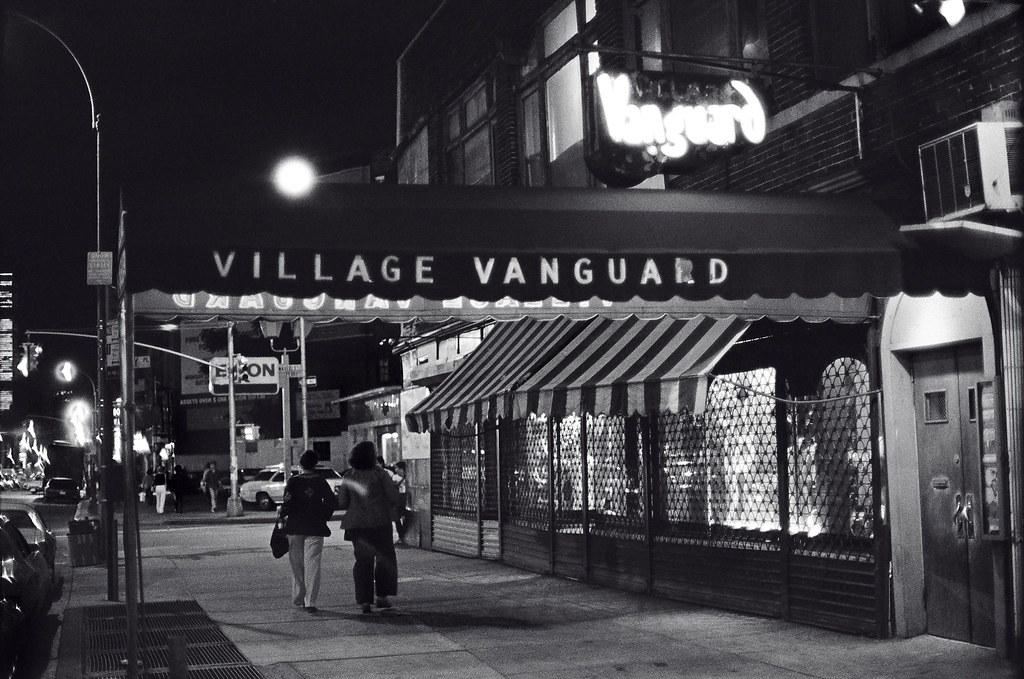
[10] Renee Rosnes Quartet at The Village Vanguard | #1Summer50Concerts

Image result for village vanguard

WHO: Renee Rosnes Quartet
WHERE: The Village Vanguard
WHEN: June 5, 2019, 8:30pm

We're one-fifth of the way there guys! Woohoo!

I get a certain satisfaction out of jazz that I simply don't find in classical music. Don't get me wrong, classical music is still my bread and butter, but like, bread and butter doesn't have a whole lot of vitamins and minerals. And I get those vitamins and minerals from jazz.

I love spontaneity. I love music that turns out different every time. I love music that has no "right" way.

So, when judging jazz players, I cherish spontaneity over all else. I want to see them looking at their group-mates, taking cues, and going with the flow.

Renee Rosnes did not deliver.

Rosnes is best known as a composer, but for some reason this set was primarily (if not all -- she didn't announce every piece) arrangements of swing-era hits. It seemed like a safe play, really too safe for a venue like the Vanguard, where modern jazz attracts the biggest audiences. There was nothing "out there," nothing of particular note; just canned arrangements of Fats Waller and contemporaries.

Note: the New Masada Quartet sold out soon after it went on sale. Renee Rosnes didn't even come close.

In a small group setting, each member is personally responsible for keeping the music moving forward -- if one member starts to hesitate, the whole group stalls. It felt like Rosnes was placing the burden of moving the music forward on her bassist (Peter Washington -- he had a terrified expression on his face the entire time, and you could tell which charts he did and didn't know) and her drummer (Carl Allen -- he was on top his music, and his riffs were well-played, if not necessarily the most creative). That got a little bit better towards the end, I will concede.

So you may have noticed that I've only mentioned three of the four quartet members so far, and that's because I wanted to save the best for last. Rosnes's quartet, instead of employing a more conventional saxophone or trumpet, rounds out the quartet with a vibraphone player -- one of few non-vibraphonist-led ensembles that I know of that does this.

Vibes player Steve Nelson wholly upstaged the headliner. His solos were passionate without being cerebral -- you could tell that Nelson was flying by intuition rather than thinking his riffs through, and I would have it no other way. When the rest of the group was ambling along in what seemed like an endless loop of the same eight-bar chord progression, played the same way for the umpteenth time, Nelson's imaginative soloing provided something memorable above a sea of meh. And you could hear him singing (grunting?) along, which was totally endearing.

The thing is, I don't think Renee Rosnes is bad. In the wake of this gig, I listened to a couple of her albums; they were exactly what you would expect if a classically trained pianist wrote jazz, but not in the bad way. She's won Juno awards (think Grammy, but Canadian) for her compositions, and I totally see why. It seemed to me like she was sort of nonchalantly dialing it in for just another set at the Vanguard, and that she didn't really care that much, which in my opinion is kind of unfair to the audience. That said, she did have another show to play that night.

If you want to see Renee Rosnes, perhaps see her under a different leader -- she's playing with the Ron Carter Quartet at Blue Note in a few weeks (July 9-14). If you really want to see Renee Rosnes as headliner, make sure you know what's on the set: arrangements or originals. If it's originals, go; if it's arrangements, skip it.

Thursday, May 30, 2019

[2] Uri Caine Trio at The Stone @ Mannes | #1Summer50Concerts

WHO: Uri Caine Trio (Uri Caine, piano; Mark Helias, bass; Ben Perowsky, drums)
WHERE: The Stone at The New School
WHEN: May 29, 2019, 8:30pm

I only decided I was going to this concert about 2 hours before it actually started. And I was almost late because I spent too long looking for the nonexistent lunchbox section at TJ Maxx.

Ah, the joys of adulting.

Admittedly, I didn't know a ton about Uri Caine before showing up to his concert last night. I knew was a pianist, and that he had done a jazz Mahler album that I've been meaning to listen to for years, and that was about it. I don't know why his week-long residency at Mannes didn't get more press -- the audience was maybe half full, only about 30 people. But that didn't stop the trio from taking the audience on an adventure to remember.

After sitting down at their instruments, the players began to noodle around, as is common for the first minute or two of a jazz set. But they kept noodling longer than that until eventually Perowsky began to play in something resembling a steady four-beat, seemingly on the fly. The other two adjusted their fooling around slowly, almost imperceptibly, until eventually the entire trio was synced. It was the kind of thing that leaves the audience with jaws on the ground; I know I was in total awe.

*applause* "Quick, take a photo, my phone is dead!" *band starts to pack up* "What, now?" "Yes!" *fumbling with phone*  -- an actual conversation my date and I had yesterday

The word that pops to mind when describing the trio is deft. Their entire set was full of tact and panache, and each player performed to his fullest without detracting from the others. Even at times when the music entered a "free" state similar to the opening of the set, it seemed like the players were aware of each others' improvisations -- perhaps that explains how they always found a common beat after a few seconds, even though Caine's gaze was glued to his hands and Helias never once opened his eyes.

Caine's improvised riffs very much evoked his career as a classical composer; though I didn't know he was classically trained when I saw him, there were a few moments where I turned to my date and mouthed "Debussy? Stravinsky? Messiaen?" and she smiled and nodded in corroboration. A disciple of George Crumb, Caine's claims to fame are his reworkings of classical music: not just Mahler, but Wagner, Schumann, Mozart, and even Bach's Goldberg Variations. One riff in particular from last night's concert evoked a dreaded piano solo from Stravinsky's Petrushka.

Helias's bass lines were creatively realized, if a bit stodgy. He, unlike many jazz bassists, was equally apt with a bow as pizzicato -- his bowed walking bass was refreshing. Perowsky left no timbre unexplored on his kit, from the side of the crash cymbal to the stands of his drums. His wrists alone were something to write home about; when he wanted a crash, but not too loud, he would tense his wrist completely and essentially push the cymbal down with his stick, muffling the sound just enough.

They played for an hour without stopping. The lines between actual charts and improvised filler material were blurry; that being said, the charts ranged from up-tempo rock-with-jazz-chords-sounding romps to the usual swing patterns. The final minute consisted of a series of dominant-tonic progressions -- literally V-I-V-I etc. -- but each time he played it he added more notes until he ended up with cluster-cluster-cluster-cluster. Take that, Mozart.

If you get a chance to see Uri Caine and any cohort of his, you should jump on that opportunity. His music has charisma and charm; it's nouveau-jazz without being inaccessible. And now that I've bought a lunchbox as well, my life is complete -- except for the fact that I forgot to bring it (with my lunch inside) to work today. Sigh.

The trim matches my backpack!