Showing posts with label American. Show all posts

Wednesday, December 25, 2019

Virgil Thomson's Roast Lamb: An Experiment in Gastro-Musicology


One thing I have not made clear enough in my reviews: I am a foodie. The only thing that rivals my love for a good, cheap concert is a good, cheap meal. Not shockingly, it's much easier to find the former around NYC -- I'm pretty sure if I waltzed into Katz's Deli and asked for the "student discount" I'd get a laugh and a proverbial kick in the shins (then again, it's hard to do anything at Katz's without getting made fun of, that's kind of their brand).

Now that I live in an apartment, I've finally been able to get back into cooking regularly. I've had some interesting experiments in my tiny one-person kitchenette. A moderately successful crispy pork belly. Beef rendang with a paste I bought at a hole-in-the-wall Indonesian market in Forest Hills -- the paste had so much chili that it kinda gassed out my apartment even with all the windows open. A five-ingredient butter-soy-garlic braised enoki mushroom dish that I now swear by.

My friend Amanda is my cooking buddy. We grocery shop together, we exchange recipes, sometimes we even eat together. A couple months ago, Amanda texted me a picture from a ratty spiral-bound cookbook and said, "Project?"

The recipe was from Amanda's old copy of the Chicago Symphony Orchestra Cookbook (out of print, but available on Amazon) from the time when her father played trumpet with the CSO. A compilation of exceedingly 1970s-esque recipes, the book includes favorites from musicians, conductors, spouses, and composers.

I'm not sure which I love more: the fact that he wishes us luck at the end,
or the fact that he signs with "Warmly everbest"

Our project: American composer Virgil Thomson's (1896-1989) recipe for roast leg of lamb. Thomson's musical oeuvre has largely been forgotten; he's remembered most fondly as a father figure for composers of the next generation, most notably Leonard Bernstein and Ned Rorem. According to academics, the trio was "united as much by their shared homosexuality as by their similar compositional sensibilities." His most famous works include three operas (two with libretti by Gertrude Stein, one of which the NY Phil is doing later this year) and a handful of Ken Burns-style PBS film scores.

His lamb recipe looked edible. Huge leg of lamb. Cut all the fat off. Rub with crushed garlic and rosemary (no salt, he's very clear about that). 550°F oven. 8.5 minutes per pound. Easy enough, I suppose.

So Amanda and I checked our GCals and penciled in a date around finals -- what better way to celebrate the holidays (and procrastinate on my final papers) than with a huge hunk of Roast Beast™? (please don't sue me Dr. Seuss Trust please please please)

I showed up to Amanda's house around 6:45 on a Monday night. We poured ourselves glasses of wine (I had written most of a 12-page paper that day, I damn well deserved it) and set to work trimming the six-pound leg of lamb of all of its fat. Yes, all of it, or else, Virgil assured us, we'd set our oven on fire. Nice.

I suppose I should say now that we committed ourselves to following Thomson's recipe exactly, so help us god. This is important, because we made some steps that we knew would produce wonky results. But we did it for science!

We crushed some rosemary and garlic and rubbed it on. Just like we were supposed to. And then we stuck it in the oven. And, predictably, the garlic and rosemary torched almost immediately and set off the smoke alarm for the first time that night. We dismantled the smoke detector after that, but that was definitely not the last time the smoke alarm should have gone off.

smoke alarm: BEEP
me: *goes to fan smoke alarm*
Amanda: "Do you want me to take a video of this for your blog?"
Me: "I mean....I guess so?"
Virgil Thomson's Four Saints in Three Acts: *playing in the background, if you listen closely*

The original plan was to make an entire Chicago Symphony dinner, but we looked through the book and decided that everything looked too....well, too 1970s. Lay off the gelatin, guys.

After smoking out the apartment three times (though admittedly those last two were thanks to our complete and utter incompetence at making Yorkshire pudding), we pulled the lamb out of the oven. It looked nice enough. We carved it according to Virgil's instructions (ALWAYS perpendicular to the bone -- he was very particular) and sat down to eat. We ended up with:
  • Virgil's lamb, which was juicy but had a prominent essence of burnt garlic and that distinct 1970s gray color. Oh, and why didn't they ever salt anything in the 1970s? Literally, rub the outside with salt instead of garlic and rosemary and we wouldn't have had a problem with flavor or garlic charcoal.
  • Sautéed Brussels sprouts with bacon. Mmmm, bacon.
  • Arugula "salad" with olive oil and kosher salt, that's it (Virgil's instructions were actually watercress, but arugula is so much better).
  • Amanda's mother's delicious almond torte recipe
Overall not too bad. But Amanda and I looked at each other after enduring three smoke-outs and more than our fair share of other hilarity and said, "We are obviously better cooks than Virgil Thomson. Let's just use our own recipe next time."

An evening of musicology at its most amusing, if you ask me.

Sunday, November 10, 2019

Review: International Contemporary Ensemble performs George Lewis's "Soundlines"

Peep: Shick and Lewis trying to explain the meaning of music
in half an hour, in terms that a middle schooler could understand

WHO: International Contemporary Ensemble; Vimbayi Kaziboni, conductor; Steven Schick, percussion and orator
WHAT: GEORGE LEWIS Soundlines; P. Multitudinis
WHERE: Skirball Center for the Performing Arts @ NYU
WHEN: October 18, 2019 at 7:30pm

One of my friends told me I should drop everything to see this concert. By the time he finished telling me why, my tickets were already bought. I'm easily swayed.

The first amazing thing about this concert was the sheer density of objects and individuals onstage. In addition to the large Skirball stage, a large vertical platform stood front and center -- the kind of platform off of which I flung (and broke) a bow in my freshman year of high school while playing in the orchestra for Pippin. (That was my second broken bow that year. I broke the first by literally sitting on it during an orchestra rehearsal. I was a clumsy child.)

Spilling out of the pitch-black underbelly of said raised platform was a smattering of unusual percussion instruments -- drums, various shakers and rainsticks and whatnot. The conductor sat in the partially-lowered orchestra pit, visible to both those on the platform and on the stage. Basically, I'm trying to say that the setup was weird.

Within the first few measures of Soundlines, two LED panels lit up the dark underside of the platform, revealing the rest of the percussion setup surrounding a blank-faced Steven Schick.

Schick proceeded to tell the tale of an artistic mission upon which he embarked a few years ago: a daring seven-hundred-mile walk from San Diego to San Francisco. George Lewis designates his musical setting of Schick's memoir as a melodrama, but Schick's performance was anything but hyperdramatic. His face remained largely neutral through the piece, one of the more impressive feats of solo performance I've seen in the last year.

Lewis used the vast percussion set to emphasize Schick's oration syllable-for-syllable -- that was where the melodrama of this piece came from. The instrumental accents did not always match the syllable stress of the speech. That was part of the fun. Schick took it all in stride. His body was one, and the hands that operated the mallets were one with the mouth that narrated.

The rest of the ensemble snuck onstage at the end of the piece, and they seamlessly transitioned into P. Multitudinis, more a soundscape than a piece with distinct melody and harmony. The musicians were divided into distinct instrumental groups -- a wind quintet atop the platform, a string quartet stage right, a pianist stage left, a couple of hodgepodge ensembles in the side balconies. Each group had some discrete number of musical modules to play; it wasn't clear exactly how they decided when to switch, but from what I could tell motion was predicated on finger-numbers and Macarena-like hand signals. Conductor Vimbayi Kaziboni kept things moving by slinking around between groups, checking in as a waiter does on a table of guests. Amusing, and who am I to argue with results?

And the best thing about it all was the speech that George Lewis gave afterwards. He was very, very happy. And for me, that enhances the experience so very much. Satisfied composer + satisfied audience = satisfied critic.

Saturday, August 17, 2019

[46] American Modern Opera Company presents "Veils for Desire" at Caramoor | #1Summer50Concerts

One moment before God decides that the Abraham-and-Isaac 
telenovela doesn't need to end like Orange is the New Black did
(intentionally vague to avoid spoilers -- if you know, you know)

WHO: American Modern Opera Company (Anthony Roth-Costanzo, countertenor; Paul Appleby, tenor; Matthew Aucoin, piano; Wayne Koestenbaum, narrator)
WHAT: Veils for Desire: Works by Britten, Monteverdi, Bach, and Aucoin
WHERE: Spanish Courtyard at Caramoor
WHEN: July 25, 2019 at 7:00pm

Poolside blogging. I think I've reached a new low.

Just a short one for today, because I reviewed this concert for Opera News (I think it'll be published in October along with my last one?) and I can't release any spoilers! So here are a few things that didn't make it into my review:
  • I think short-sleeved button downs are the concert dress of the future, especially when they're bright pink like Wayne Koestenbaum's was. Too bad I can't pull one off to save my life.
  • ARC and Paul Appleby had an interesting father-son chemistry in Britten's Canticle II: Abraham and Isaac -- it worked, to say the least.
  • Wayne Koestenbaum is a badass. He didn't sing, so I couldn't say much about him in my review. But he had such a cadence to his speech...love at first word.
  • Caramoor is still absolutely LOVELY. Nature for the win.
  • I wish trains ran from Katonah more than hourly because I waited on that platform for, like, half an hour and I had about 973 bug bites to show for it.
The review should drop soon! I'll link to it when it does, and you can read it (if you're a subscriber).

Monday, July 29, 2019

[37] Davóne Tines and the Dover Quartet play Mendelssohn, Dvořák, Barber, and Caroline Shaw at Caramoor | #1Summer50Concerts

Perks of reviewing for legit organizations: actual professional photos (PC: Gabe Palacio)

WHO: Davóne Tines, bass-baritone; Dover Quartet
WHAT: MENDELSSOHN Theme and Variations, Scherzo, and Fugue from Four Pieces for String Quartet, Op. 81; BARBER Dover Beach; CAROLINE SHAW By and By; DVOŘÁK String Quartet No. 14 in A-flat major, Op. 105
WHERE: Spanish Courtyard at Caramoor
WHEN: July 12, 2019 at 8:00pm

I'm not going to say much about this performance -- I reviewed this concert for Opera News and I don't want to give away my opinions before it gets published. I'll link the review here once it gets published -- you can read it if you're a subscriber.

In the meanwhile, here are a few things that I didn't get to mention in my review:
  • Davóne Tines's stage outfit was a black suit with no shirt. Let me tell you, he ROCKED it.
  • There was some action with candles onstage -- Tines lit a candle in the silence between Dover Beach and By and By, and an ill-timed breeze nearly burned the stage tent down.
  • At the pre-concert Q&A session, a(n over-)zealous chamber-music camp parent chaperone asked Dover cellist Camden Shaw how he handles it when he gets lost in a performance. After a short pause, he answered in his booming, croony voice, "I don't know, look pretty?"
  • Caramoor is absolutely LOVELY. You know why? Because nature is great. NYC almost made me forget that.
  • Caroline Shaw was not there or I would have said hi to her this time. I promise.
Stay tuned for the full review!

Thursday, July 25, 2019

[35] Pauline Kim Harris and friends play John Zorn at The Stone @ Mannes | #1Summer50Concerts

I didn't take any photos. So here's a video.

WHO: Pauline Kim Harris, violin; Christopher Otto, violin; Ches Smith, drums
WHAT: JOHN ZORN Passagen for solo violin; Apophthegms for two violins; Ceremonial Magic for violin and drums
WHERE: The Stone @ The New School
WHEN: July 9, 2019 at 8:30pm

So this is my third concert so far at The Stone, and I have to say it's one of my favorite new concert venues in Manhattan. They run on a jazz-club schedule: artists take up weekly residency from Tuesday to Saturday and play a different hour-long show each night at 8:30pm. I have to imagine it's hard for the artists, but I've never seen any player at The Stone that looks like they don't want to be there, so they must be doing something right.

But even though they started as a jazz club of sorts (before they went under and The New School picked them up), the conservatory atmosphere has been infusing more experimental classical music into their ranks. Pauline Kim Harris was the first artist this summer who I would confidently say falls firmly in the classical camp, but she started her residency with a program from John Zorn, a composer who treads the line between experimental classical and experimental jazz.

Zorn's music is the most organized chaos you've ever heard. After a few minutes, you sort of write off any possibility that the instrumentalists are still in the correct place in the music -- of course, as soon as you do that, they come to some sort of serendipitous moment with *gasp* a consonant major chord or something like that and you realize that all of that chaos was just a means to an end (or vice versa?).

Pauline Kim Harris's playing was great, although her sound felt a little bit stifled by the red velvet curtains that were drawn around the audience and stage. Of course, that's not her fault -- her instrument has a quieter setup, so it needs a hard shell around the stage. But, for her sound problems, her playing was still vivacious and accurate.

Her co-conspirators didn't overshadow her, but were tremendous in their own right. JACK Quartet violinist Christopher Otto, armed with a louder instrument than Harris's, performed that Apophthegms as if it were encoded in some collective strand of DNA that he and Harris shared (it became eminently clear that their friendship was primarily musical by the awkward hug they shared after the performance). Ches Smith's drumming was possibly the highlight of the program -- the paradox between his sticks playing passages that would make Whiplash go pale, contrasted with the calm, slackjawed look on his face, was especially amusing.

Go to The Stone. That's all I'm going to say. Best $20 you'll ever spend.

Saturday, July 20, 2019

[31] Duplexity: Elissa Cassini and Ashley Bathgate at National Sawdust | #1Summer50Concerts

The piece is based on Bach's fourth cello suite -- see the resemblance?

WHO: Elissa Cassini, violin & Ashley Bathgate, cello
WHAT: WINKELMAN Rondo with a Janus Head; SAARIAHO Aure; NORMAN For Ashley; WINKELMAN Ciaccona; RAVEL Sonata for Violin and Cello
WHERE: National Sawdust
WHEN: June 29, 2019 at 7:00pm

I had a depressing conversation with another music critic friend the other day -- the topic was a syndrome that I like to call "critic brain." After reviewing 30 concerts, I feel jaded and hypercritical, like I never really enjoy anything to its full potential. In other words, I have started to wonder whether anything can really wow me anymore.

But every now and then a concert sets me straight, and makes me realize that my standards (which generally run a little too high) can be met. Can you guess what I'm going to say about Elissa and Ashley?

Yeah, they killed it. Like, jaw-on-the-floor.

Cassini has been spending the past couple years touring as a solo duo, so to speak. She teams up with anyone and everyone -- string players, non-string players, classical, jazz, world music -- to bring the gospel of duo music to her audience. And, what's more, she tries to engage with her audiences -- that's right, more audience participation! (Although this particular performance was not so heavy on the repeat-after-me songs I've been dishing on throughout the summer.)

Her partner this time was Ashley Bathgate, current cellist of the Bang on a Can All-Stars (one of NYC's first and foremost new music ensembles). Bathgate has always been a force of nature; critics went crazy for her first album, a 2016 recording of six new works for solo cello by Australian composer Kate Moore. She was actually what drew me to this concert in the first place, quite frankly.


But both Cassini and Bathgate played astoundingly well. They are longtime friends, and it just sort of felt like we were sitting in on another Saturday-night jam session. Smiley and energetic, the duo were in sync to the millisecond -- the NY premiere of Helena Winkelman's highly technical Rondo with a Janus Head showed off their two-as-one synergy, while Kaija Saariaho's Aure showed each's individual musical prowess a bit more.

The two performers each channeled Bach through a pairing of solo movements; the first was a Bathgate-commissioned piece by LA native Andrew Norman, the second, another NY Premiere by Helena Winkelman. The Norman was particularly cool, taking one rhythmic module and modifying it by microtones throughout. The concert finished with the Ravel duo which is sort of proto-modernist -- it uses a lot of the same harmonic language as did Andrew Norman or Kaija Saariaho.

I don't know. I feel like I'm not saying anything particularly inspiring about this concert. But I have to emphasize that it was truly fantastic. Maybe I just remember that it was fantastic and don't remember a ton of the details. But it was amazing. Trust me.

Tuesday, July 16, 2019

[30] Wadada Leo Smith and friends at The Stone @ Mannes | #1Summer50Concerts #JazzWeek

Image result for wadada leo smith


WHO: Wadada Leo Smith, trumpet; Mariel Roberts & Okkyung Lee, cello; Erika Dohi, piano; Gabriel Zucker, synthesizer
WHAT: WADADA LEO SMITH Red Autumn Gold; Silence
WHERE: The Stone @ The New School
WHEN: June 28, 2019 at 8:30pm

So here's the thing.

I loved Wadada Leo Smith's performance. I think that what he did was innovative, and cool, and kept me interested the whole time.

There's only one problem: I don't really know what he did.

I think it was some sort of free jazz. Let me try to describe it. All the musicians were reading off of graphic scores, the kind that don't really specify anything other than direction and approximate time. The keyboard played a lot of single drone notes. The pianist alternated between random, Messiaen-tinged licks and dissonant chords for which she leaned over the top of the piano to damper the strings. The cellists never really played notes so much as effects -- a lot of sliding, a lot of weird in-between harmonics. And Wadada Leo Smith would occasionally come in with a super super loud entrance that would disturb the peace like a comic book character who pops a thought bubble with a pushpin.

Free jazz isn't the right term. It was just kind of....free. I think Wadada's goal was to let the music flow for itself. He sort of vaguely conducted occasionally, but really it was up to the players how the music went. They weren't given too many instructions. They did what they wanted. Wadada nodded in approval.

I mean, I don't have a ton to say about the performance. It was exactly what I needed on a Friday night. It wasn't particularly tough to listen to. Wadada's occasional loud entrances made me jump a little bit, especially considering that the #@%$ing column in the middle of the venue (huge design flaw) kept me from seeing him half the time. The performers all had good imaginations and, even in moments with repeated modules, every note was novel.

If you want to get into new music, this is not where you should start. But if you're interested in exploring a new sound world -- my date and I concluded that it was a sound world rather than a type of music -- then give Wadada a try.

Also, one parting observation: we need more cello jazz in this world. That is all.

Thursday, July 11, 2019

[28] Ethan Iverson and Mark Turner at The Village Vanguard | #1Summer50Concerts #JazzWeek

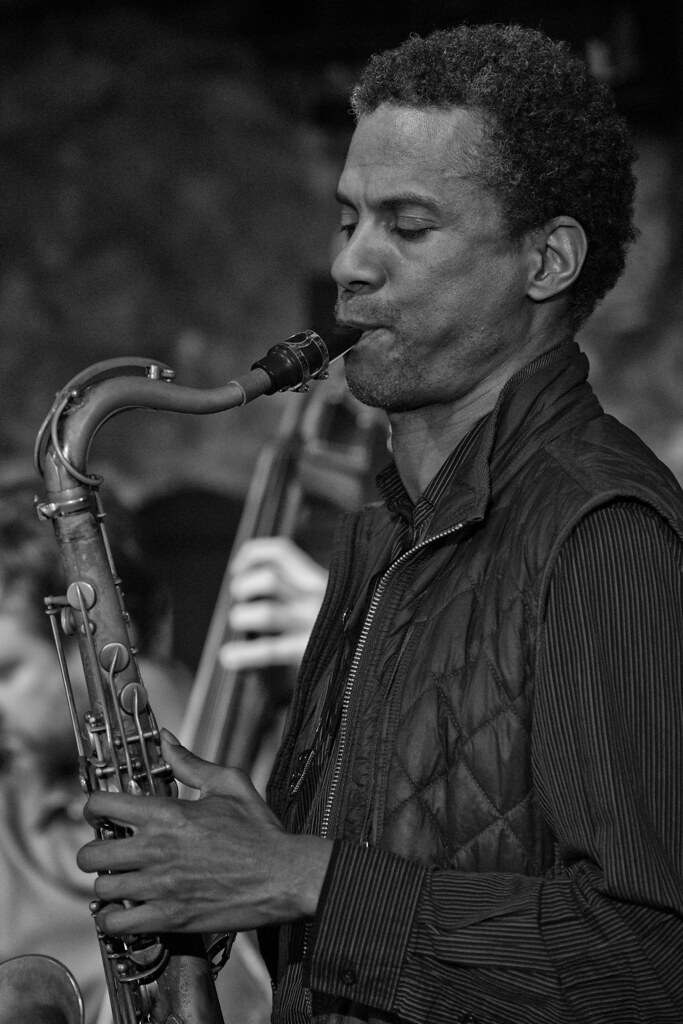
Image result for ethan iversonImage result for mark turner
I'm not allowed to use the picture of them together, because it's under copyright. Boo.

WHO: Ethan Iverson, piano; Mark Turner, tenor saxophone
WHAT: jazz standards, mostly
WHERE: The Village Vanguard
WHEN: June 27, 2019 at 10:30pm

I, like many musicians, love music. I profess my love often. I talk about albums, concerts, everything. Hell, I'm going to 50 f*cking concerts this summer -- that's something that only someone who loved music would do. Will I still love music after 50 concerts? Stay tuned to find out!

I tell people that I love music because I'm not a good enough performer to sound like I love the music. When Hilary Hahn pulls out the Bach violin suites for the umpteenth time, her affect, her expression, her energy conveys her love to the audience in lieu of speech.

Having attended their concert, I can tell you with utmost certainty that Mark Turner and Ethan Iverson love music.

Iverson and Turner both approach jazz from different perspectives. Iverson's compositions are on the cusp of classical and modern, as evidenced from The Bad Plus's big Rite of Spring project from 2014. He still regularly performs classical music -- I just found out that he'll be playing Schubert's Winterreise alongside British tenor Mark Padmore next May. Turner, on the other hand, is a little more heavy-handed on the modernism. He's not exactly a mogul of free jazz, but he's done some things that my grandparents may refuse to recognize as jazz (Ornette Coleman IS REAL JAZZ GRANDMA).

So they met in the middle. Back to basics: blues and standards.

As you may recall, last time I saw standards, I was duly unimpressed -- I've just resigned myself to the fact that Renee Rosnes won't be inviting me to any of her garden parties in the future. Oh well. But there's a difference, I have found, between playing standards and playing standards like you mean it.

In any innovation, there's a degree of respect that has to be present. Iverson and Turner's innovative takes on Coltrane and Strayhorn and Just Friends were full of not only a love for the music, but also showed so much respect for the original composers. They didn't recompose or deconstruct any of the original framework, they simply infused it with a rollicking, Iverson-Turner flair. Think of it like a partially-possessed human -- when you hear Giant Steps for the millionth time, do you want to hear Coltrane, or do you want to hear the performer? Well, with Turner and Iverson, we heard both.

They didn't actually do Giant Steps. The whole set was far too laid-back for that. Iverson played a composition of his, something about duels and arguments, in celebration of the Democratic debate that was happening the same night -- even that felt like a debate between two people who had smoked a little too much pot. Not complaining, though. My brain was pretty fried by that point, and some easy listening was exactly what I needed.

This was the perfect everyman's concert. Two jazz icons, charismatic from the stage, playing to a weekday 10:30pm audience of about 12 people, playing fun, enjoyable music that doesn't require too much thinking. Were Turner's solos still perfectly thought-out? Of course. Were Iverson's 12-bar blues progressions still spot-on? Yes. But it wasn't finicky. It was simple, clean, and to the point. If you want to know what I mean, listen to their album from last year, Temporary Kings.

Tuesday, June 25, 2019

[21] The Knights play Jacobsen, Sanna, Britten, Bielawa, and Mendelssohn at Temple Emanu-El | #1Summer50Concerts

The gorgeous (GORGEOUS!!!!) Temple Emanu-El

WHO: The Knights; Colin and Eric Jacobsen, directors; Kristina Nicole Miller, narrator and vocals; Nicholas Cords, viola; Alex Sopp, flute; Michael Atkinson, horn
WHAT: C. JACOBSEN, E. JACOBSEN, KYLE SANNA Compositions after Walt Whitman; BRITTEN Lachrymae; LISA BIELAWA Fictional Migration; MENDELSSOHN Octet, Op. 20
WHERE: Temple Emanu-El
WHEN: June 18, 2019, 7:00pm

"Don't fart."

That's all I can think when I sit in the audience of live-broadcast concerts. A cough is forgivable; a sneeze even more so. But if those WQXR microphones are poised just right, your toot could be the talk of the nine people who still listen to live concerts on the radio.

God, look at me. Potty humor, radio jokes, you'd think I grew up in the 2000's or something.

This concert was the opening of this year's Naumburg Orchestral Concerts, so named for the Naumburg Orchestral Shell in Central Park where they're usually played. However, 114 years of free orchestral concerts can take its toll, and the shell was in dire need of some TLC, so the concerts were moved for this year to the gorgeous (GORGEOUS) Temple Emanu-El on E 65th. Good thing, too -- it was rainy and disgusting while we were standing in the long, long line to get inside.

The Knights are one of the more active independent orchestras in New York City, the kind that starts with friends playing chamber music in someone's living room. This was their tenth consecutive appearance at the Naumburg series, and you could tell they felt right at home. This concert was a dual celebration: first and foremost, they were celebrating the 200th anniversary of Walt Whitman's birth. However, they also managed to get their hands on a tremendous Amati viola which was celebrating its 400th birthday -- move over, Whitman!

The full WQXR broadcast from the other night, fart-free!

Though Kristina Nicole Miller was credited in the program as a "narrator," her singing was one of the highlights of the first half. Kyle Sanna's Whitman composition, after a section of Song of Myself, morphed into something of a Disney-meets-modernism situation -- very interesting indeed. Miller would have been right at home as a Belle or Ariel, but her clear understanding of the complex Whitman propelled her far ahead of any Disney aspiration.

Lisa Bielawa's piece took many a cue from composer and amateur ornithologist Olivier Messiaen, weaving birdsong in and out of the gossamer orchestral texture with impressive aptitude -- though Bielawa's birdsongs were not taken from real birds, they were just as convincing as any material Messiaen drew from. Flautist Alex Sopp channeled her inner avian as though she'd been doing it regularly all her life; hornist Michael Atkinson played similarly well, but the gorgeous (GORGEOUS) Temple Emanu-El's acoustics did him a disservice by swallowing him completely.

The Amati came out in the hands of violist Nicholas Cords for Britten's Lachrymae, a piece modeled after John Dowland's 17th-century consort work of the same name. Cords played ridiculously well, from what I could hear of him -- Emanu-El is harsh on all mid-range instruments, not just horns. Too often, modern reinterpretations of early pieces suffer from hypermodernization; Cords and The Knights, under the functional baton of Eric Jacobsen, infused the Lachrymae with almost as much Dowland as Britten.

As for the Mendelssohn -- well, it certainly did the job. Eric Jacobsen pulled out his cello and joined the lively octet with his brother (concertmaster Colin Jacobsen), Nicholas Cords (400-year-old Amati in his hands), and five others from the orchestra. It was great. It was everything you wanted from chamber music. By the time the ensemble played the final E-flat chord, I was fully convinced that a) they had been playing together as an octet for years, and that b) they were all best of friends. Whether either of those were true, who knows, but that's the kind of emotion they exuded, and let me tell you, I couldn't wipe the grin off my face for the rest of the evening.

Free concerts are always worth it, but that doesn't mean that some free concerts aren't better than others. The Knights have impressed once again that not all great music has to come at a great price; some organizations care more about serving their audiences than they do about turning a profit. All musical ensembles want to serve their communities to at least some extent. And I think the Naumburg series has refined that art down to a T.

Stay tuned for the next Naumburg concert on July 10: Venice Baroque Orchestra with Anna Fusek, recorder!

Sunday, June 23, 2019

[20] Dalit Hadass Warshaw's "The Letters of Mademoiselle C." at National Opera Center | #1Summer50Concerts

It specifically reminded me of one of those neon candy orange slices -- does that make me a terrible person?

WHO: Dalit Hadass Warshaw, composer and piano; Nancy Allen Lundy, soprano; Beth Greenberg, director
WHAT: The Letters of Mademoiselle C., by Dalit Hadass Warshaw (world premiere)
WHERE: Marc Scorca Hall at the National Opera Center
WHEN: June 17, 2019 at 7:00pm

I am an opera nut. We have established this before.

You'd think I would have at least heard of a place called the National Opera Center. Where the organization OPERA AMERICA is based. But I hadn't. My date made fun of me for that one -- rightfully so.

Anyway, the NOC is on the sixth or seventh floor of your average Gramercy office building, above a couple bodegas and a payroll services shop. It looks like a pretty average office lobby until you step into the concert hall. I mean, no office space has a concert hall, but this is probably the weirdest venue I've been in so far. Imagine if you took an orange slice and modeled a concert hall after it -- sort of like if you sliced a cylinder and then sliced those slices in half lengthwise, and then put in a wood paneled floor and a stage and painted the walls blue. Weird.

But my date sent me the Facebook event attached to a message that said, "We're going to this." So it's not like I had much of a choice.

I suppose I should be glad that my friends know to forward me any and all concerts. But hey, I'm an ingrate. That's why I'm going into music criticism.

So, I'm terribly illiterate, and I had only heard the name Camille Claudel once or twice. From what I gathered from the program notes, the performance, and S2E1 of Marvelous Mrs. Maisel, she was a sculptor who had an affair with Auguste Rodin and was subsequently committed to an asylum on dubious suspicions that she was mentally ill. That kind of story arc makes for a perfect song cycle, I will concede.


I think her primary instrument is theremin -- what a legend

The program started with three composers that would have been ringing in Claudel's ears: Germaine Tailleferre, Lili Boulanger, and finally a prelude of her dear friend Claude Debussy. Warshaw's performance was sound indeed -- it was almost invocative of jazz in the way that the individual lines were phrased in relation to one another. The product was an interesting interpretation that traded absolute readings of dynamics in favor of a sense of relativity, which was, in my opinion, a novel and refreshing.

And then, as the Debussy ended, soprano Nancy Allen Lundy, as the disheveled Claudel, slowly and trepidly walked down the center aisle of the audience. Onstage were a couple of chairs and a shawl; director Beth Greenberg made the most of a sparse staging.

The music itself was tremendous -- imagine all of the rhythmic uncertainty of Schoenberg or Webern, but with a color palette similar to that of Debussy and ilk. Warshaw played beautifully, not just because it was her piece; she clearly had a stylistic goal in mind, and she executed it beautifully. One would have thought the music emerged straight from a table at Les Deux Magots or another Parisian intellectual haunt.

Lundy's performance had its ups and downs. Her climactic high notes were right on target, impassioned and drenched in a thick coating of manic sorrow. Most of her tessitura, though, was underwhelming; her tone was breathy, and her diction was barely there. One of the movements had a refrain that repeated the word "chisel", which invariably came out as "shizzle" or "jizzle."

Because of the diction issues and the lack of subtitles, I don't think I got as much out of this premiere as I could have. The piece was obviously very well thought-out, and I'd like to see it performed again once it's had the opportunity to go through some stages of performance workshopping -- hopefully, the performers will tour it and give it the chance it really deserves.

Thursday, June 20, 2019

[17] confluss + Spark Duo at Saint John's in the Village | #1Summer50Concerts

West Village churches: fighting homophobia one LGBTQ+ themed concert at a time

WHO: confluss (Amber Evans, soprano & Samuel Zagnit, bass) and Spark Duo (Kate Amrine, trumpet & Ford Fourqurean, clarinet)
WHAT: a concert in honor of Pride Month
WHERE: Saint John's in the Village
WHEN: June 13, 2019 at 7:30pm

I think I said it once in passing, but I'll say it again, louder this time:

Happy Pride Month!!!!!!!

I love love LOVE being a classical music geek in NYC during pride time. When you go to other cities, their "pride month concerts" center around the composers who lived in a time when being LGBTQ+ was taboo. A lot of Tchaikovsky, a lot of Poulenc, some Britten if you're lucky. Gotta keep those tickets sales high with the *older demographic*.

Thank god NYC has a burgeoning new music scene, because I think I'd die if I only heard Tchaikovsky throughout the entire month of June.

The classical music pride celebration hasn't been spearheaded by any of the larger ensembles in NYC -- their social media accounts show their support, but something about a program of Mahler and Bruckner doesn't scream queer (*ahem* MET ORCHESTRA). So, it's up to the smaller venues to program for the special season.

Saint John's in the Village has a whole series of LGBTQ+ themed concerts, from a 1920s portrait of "Le gai Paris" to lecture-concerts on the role of gay culture in worldwide popular music. This concert featured exclusively works by LGBTQ+ composers, many of which were commissioned by the two ensembles.

The program ran the gamut from (relatively) traditional to (totally) experimental, and some pieces fell off that spectrum entirely. Those included a piece inspired by punk rock legend Kathleen Hanna; a piece, performed by both confluss and Spark, in which the instrumentalists would shout random letters, each of which was associated with an instrumental sound (a musical interpretation of synesthesia, according to the composer); and a series of Sonic Meditations by the late Pauline Oliveros (one of which was interactive -- what is it with me and inadvertently walking into audience participation situations???).

The highlights of the program were far and away the compositions by confluss bassist Sam Zagnit. His diverse background shone brightly throughout, especially in excerpts of his long-form song-cycle-quintet catalogues, whose soprano part contains a theatrical breakdown that could be excerpted straight from a 1960s sitcom (or Marvelous Mrs. Maisel, pick your poison). Soprano Amber Evans proved she is as much actress as singer, which is saying something considering she's one hell of a singer. Zagnit seemed precisely in his element as an aesthetically stoic, but musically expressive foil to the hilarity that ensued from the singer's side.

Spark Duo's program was more subtle than that full-blown episode, though no less interesting. Each player had a solo -- clarinetist Ford Fourqurean played a piece entitled Rhapsody and Groove, which he described as "rhapsodic...then groovy," which seemed rather reductive at first but turned out to be the only apt description for the piece. Trumpeter Kate Amrine's solo made more of a statement in the form of a piece for trumpet and video reel entitled Thoughts and Prayers, which interspersed music with both live and recorded calls to action in the wake of gun violence. Rounding out their half of the program was another Zagnit premiere, this time in a more postmodern vein, but equally enjoyable.

There is a reason why this performance is on the channel "Famous musicians you haven't heard of yet"

If you're not sniffing out these tiny little new music concerts in NYC, then you're doing it wrong. People often moan and groan about how classical music is dying. Wake up and smell the roses: if you want classical music to live on and gain back some of that precious pre-WWII cultural relevance, stop complaining and start supporting the innovators of the future.

Saturday, June 15, 2019

[14] Roomful of Teeth performs Bryce Dessner's "Triptych" at Brooklyn Academy of Music | #1Summer50Concerts


WHO: Roomful of Teeth and friends
WHAT: Triptych (Eyes of One on Another) by Bryce Dessner
WHERE: Peter Jay Sharp Theater, Brooklyn Academy of Music
WHEN: June 8, 2019 at 7:30pm

"In america,
I place my ring
on your c*ck
where it belongs"
-- Essex Hemphill, from American Wedding

Like, how am I supposed to react to that? Especially when that phrase repeats for ten minutes straight?

When I realized that Dessner's Triptych was a "new way" of looking at the photographs of Robert Mapplethorpe, I knew I was in for some graphic material. But oddly enough, it didn't bother me. The graphic nature was attenuated by the music that accompanied -- the experience altogether read less as glorification of sexuality and more as an earnest snapshot of the life of another.

Roomful of Teeth occupies a singular niche in the music world: they are the crossover of all types of music. A bold statement, I know, but if you listen closely they really do have a twinge of just about any style you can think of. In this performance alone, they were all over the map: early music (side bar: how amazing would it be if Roomful of Teeth did Monteverdi????), gospel, rock and roll, contemporary classical, spoken word, you name it.

Does someone want to explain to me why Brooklyn has all the best
concert venues? Look at those chandeliers!

And because Roomful of Teeth is a group of young people at the top of their field, they collaborate with a bunch of other young people at the top of their fields. Accompanying Roomful's always impeccable singing were a chamber orchestra conducted by Roomful founder and music director Brad Wells and beautiful lights, set, and video by leading designers in the avant-garde theater world.

A couple of auxiliary vocal soloists joined Roomful of Teeth for this performance. Mezzo-soprano Alicia Hall Moran walked the line between opera and gospel perfectly, her singing passionate and soulful. But the tenor soloist, Isaiah Robinson, takes the cake for this performance. "Tenor" doesn't even begin to describe what he is. I think he's gospel trained, but imagine if you took your average gospel tenor and then eliminated any trace of shouting in the higher registers. He was reaching D's, E's, even an F and a G at one point without any trouble or effort -- I know sopranos who can't do that.

This is one of those pieces that I would advise against listening to if it's ever recorded -- the piece is nothing without the full experience. Without the accompanying video, the stark choreography (complete with iPad-music stands on wheels), the sometimes-blinding lighting design, you would lose much of the effect. I think they're continuing to tour the piece for the next couple months -- catch it if you can!

Monday, June 10, 2019

[11] NY Philharmonic premieres David Lang's "prisoner of the state" at David Geffen Hall | #1Summer50Concerts


WHO: New York Philharmonic; Jaap van Zweden, conductor; vocal soloists; tenors and basses of the Concert Chorale of New York (Donald Nally, choirmaster)
WHAT: prisoner of the state, by David Lang (world premiere)
WHERE: David Geffen Hall
WHEN: June 6, 2019, 7:30pm

I'm not going to lie, prisoner of the state was gritty, gritty, gritty. Like, I just sat here for half an hour trying to think of an opening joke for this post. And I couldn't think of one. Because there was not a single uplifting moment in this 70-minute opera.

The stage of David Geffen was surrounded by a chain-link fence laced with barbed wire. The orchestra players wore all-black with optional black skull caps (the horn section looked particularly good in their matching hats). In the front was a faux-stone stage (with two trap doors, only clearly visible from directly above, which of course I was because I got seats on the side of the stage in the third tier because I am CHEAP), and in back, behind the fence from most vantage points, was a cell-block-looking stage that was unequivocally too small for the forty-some men of the choir.

The chorus processed out in yellow jumpsuits, wrist chains, and possibly the most convincing dirt-makeup I've ever seen. Granted, a couple of them still had perfectly coiffed hair that didn't exactly shout "prison," but the aesthetic was there.

David Lang's music exists in a strange quantum state (to the extent I understand what that means -- physicists, comment below and let me know if I'm an idiot). The way his music sounds and feels, one thinks it's simultaneously racing forward and dawdling. Many of the orchestral figures were frantic and exceedingly precise; yet, there was so much repetition that forward motion was quasi-nonexistent.

prisoner of the state was Lang's take on Beethoven's Fidelio, a convoluted plot that, without any subplots, essentially concerns itself with a political prisoner (Fidelio), who is to be killed by gradual starvation, and his devoted wife, who dresses as a guard to sneak her way into the prison and reveal the twisted reasons for her husbands unfair detainment. It's a happy ending: Fidelio is freed, his opponent is detained, joy, triumph, yay!

Lang essentially strips the two-hour-plus Fidelio of all its subplots, casting a modern light on the main story line. The characters are all deranged in one way or another, and each gets an aria to explain his or her affliction. The dehumanized "assistant" (the character of the wife) sings of how she once was a woman, but is no longer; the power-hungry "governor" sings of his obsession with fear over love; the sadistic guard sings of his willingness to do anything for wealth; the prisoner (congruent to Beethoven's Fidelio) sings of the solitary confinement that has driven him to the brink of extinction.

Thing I did not mention: my job got me into a press rehearsal a couple days before the
actual performance. It was us and a bunch of classical music "influencers" -- I didn't know those existed

French soprano Julie Mathevet, who played the assistant, was perfect in her character. Mathevet portrayed not an ounce of emotion until the (seemingly uplifting) end, very clearly on purpose. The governor, played by British tenor Alan Oke (who really really channeled the Patrick-Stewart-circa-Macbeth look for this role), almost struck like a Herod-type character: obsessive, whiny, and opinionated. MET regular Eric Owens (the guard) struck a perfect balance between capitulating and strong-willed. But the prize for most convincing goes to Jarrett Ott, the prisoner of the state himself (oh, THAT'S why they called it that!), whose bloody makeup and languid appearance did not compromise his operatic presence one bit.

The Concert Chorale sounded tremendous -- they beefed up their ranks significantly for this one. On the roster were are few names I recognized from spectating around the NYC and New Haven concert scenes. And holy crap, did they have tenors. High Bb's for days. Even with the choreography, which mostly included stomping and walking, the music was forceful, stark, and effective.

Lang has a knack for social commentary. I was fortunate enough to sing a piece of his earlier this year which sets the pre-sentencing speech of Eugene Debs, who was convicted under the Sedition Act for his anti-WWI speeches. To quote Lang himself: "I was mad, so I wrote this." And that seemed to be more or less the case for prisoner as well -- except in this case he had control over his own libretto. At what would be an otherwise happy ending, Lang throws in the caveat that technically we *are* still prisoners in the world, and that the only difference in a real prison is that you can see the chains. Nice.

All else aside, this was a tremendous performance. And even if you didn't get to see it, I'm certain it's going to come back. This is the kind of thing that was far too much work to truly only last for one weekend. My guess is that this production will make its way around the major symphony orchestras and opera houses and eventually get recorded. Good thing, too; it's catchy as hell and it's going to be stuck in my head until I can get my hands on a recording.

I hummed this at a concert two days later, and a lady who was sitting in front of me
turned around and said, "Is that prisoner of the state?" I think I've found my people <3

Saturday, June 8, 2019

[9] Laura Kaminsky's "As One" at Merkin Hall @ Kaufman Center | #1Summer50Concerts

The full credits list
WHO: Briana Elyse Hunter, mezzo-soprano (Hannah After); Jorell Williams, baritone (Hannah Before)
WHAT: As One, by Laura Kaminsky
WHERE: Merkin Hall at the Kaufman Music Center
WHEN: June 4, 2019, 8:00pm

This is going to be a hard one to write. And I think I just need to get something off my chest real quick: I am not here to provide an evaluation of the subject matter expressed in this opera. I will be doing my best to evaluate the work objectively as an art form. This opera concerns itself with struggles that I am not qualified to comment on, and the last thing I want or intend to do is invalidate those struggles and the people who have endured them. I am not commenting on the message this opera conveys (I happen to agree with that message wholeheartedly); I am commenting on how the message is conveyed.

I was super excited when I heard about As One. The concept was fabulous, in my opinion: using two singers to chronicle a trans woman's struggle and eventual transition. I really truly think that music and text together are more powerful than either one in isolation.

The performances, by baritone Jorell Williams and mezzo Brianna Elyse Hunter, were fabulous. Williams's sheepish, yet confident acting (backed up by one hell of a voice) conveyed the internal struggle that the opera meant to convey. Hunter's intrepid final scene showed a newfound, in-plain-sight joie de vivre.

I really quite enjoyed the music of this opera as well. It was sort of a mishmash of American classical music: the pointed repetition of Reich and Glass, the ninth chords of Whitacre, the plaintive solo lines of Barber. The quartet that played the score was accurate, expressive, and always sensitive to the vocalists on stage. The set design, while minimal, was exactly as much as was needed.

The place where I feel like this opera fell flat was in the libretto. The opera was structured as a series of vignettes, and it seemed like at times the libretto did not connect one scene to the next. For instance, when Hannah decides she needs to get away from the society she knows, she decides to go to Norway; rather than showing a thought process, she just kind of sings, "Norway!" and then...she's there? A little bit discontinuous, in my opinion. Also, the libretto seemed to be very cookie-cutter -- I think about half of the sentences started with "I feel," especially towards the end of the opera. I think that the characters would have had more dimension if the libretto explained not only what they feel, but how they feel it.

Overall, not my favorite experience. There's a recording coming out soon, I might recommend listening to that; however, I wasn't so keen on this performance. It wasn't *bad* per se, but I think it could have used some fine-tuning.

Tuesday, June 4, 2019

[6] Experiments in Opera presents "Chunky in Heat" at The Flea | #1Summer50Concerts

WHO: Experiments in Opera and Contemporaneous
WHAT: Chunky in Heat
WHERE: The Flea Theater
WHEN: June 1, 2019, 7:00pm

I like my opera like I like my Campbell's chicken noodle soup: chunky.

No, that's not it.

I like my opera like my grandmother describes my waistline: chunky.

Eh, that's better.

I had no idea what to expect when I showed up to The Flea, a venue for experimental theater, for Experiments in Opera's production of Chunky in Heat on Saturday evening. I don't really fancy myself a consumer of experimental theater, apart from opera; I found out that I very much fit the *opera* aesthetic. Whereas the theater nuts were dressed in felt hats and billowy cotton pants, I was there in a t-shirt, jeans, and cardigan. Too casual was perhaps not the issue so much as the wrong kind of casual.

At the door, I was greeted by a worker in a pride pin (it was June 1 after all -- HAPPY PRIDE MONTH!!!!) who asked me which performance I was there to see: Chunky, or two other performances whose names I don't recall but sounded just as strange. I got my ticket, mounted the stairs, and plopped down in an empty chair in a pretty sizeable black box theater. The stage was a simple house with an astroturf lawn, two lawn chairs, and a side table containing a can of TaB cola (throwback much?),  a cup of drinking straws, and a tube of sunblock. An inflatable smiling sun graced the background; a tree with a camera attached stood off to the side, by the rightmost edge of the audience.

The set, featuring one creepy-ass sun

Chunky in Heat started off like any other modernist opera. The orchestra built pulsing chords from the bottom up, not unlike the opening of John Adams's Death of Klinghoffer. Chunky (a nickname for Cynthia ) is onstage at her house (supposedly in Los Angeles -- hence "in heat"), agonizing over being a little bit...erm...chunky, as well as expressing her lust for the archetypal "boy next door" ("Walter, like a tall drink of water"). It could have continued relatively normally.

But then the tree started talking -- actually, not just talking, but describing in great detail two passing fruitflies engaging in coitus. And that's when I knew I was in for a ride and a half.

Suddenly, the stage turned devil-red; the orchestra's drummer began to play a generic dance-pop backbeat; on came Chunky's mother and father, dancing some faux-conga-line type thing. It was a riot.

Those sudden changes of scene occurred often throughout the 90-minute piece. A collaboration among six composers, Chunky in Heat appeared to lack a singular musical style, but it was presented in a way that made that decision with purpose and intention. It was definitely a pastiche, but it was a pastiche determined to be so rather than one that was so out of convenience.

Image result for chunky in heat
She's underwater, can't you tell?

The orchestra was Contemporaneous, one of NYC's foremost new music ensembles, led by co-founder Dan Bloom. They played exactly how you want an opera orchestra to play: tastefully, accurately, and supportively. This was right up their alley -- whereas Bang on a Can developed a signature aesthetic long ago, Contemporaneous is still up for anything and everything. I would go so far as to call them New York's most open-minded ensemble: everything, no matter how strange, is an experiment.

The singers were all excellent. Soprano Sarah Daniels (Chunky) kept a youthful levity throughout the opera, her voice reflecting her character's girlishness rather than becoming weighted with teenage angst. Emily Geller's (Mother) lower range was impressively forceful, penetrating easily over a fortissimo orchestra. Timothy Stoddard's (Walter/Fiancé/Beekeeper) high A's and Bb's were few and far between, but when they were written, they were delivered with full tone and gusto. Joshua Jeremiah's (Father) rich baritone and Abigail Doehring's whimsy mezzo (and impressive method acting as a coyote -- LA things only, amirite?) rounded out a strong cast.

If you're not a fan of non-traditional, this is not for you. But Experiments in Opera is obviously a noble cause, and truly unique. Few other cities have "opera collectives" at such a high level of professionalism, even though new opera is just as important as -- if not more important than -- old opera. If Einstein on the Beach left you craving more, or you just want to know what's happening *now*, give experimental opera a try.

Saturday, June 1, 2019

[3] New York Philharmonic plays Brahms, Mozart, and Corigliano at David Geffen Hall | #1Summer50Concerts

WHO: New York Philharmonic; Jaap van Zweden, conductor; David Fray, piano
WHAT: BRAHMS Tragic Overture; MOZART Piano Concerto No. 24; CORIGLIANO Symphony No. 1
WHERE: David Geffen Hall
WHEN: May 30, 2019, 7:30pm

I've been known in the past to give tepid, if not negative reviews of the NY Philharmonic in the past. I saw them a couple times in their last season with Alan Gilbert, and their affect often seemed listless at best. It seemed like a group of accomplished soloists each playing without much regard for what the rest of the orchestra was doing.

I'm glad to say that era is on its way out. Jaap van Zweden, the notoriously fierce Dutch conductor who took over as the Phil's music director this year, is fixing them. The orchestra will almost certainly be back to its Bernstein-era glory in a few years.

Still, though, the Phil is in an intermediate period. There are moments where everything clicks and they sound like the most expressive, polished orchestra on this side of the Atlantic. One of those moments was at the beginning of the Brahms's Tragic Overture, which started this concert. Quite frankly, I find the piece to be very take-it-or-leave-it. Is it better than I could have written? Absolutely. Is it Brahms's magnum opus? Nowhere near. But the Phil brought certain moments to life -- the opening (and the recap) sounded almost like a period ensemble, with hard-sticked timpani and vibrato-less strings, a timbre that van Zweden clearly thought out well. The rest? It was fine.

I suppose I should mention the caveat that I had a TERRIBLE seat for the first half of the concert. The box office refused to sell me a student-priced ticket (even though there were empty seats everywhere?????), so I was stuck with the only other seat that was in my budget: top floor, side boxes, partial view. And it was still twice as expensive. UGH. I moved to a top-floor front-facing seat for the Corigliano (and thank god I did -- that partial view would have blocked out the mandolinists!).

To give you an idea of where I was sitting...Fray, van Zweden, and the orchestra

Both of Mozart soloist David Fray's last two albums have been Bach interpretations -- his concerti for multiple keyboards in 2018 followed by his sonatas with star French violinist Renaud Capuçon. I've like his Bach (much as I usually prefer my Bach on harpsichord), so I was interested to hear his Mozart. His Mozart (the 24th piano concerto) struck me as a little far removed from his Bach; his use of pedal was a little more liberal than I would have liked, though not totally outlandish. That being said, his slow movement was incredible: heartfelt, musical, and not too soupy. Special mention to the wind section Phil for that same slow movement.

I was proven wrong. But I still don't think the mandolins were *totally* necessary.
I really didn't want to like the Corigliano. At first glance, the orchestra seemed too big, almost big for the sake of being big. But John Corigliano himself came onstage and gave some verbal program notes, on the verge of tears as he remembered the people this piece eulogizes, friends of his who died in the AIDS epidemic. Once the piece started, I understood why that orchestra was so huge. Corigliano accurately encompasses so many emotions in this piece -- terror, sadness, wistfulness, nostalgia -- that even the most emotionless of listeners is moved.

The highlight of the piece was the opening of the third movement, in which principal cellist Carter Brey delivered a solo (in commemoration of a cellist friend) that was not only polished, but also so deeply felt that a cavern opened up in my stomach and I was fighting back tears. Overall, a tremendous performance.

If you get a chance to see the NY Phil, certainly do it. While they are not necessarily the best orchestra in NYC (that honor goes to the MET Orchestra), they are definitely worth a visit, even in their acoustically dead hall. But, more importantly, if you get a chance to see John Corigliano's Symphony No. 1, jump at it. I hear the Chelsea Symphony is doing it at the end of this month (June 29-30), who's going with me?

Thursday, May 30, 2019

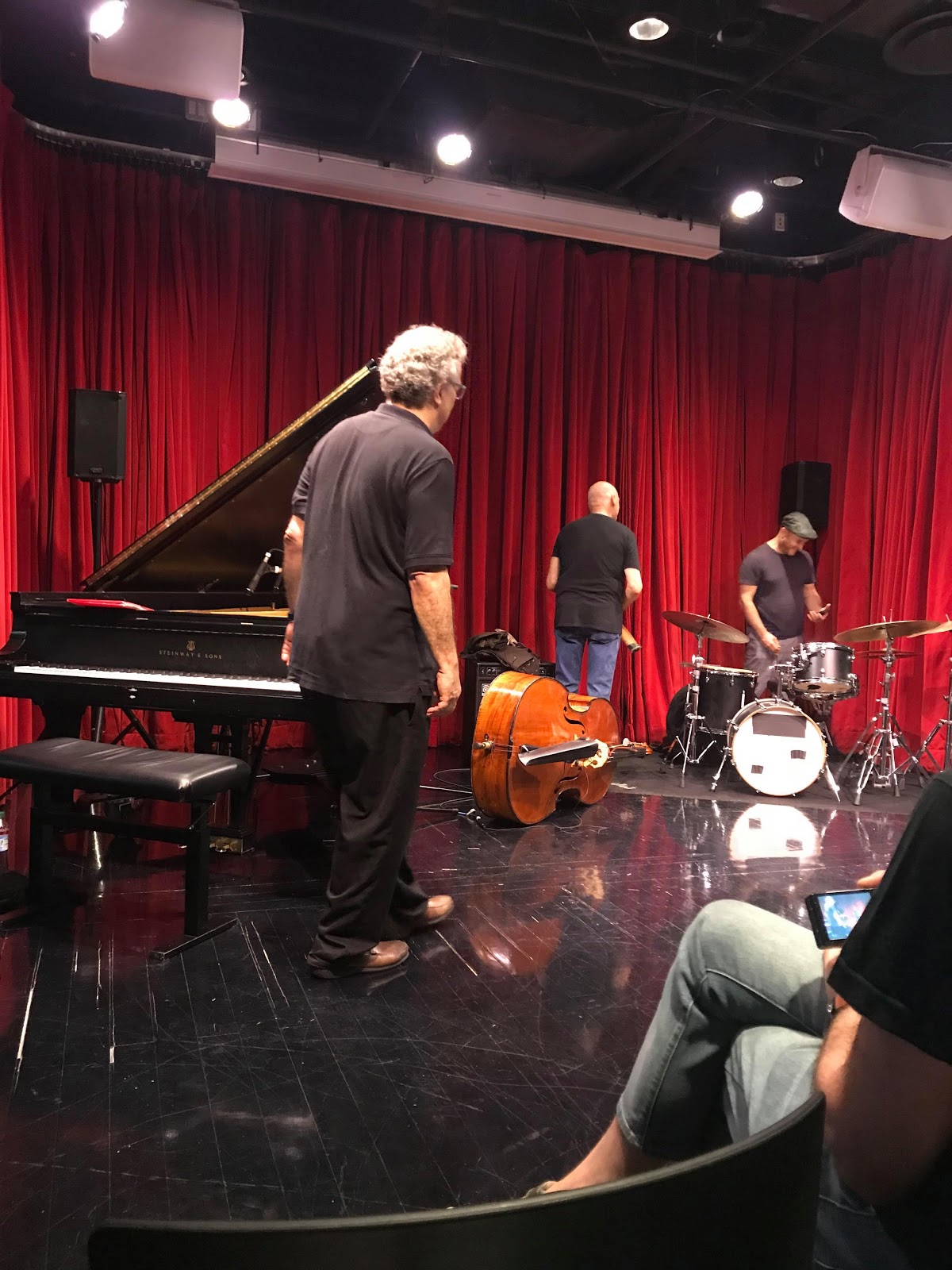
[2] Uri Caine Trio at The Stone @ Mannes | #1Summer50Concerts

WHO: Uri Caine Trio (Uri Caine, piano; Mark Helias, bass; Ben Perowsky, drums)
WHERE: The Stone at The New School
WHEN: May 29, 2019, 8:30pm

I only decided I was going to this concert about 2 hours before it actually started. And I was almost late because I spent too long looking for the nonexistent lunchbox section at TJ Maxx.

Ah, the joys of adulting.

Admittedly, I didn't know a ton about Uri Caine before showing up to his concert last night. I knew was a pianist, and that he had done a jazz Mahler album that I've been meaning to listen to for years, and that was about it. I don't know why his week-long residency at Mannes didn't get more press -- the audience was maybe half full, only about 30 people. But that didn't stop the trio from taking the audience on an adventure to remember.

After sitting down at their instruments, the players began to noodle around, as is common for the first minute or two of a jazz set. But they kept noodling longer than that until eventually Perowsky began to play in something resembling a steady four-beat, seemingly on the fly. The other two adjusted their fooling around slowly, almost imperceptibly, until eventually the entire trio was synced. It was the kind of thing that leaves the audience with jaws on the ground; I know I was in total awe.

*applause* "Quick, take a photo, my phone is dead!" *band starts to pack up* "What, now?" "Yes!" *fumbling with phone*  -- an actual conversation my date and I had yesterday

The word that pops to mind when describing the trio is deft. Their entire set was full of tact and panache, and each player performed to his fullest without detracting from the others. Even at times when the music entered a "free" state similar to the opening of the set, it seemed like the players were aware of each others' improvisations -- perhaps that explains how they always found a common beat after a few seconds, even though Caine's gaze was glued to his hands and Helias never once opened his eyes.

Caine's improvised riffs very much evoked his career as a classical composer; though I didn't know he was classically trained when I saw him, there were a few moments where I turned to my date and mouthed "Debussy? Stravinsky? Messiaen?" and she smiled and nodded in corroboration. A disciple of George Crumb, Caine's claims to fame are his reworkings of classical music: not just Mahler, but Wagner, Schumann, Mozart, and even Bach's Goldberg Variations. One riff in particular from last night's concert evoked a dreaded piano solo from Stravinsky's Petrushka.

Helias's bass lines were creatively realized, if a bit stodgy. He, unlike many jazz bassists, was equally apt with a bow as pizzicato -- his bowed walking bass was refreshing. Perowsky left no timbre unexplored on his kit, from the side of the crash cymbal to the stands of his drums. His wrists alone were something to write home about; when he wanted a crash, but not too loud, he would tense his wrist completely and essentially push the cymbal down with his stick, muffling the sound just enough.

They played for an hour without stopping. The lines between actual charts and improvised filler material were blurry; that being said, the charts ranged from up-tempo rock-with-jazz-chords-sounding romps to the usual swing patterns. The final minute consisted of a series of dominant-tonic progressions -- literally V-I-V-I etc. -- but each time he played it he added more notes until he ended up with cluster-cluster-cluster-cluster. Take that, Mozart.

If you get a chance to see Uri Caine and any cohort of his, you should jump on that opportunity. His music has charisma and charm; it's nouveau-jazz without being inaccessible. And now that I've bought a lunchbox as well, my life is complete -- except for the fact that I forgot to bring it (with my lunch inside) to work today. Sigh.

The trim matches my backpack!