Showing posts with label French. Show all posts

Saturday, March 28, 2020

Album Reviews: My Liederabend | An Album a Day Keeps the Doctor Away

You may notice I haven't posted in a few days. This week, I learned that online school is still a full-time job when you procrastinate as much as I do. Oh well.

But that doesn't mean I haven't been listening -- in fact, as assignments pile up, I've been listening more than ever!

A few nights ago, I had a particularly difficult and long-winded problem set. Long enough that I feel like I can put "reconstructing sounds of proto-Quechuan" on my resumé now. I found myself hankering for lieder, so I put on one album after another and next thing I knew, I had gone through four full albums.

I figured it prudent for my time (and yours) to do a mini-reviews post rather than four full-length posts. So here you go: a summary of my liederabend.


1. The Contrast: English Poetry in Song
Carolyn Sampson, soprano; Joseph Middleton, piano. Works by Walton, Vaughan Williams, Bridge, Quilter, and Huw Watkins. Released on BIS in February 2020.

I don't believe in God. But I do believe in Carolyn Sampson. And that's kind of the same thing.

I think there might have been a time when Carolyn Sampson was a strict early music specialist, but thankfully she's branched out. Of course, her Bach solo cantatas are still my favorite out there, but her musical sensibility applies so well to everything and anything, from heavily stylized French baroque to quirkier selections like these. I'm not going to try to find words to describe her voice, but let's just say this: I sent this album to a good friend and her reaction was (verbatim): "Who is this angel, and when can I see her live?" Joseph Middleton has that perfect touch of a pianist who specializes in lieder, never overshadowing the voice and always magnifying its drama. They are the unstoppable duo.


2. A Lesson in Love
Kate Royal, soprano; Malcolm Martineau, piano. Works by pretty much anyone you can think of. Released on Warner Classics in February 2011.

The program of this album is all over the place in the best possible way. Cabaret songs, Schumann and Brahms, folk music of America, Britain, Ireland, France, all in some of the best versions I've heard. Case in point: almost every soprano has recorded "Gretchen am Spinnrade" at some point, and Royal's rendition is easily in my top three (right up there with Carolyn Sampson). Her American music is better than most American singers -- two different takes of William Bolcom's jazz-twinged "Waitin'" give the varied program a distinct contour and a resounding cadence, and a short pastorale of Copland left me halfway to tears. Malcolm Martineau accompanies the simple British airs -- think "Danny Boy" and "O Waly, Waly" -- with just as much tender attention as the more conventionally difficult music on the program.


3. Art Songs
Fiora, soprano; Paul Hankinson, piano. Works by a lot of people, look for yourself you lazy bum. Self-released in 2002.

I'm pretty sure Fiora hasn't thought about this album in awhile. She's now a successful singer-songwriter with 600,000 monthly listeners on Spotify. But before she hit her fame in that field, she released a single album of art songs -- she's a classically trained vocalist and composer. Honestly, I was really impressed. She's got this lovely syrup to her voice, fluid and unencumbered by excessive vibrato. Her program has a couple standouts, including the opening movement from Hindemith's "Das Marienleben" (a piece that makes me regret not being a soprano) and a beautiful original setting of "The Watcher" (couldn't figure out who the poet was).


4. The Divine Muse
Mary Bevan, soprano; Joseph Middleton, piano. Works by Haydn, Schubert, and Wolf. Released on Signum Classics in January 2020.

Haydn's vocal works never get the love they deserve. Recently, I've fallen in love with Arianna a Naxos, a virtuosic monodrama depicting the scene where Theseus abandons Ariadne on the island of Naxos. Fiery, passionate, and vocally demanding, the music suits Mary Bevan's full voice perfectly, Ariadne's agony clear from her frenzied inflections. She cools significantly for selections from Wolf's vast vocal opus, the crunchy harmonies providing latticework for her calming melodic overlay. And of course, you can never go wrong with Schubert. Overall, a fabulous album -- though maybe not as fabulous as her recording of Holst's set of four songs for soprano and violin, one of my favorite pieces ever (I have a lot of favorite pieces ever).

Monday, March 16, 2020

Review: Ensemble Graindelavoix at The Met Cloisters


WHO: Ensemble Graindelavoix; Björn Schmelzer, director
WHAT: JOSQUIN Stabat mater; BROWNE Salve regina; OBRECHT Salve regina à 6; ASHWELL "Sanctus" and "Agnus Dei" from Missa Ave Maria
WHERE: Fuentidueña Chapel at The Met Cloisters
WHEN: March 7, 2020 at 3pm

What a week it's been.

I try to be an optimist when I can. So, when the Yale Glee Club's tour got canceled two hours before we were supposed to leave, I decided I'd hop down into NYC and see a couple weeks of concerts instead. Foolproof, right?

Well, I only got to three concerts before all my other tickets started getting canceled. So now I'm back in my apartment in New Haven, leaving only to make apocalyptica runs to Trader Joe's or to take long, brooding walks with friends (maintaining a distance of six feet, of course). Sigh.

But hey, more time for writing, I guess? Optimism!

Whoever curates The Cloisters' live arts series deserves a medal. I've now seen four concerts this year in the Fuentidueña Chapel, and each one has left me significantly happier than when I sat down. This one was no different. Despite the surgical-mask-clad couple next to me and the stenches of hand sanitizer and hysteria in the air, Graindelavoix provided a perfect, hour-long vacation.

And it was after-hours on a Friday too. Meryl, if you're reading this, you're a saint.
I consume a lot of Renaissance polyphony -- it's my go-to stress relief music. Each ensemble has their signature sound. Tenebrae has wobbly basses. Voces8 has no vibrato at all (AT ALL). Vox Luminis has a distinctive ensemble crescendo (it's freaky how together they are).

Grandelavoix's hallmark seems to be a heftier take on polyphony. Tempos are majestically slow (not to be confused with boring), and the singers have this sinewy, almost buzzy tone that highlights harmonic clashes. Everything is prone to ebb and flow; the tempo stretches like taffy, then slowly regains its shape. The singers each add their own ornaments into the music, almost reminiscent of traditional folk polyphonies of Corsica or Sardinia.

Conductor Björn Schmelzer's degrees are not in conducting, but rather in musicology and anthropology. His interpretations stem from interdisciplinary approaches to music, clearly well-informed by early modern history as well as medieval vocal traditions. Merely a catalyst for an ensemble that clearly trusts each other, his large gesture pulls musicality from the ensemble like a stubborn cork from a wine bottle.

God, I'm in a metaphorical mood today. Gotta let the imagination run wild when you're inside all day, I suppose.

Anyway, I get the sense that Graindelavoix doesn't make it stateside so often, but if they're near you I'd recommend you go. In the meanwhile, they have many fabulous albums -- the one that I listened to on the way back downtown was Byzantine chant and 13th-century antiphons from the Codex Cyprus, one of few medieval manuscripts surviving the French court in Nicosia, Cyprus. And, according to one of their countertenors (s/o Andrew for chatting with me for like 20min), there's a new Josquin album dropping next year to celebrate 600 years since his death. Take that, #Beethoven250!

Monday, July 29, 2019

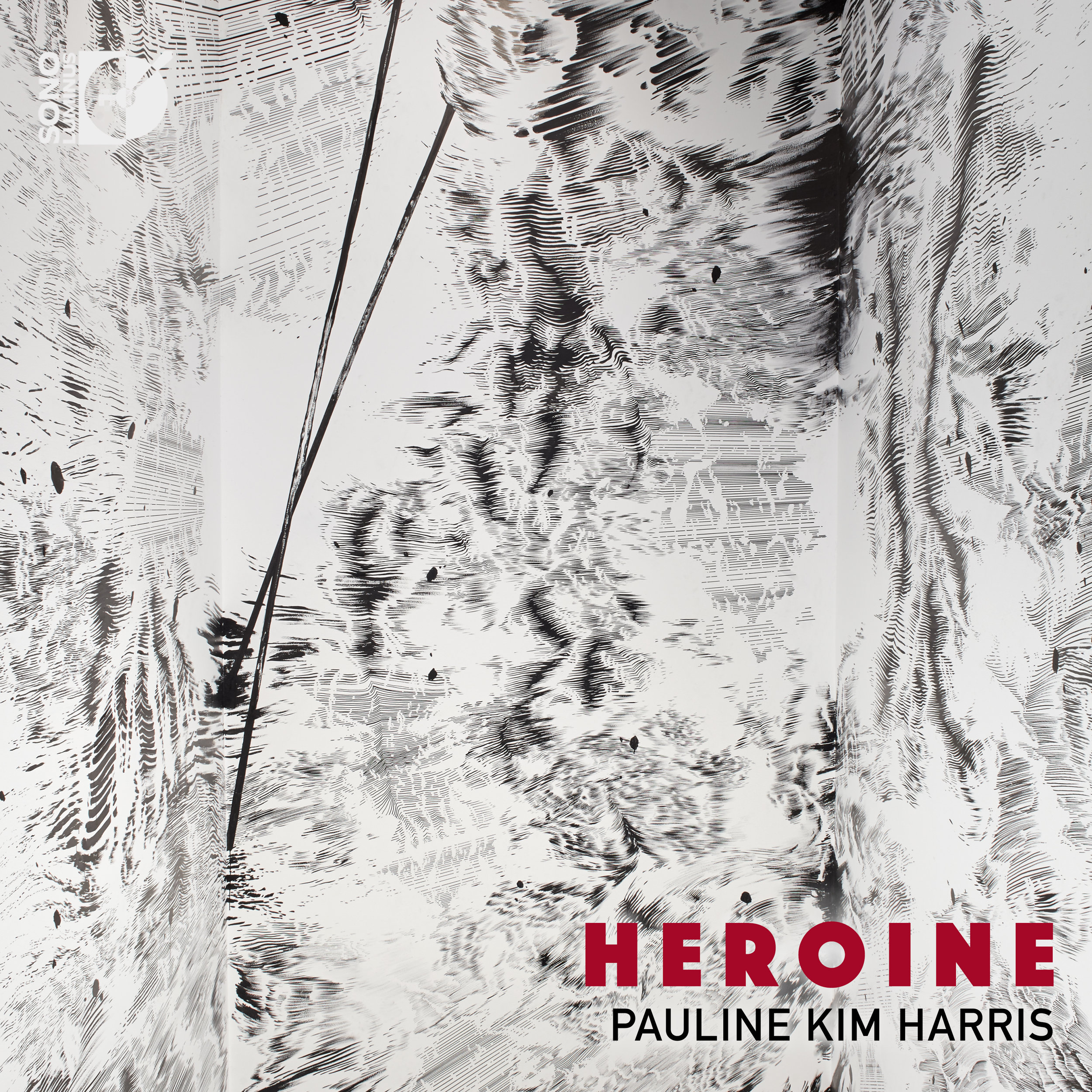
[36] Pauline Kim Harris and Spencer Topel perform original compositions at The Stone @ Mannes | #1Summer50Concerts

DSL-92235 Album Cover.jpg


WHO: Pauline Kim Harris, violin; Spencer Topel, electronics
WHAT: HARRIS/TOPEL Ambient Chaconne; Deo
WHERE: The Stone @ The New School
WHEN: July 11, 2019 at 8:30pm

In theory, going to concerts shouldn't be tiring. You get to sit. In air-conditioning, usually. Other people do the work of filling your ears with beautiful music. It's all included in the ticket price -- you just sit back and relax.

But going back to what I said a couple posts ago about not being able to turn my critic brain off -- concerts are tiring for me. In my mind, listening to music is synonymous with forming judgments. I don't see that as either a good thing or a bad thing. It just kind of is how I work.

Occasionally, though, I wish that I could lose myself in a concert. Turn off my brain for a few minutes.

I'm not going to tell you that I succeeded. But I came damn close at this concert.

I'm usually not a huge consumer of ambient music, but there are some great classical-ambient crossovers. I think that the Harris/Topel duet is going to join the greats of the genre when their new album comes out in September. Armed with only a violin, a microphone, and a soundboard, the two presented a refreshing take on Bach (and also another composer -- I'll explain in a second).

I can't tell you a whole lot about the music itself. It moved slowly, sometimes changing so slightly over such a long period of time that I couldn't detect the transformation until after it had already happened. There were no jagged new-music-characteristic jump scares; just the sweet tone of Harris's violin, looped and amplified and augmented.

The first piece, Ambient Chaconne, was a transformation of the famous chaconne from Bach's D minor violin partita; bits and pieces were recognizable throughout, but the already-long piece was lengthened from 15 minutes to almost half an hour with a range of clever electronic fillers. (Side note: I turned to my trumpet-playing friend after the performance and asked if he'd heard the original chaconne. Blank stare.)

The second piece was based on a Deo gratias -- I heard the composer as Lachenmann, my friends heard Bach. Neither of those people wrote Deo gratias settings. Phooey. But it was great.

Update: I just looked at the album's liner notes. It was Ockeghem's Deo gratias. I think I was closer.

You can pre-order the album, Heroine, here, or just wait until September 27, when it will hopefully be available on Spotify. Fingers crossed.

EDIT: It's September 27, and the album dropped and is just as good as the live version was! 

Saturday, July 20, 2019

[31] Duplexity: Elissa Cassini and Ashley Bathgate at National Sawdust | #1Summer50Concerts

The piece is based on Bach's fourth cello suite -- see the resemblance?

WHO: Elissa Cassini, violin & Ashley Bathgate, cello
WHAT: WINKELMAN Rondo with a Janus Head; SAARIAHO Aure; NORMAN For Ashley; WINKELMAN Ciaccona; RAVEL Sonata for Violin and Cello
WHERE: National Sawdust
WHEN: June 29, 2019 at 7:00pm

I had a depressing conversation with another music critic friend the other day -- the topic was a syndrome that I like to call "critic brain." After reviewing 30 concerts, I feel jaded and hypercritical, like I never really enjoy anything to its full potential. In other words, I have started to wonder whether anything can really wow me anymore.

But every now and then a concert sets me straight, and makes me realize that my standards (which generally run a little too high) can be met. Can you guess what I'm going to say about Elissa and Ashley?

Yeah, they killed it. Like, jaw-on-the-floor.

Cassini has been spending the past couple years touring as a solo duo, so to speak. She teams up with anyone and everyone -- string players, non-string players, classical, jazz, world music -- to bring the gospel of duo music to her audience. And, what's more, she tries to engage with her audiences -- that's right, more audience participation! (Although this particular performance was not so heavy on the repeat-after-me songs I've been dishing on throughout the summer.)

Her partner this time was Ashley Bathgate, current cellist of the Bang on a Can All-Stars (one of NYC's first and foremost new music ensembles). Bathgate has always been a force of nature; critics went crazy for her first album, a 2016 recording of six new works for solo cello by Australian composer Kate Moore. She was actually what drew me to this concert in the first place, quite frankly.


But both Cassini and Bathgate played astoundingly well. They are longtime friends, and it just sort of felt like we were sitting in on another Saturday-night jam session. Smiley and energetic, the duo were in sync to the millisecond -- the NY premiere of Helena Winkelman's highly technical Rondo with a Janus Head showed off their two-as-one synergy, while Kaija Saariaho's Aure showed each's individual musical prowess a bit more.

The two performers each channeled Bach through a pairing of solo movements; the first was a Bathgate-commissioned piece by LA native Andrew Norman, the second, another NY Premiere by Helena Winkelman. The Norman was particularly cool, taking one rhythmic module and modifying it by microtones throughout. The concert finished with the Ravel duo which is sort of proto-modernist -- it uses a lot of the same harmonic language as did Andrew Norman or Kaija Saariaho.

I don't know. I feel like I'm not saying anything particularly inspiring about this concert. But I have to emphasize that it was truly fantastic. Maybe I just remember that it was fantastic and don't remember a ton of the details. But it was amazing. Trust me.

Friday, June 28, 2019

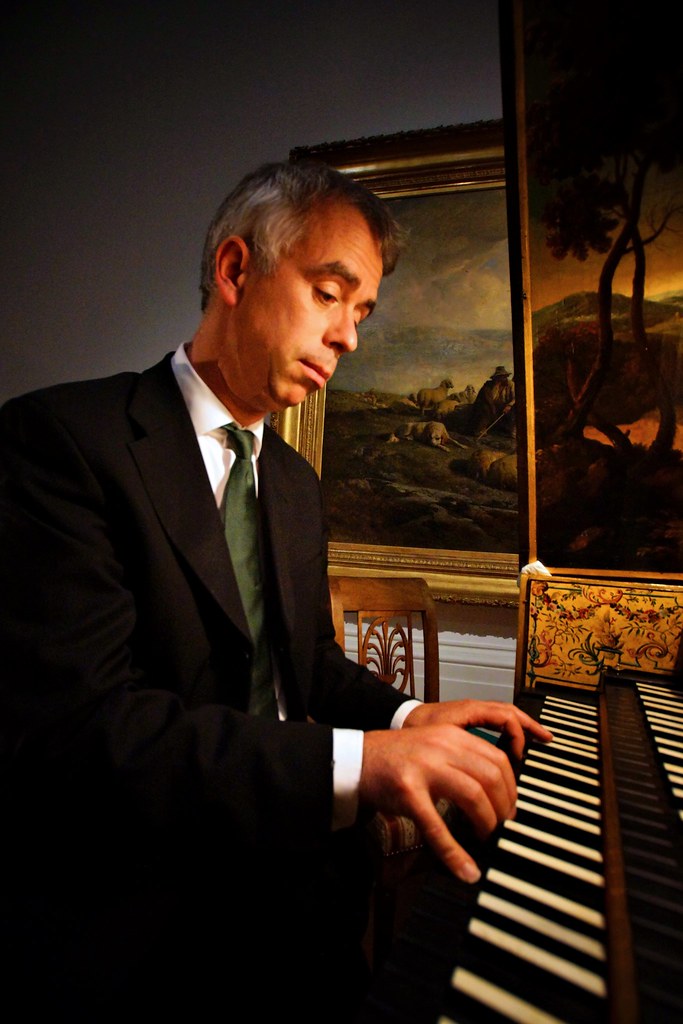
[22] Pierre Hantaï plays Bach's Goldberg Variations and more at the DiMenna Center | #1Summer50Concerts

                                            Image result for pierre hantai

WHO: Pierre Hantaï, harpsichord
WHAT: BYRD Will Yow Walke the Woods soe Wylde; BACH Prelude and Fugue in d minor; BACH English Suite in a minor; BACH Goldberg Variations
WHERE: DiMenna Center for Classical Music
WHEN: June 19, 2019, 7:30pm

I was SO excited when I heard that the Orchestra of St. Luke's was using June as a Bach celebration month. They had a couple of really interesting programs at Carnegie earlier this summer -- one of Bach orchestral music, one of cantatas -- and I was looking forward to seeing them, until one day I called their box office to get tickets:

ME: Hi, I'd like one student ticket to tonight's concert.

OSL REP: That'll be $65.

ME: *spit take, hang up*

In the end, I decided that my budget allowed me to go to only one of OSL's Bach presentations, and that decision was a no-brainer. Pierre Hantaï is one of the world's best harpsichordists. The Goldberg Variations is one of the world's best pieces. The concert was cheaper than any of the programs OSL was putting on at Carnegie. Win-win-win.

I was stupid. I didn't buy tickets ahead of time, and when we got to DiMenna the tickets were sold out. Even though my brother and I were second in the waitlist line, my heart was still pounding. Hantaï himself came upstairs for a smoke break before the concert started; it took every ounce of self-restraint I had not to approach him and beg on my hands and knees for a ticket. But I played it cool. And we got tickets, along with the 20-some Hunter College students whose professor had forgotten to make reservations even though seeing this performance was required to pass their class.

$40 for the Goldberg Variations seemed like a fair price, but apparently Hantaï didn't think so. He announced a completely separate program for the first half of his concert -- apparently, he likes to "meet ze harpsichord" before deciding on which pieces to pick out of his three-inch black high school binder. He started with the only non-Bach work on the program, citing William Byrd as a "direct predecessor of Bach's," which is a characterization I don't necessarily buy, but whatever. The Byrd theme and variations was fabulous, reserved yet supremely musical.

The prelude, fugue, and suite that followed let Hantaï put his distinctly French musical sensibilities on display. The flow was rhythmic, though not mathematical, and in those rare moments where strict rhythmic accuracy was not appropriate, Hantaï's flourishes were regal and well-organized.

As for Goldberg: of course it's a tremendous piece, but it's also LONG. Hantaï's fingers began to run out of steam in the middle -- an obvious wrong note every now and then. But his brain was in it the whole time. Even the occasional wrong note was masked by his cogent interpretation. I'm not going to mention any specific variations, because I counted about three before I lost track until the last variation, which is my favorite.

Hantaï feels like the kind of guy who can adapt to any environment. I mean, he doesn't get to bring his own instrument, and there's much more variation in the mechanics of a harpsichord than in, say, a piano. Harpsichords can have two separate keyboards stacked upon one another, and any number of levers and buttons to press to achieve the different timbres that it can't get from the player's touch. I don't know whether Hantaï spent 10 minutes or 10 hours learning the ins and outs of the DiMenna harpsichord (a beautifully decorated double-manual instrument), but he played it as if it were an old friend.

Hantaï's masterful performance was accompanied by lighting design by Burke Brown. I was expecting the lighting to be really loud -- a couple months ago, I saw pianist-composer-electronics artist Kelly Moran, whose set was accompanied by abstract animations in neon pinks and greens and blues, which was beautiful but also a lot to take in. Rather than a barrage to the eyes, the lighting read more as a mood intensifier, soft argyles of color on the wooden-slat back wall of the concert hall. Most importantly, the music came first.

I know a lot of people who say they unilaterally don't like the harpsichord because it "sounds like mosquitoes" or something like that. I urge those people to get out and listen to a real harpsichordist play a really good harpsichord. A good player knows how to take advantage of the harpsichord to its fullest, and Hantaï did just that. Not a single tone was left unexplored on that instrument. There may be a new Goldberg king in town -- move over, Glenn Gould.

Image result for glenn gould
I'm just kidding Glenn, I love you

Monday, June 17, 2019

[16] Camille Bertault Quartet and Friends at Birdland | # 1Summer50Concerts


WHO: Camille Bertault Quartet and Friends
WHAT: "Pas de Géant" Project
WHEN: Wednesday, June 12, 9:45pm

"You knew you were coming to see jazz, but you didn't know you were coming to see CRAZY JAZZ!!!!!"

And some crazy jazz was exactly what I needed on that night.

For the first two weeks of this project, I was sticking to a very strict regimen: one concert per day, two on Saturdays, a matinee on Sundays so I can grocery shop and meal prep for the week.

I'm glad to say I didn't fully burn out. But last Sunday, I decided that I needed to take a couple of concert-free days. One night I stayed in and did nothing (I mean, I tried to blog, but that didn't work so well). The next night, I went for a stroll with a professor. And Wednesday, I finally went back to the concert scene, but not before a lengthy family dinner.

Just goes to show you that you CAN get tired of things you love. I mean, that shouldn't surprise me, but sometimes I forget.

Anyway, this show was the perfect potpourri to get me back in the swing of things. Not that I expected it to be a potpourri -- I've seen many of Bertault's YouTube videos, starting with the viral one in which she scats along to the solo from Giant Steps ("Pas de Géant" in French -- that's kind of her thing), so I know she knows her way around the classical canon. She's scatted the first variation of Goldberg, she's done Doctor Gradus ad Parnassum from Debussy's Children's Corner suite, all sorts of stuff. So naturally, after a short original song for her introduction, she launched into a "tribute track" to the composers who had influenced her over the years; apparently, her father started her on piano at the ripe old age of three years old.

"Un, deux, un deux trois quatre"

And she launches into Goldberg at...help me here Moranis!

                                         Image result for ludicrous speed

Bertault had obviously done this a million times before. Her pianist, Vitor Gonçalves, looked petrified, but kept his cool to play a musically and technically impressive Bach. She followed with a series of mutations on the first movement of Ravel's Tombeau de Couperin, and then a whole song based on Satie's first Gymnopédie.

So at this point we know she does classical well. She goes into a short phase of French standards, including a Serge Gainsbourg song that starts, "I drink regularly to forget my wife's friends." Charming. That one ended up with a stone-cold sober Bertault lying on the floor "drunkenly" babbling on in French about all of her problems, and eventually falling asleep on the ground -- I gather the band was a group of New York ringers, because they seemed bewildered.

Almost as bewildered as when Bertault shooed them offstage after that chart, and invited up a piano professor from the Manhattan School of Music (god help me if I can figure out which one -- Solomon Mikowski rings a bell?) who is apparently a Birdland regular. And they played. Four-hands. A movement of Ravel's Mother Goose suite. He was sightreading. She hadn't practiced. And you know what? It was fantastic. More fun was had in that room in those four minutes than at the entire Renee Rosnes show I had seen the previous week.

Please someone tell me the name of this bassist!

The combo came back on after that -- I should take this opportunity to mention that the combo she had behind her was AMAZING. Though I'm pretty sure the trio was hired for the occasion, they knew the charts well, looking up and smiling at each other as if they were....having fun? GASP! Gonçalves's solos were the perfect character foils to Bertault's; where her solos were restricted by the technical capabilities of the human voice (even a voice as agile as Bertault's has its limits) his picked up slack, and vice versa. The bassist, whose name I couldn't catch from the stage (I think I might have heard Eduardo? Google produced no results for me) had a smirk on his face that showed he knew EXACTLY what he was doing the whole time. And the drummer, John Hadfield, was equally at home in jazz and bossa styles -- Bertault is a self-professed Brazilian music obsessor -- and his playing had the perfect balance of reliability and pizzazz.

Speaking of Brazilian music, she kicked her combo off AGAIN and brought on guitarist Diego Figueiredo, with whom she did the Carmen Miranda Radio Days bossa classic Tico-Tico no Fubá. Bertault and Figueiredo were doing a show at Birdland the next night -- I seriously considered canceling my plans and going, their rendition was so fantastic.

The moral of the story is, next time Camille Bertault is in NYC, get your butt on out to see her. Whether she's solo with a pianist or guitarist, or with a larger group, she's incredibly fun to watch, not to mention a fabulous singer. Besides which, you basically get three shows for the price of one!

Wednesday, June 12, 2019

[12] Stefan Jackiw, Yoonah Kim, Zlatomir Fung, and Conrad Tao play Quartet for the End of Time at Bargemusic | #1Summer50Concerts

Note: that boat is not Bargemusic

WHO: Stefan Jackiw, violin; Yoonah Kim, clarinet; Zlatomir Fung, cello; Conrad Tao, piano
WHAT: Quatuor pour la fin du temps (Quartet for the End of Time), by Olivier Messiaen
WHERE: Bargemusic
WHEN: June 7, 2019, 7:00pm

I would like to start by saying that Conrad Tao showed up to his own concert in knee-length black capri-chinos, which is probably the biggest power move I've ever witnessed.

And now back to your regularly scheduled programming.

Bargemusic is another one of these intimate Brooklyn concert venues that makes you go "awwwwww." Right outside of the joggers-with-strollers haven that is Brooklyn Bridge Park, just down the street from the snaking lines at competing pizzerias Juliana's and Grimaldi's, is a beautiful dock with possibly the most phenomenal, up-close view of the bridges on either side of the East River (pictured above). Tethered to the dock is usually a smattering of party boats, but this Friday night all of the party boats were off loaded with drunken twenty-somethings. Tonight there was only a small white boat with an abandoned ceiling deck and a dent on every surface. That, friends, is Bargemusic.

Inside, visitors find a single, wood-paneled room with a folding table at the front for ticket sales. We slipped in behind a few tourists who were very confused at the fact that the upper deck wasn't used for concertizing (because, after all, grand pianos love nothing more than humidity and unpredictable rain-storms), and took our seats.

I don't usually go crazy for front-row seats -- as I've mentioned in a couple of my previous reviews, I like to hear the sound after it's had a chance to blend in the room. But for some reason, it seemed right for this concert.

Twinning + twin bridges

The musicians were screwing around off to the side of the stage, the only place at Bargemusic that could even mildly be construed as a "backstage area." I use quotation marks because it essentially looks like a mudroom, but without a door or walls -- a couple coat hangers and a couple benches, and the staircase (okay, it's actually like one stair) up to the stage.

For those of you who don't know, Messiaen was drafted into the French army in WWII; he was captured at Verdun and taken to a prisoner of war camp in Germany. Luckily, he had already made something of a name for himself in the musical world, so the army gave him special treatment -- he was given a composition studio with a piano. He wrote the Quatuor entirely at the camp, and it was premiered by him and three of his fellow prisoners outdoors on a rainy January evening.

This is a piece that tests not only every facet of your technique -- how fast you can play, how slow you can play, how in-between you can play -- but first and foremost how much soul and anguish you can impart into your playing. There is nothing uplifting about the Quatuor; even the most beautiful moments are sodden with dissonance and pain.

I can barely put into words the performance that these four phenomenal musicians put forth. At the end of the concerts, my friends and I could do nothing more than look at each other, tears in our eyes, and say, "Wow."

The quartet imparted every bit of distraught passion that Messiaen wrote into the score -- and then some -- into that hour-ish of playing. They were perfectly zoned into each other the whole time, even when they weren't playing. Yoonah Kim's solo clarinet movement (Abyss of the Birds) was extreme in the most wonderful of ways. The infamously long pianissisimo (very very soft) to fortissisimo (very very loud) notes lasted upwards of 30 seconds (thanks to circular breathing -- pushing air out of your mouth while taking more air in through your nose), starting so imperceptibly that I thought her instrument had broken right in front of us on stage.

The leap-of-faith climax-to-meditation moment about two minutes from the end of Zlatomir Fung's solo movement was possibly the most delicate moment of music I have heard so far this summer, save for the congruent moment in Stefan Jackiw's movement -- it's a tie. And all the while, Conrad Tao, without a solo movement for himself, in turn accompanied dutifully and tastefully and shone in his own right, his smart touch ekeing every last timbre out of Bargemusic's Steinway.

I wish I could do justice to this performance with words. But I can't. All I can say is that somehow, everything felt right. The waves sloshing against the dock, the boat rocking at what seemed to be choreographed moments (and I say that as someone who gets violently seasick), even the EDM track that was wafting through the window from afar as the final notes of the final movement sounded. June 7th, 2019, from 7pm to 8:10pm, was a perfect moment.

EDIT: Don't believe me? Cellist Zlatomir Fung just won the XIV International Tchaikovsky Competition.

Friday, June 7, 2019

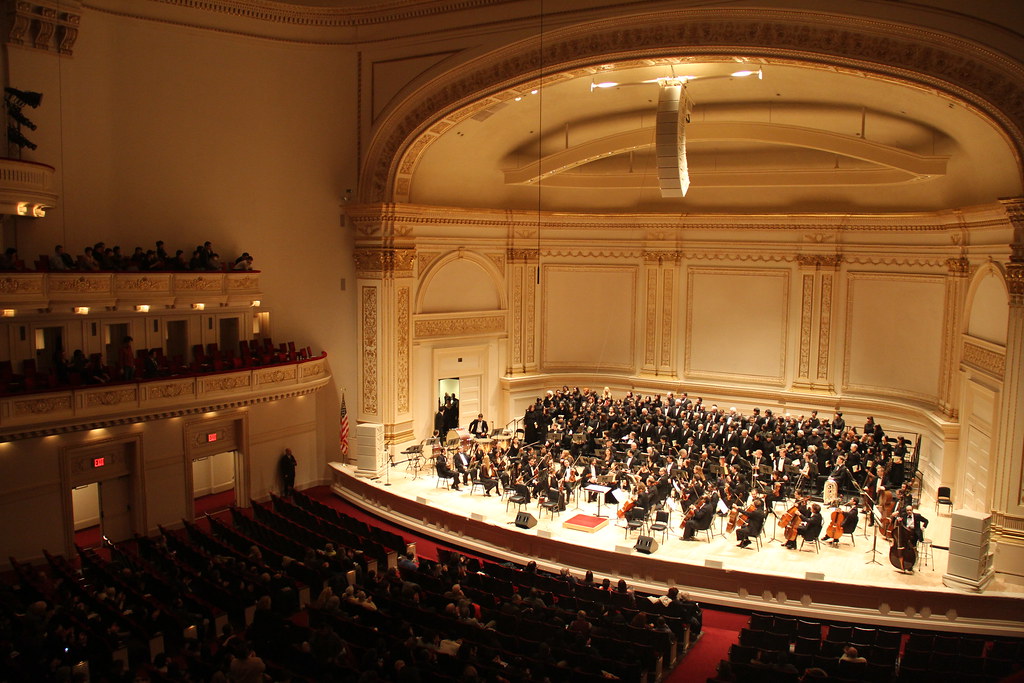
[8] The MET Orchestra and Isabel Leonard perform Debussy, Dutilleux, and Ravel | #1Summer50Concerts


Image result for carnegie hall


WHAT: DEBUSSY La mer; DUTILLEUX Le temps l'horloge; RAVEL Shéhérazade; RAVEL Suite No. 2 from Daphnis and Chloé
WHERE: Carnegie Hall
WHEN: June 3, 2019, 7:30pm

This past March, I was lucky enough to go see Richard Wagner's Die Walküre at the Metropolitan Opera. For those of you who don't know, Wagner operas are often all-day affairs, especially at the Met where intermissions are 30 minutes long. The show started at noon; I eventually walked out of the opera house at 5:10pm. The first thing that ran through my head after five hours of watching ladies in breastplates and horns howl their hearts out (yes, really):

"Gee, I want to go see another opera tonight!"

The fact that I had to be awake and singing in New Haven (about a 2hr train ride) at 9am the next day notwithstanding, I bought my standing room ticket for the 8:30pm showing of Mozart's La clemenza di Tito, hiked to the top of the Metropolitan Opera House (what is it with me and concerts that require climbing?) and stood at the top for the full two hours. And I loved every second of it.

Yeah, you could say I'm obsessed. Or you could say that I'm a passionate young adult who is invigorated by the intellectual stimulation that opera lends its listeners.

You know, I just read over that again. Let's just go with obsessed.

The most reliable part of the Metropolitan Opera is the orchestra. No matter if it's Mozart or Bartók, the MET orchestra always has their act together, whether they're in hour six of a Wagner or are playing the second show in a double-header.

Unlike most other American opera houses, the MET ends their season early (their last production was in the first week of May or so) because the MET orchestra gives a three-concert series to finish Carnegie Hall's year. Usually, at least one of the concerts has something to do with opera -- usually, they'll invite a couple of MET regulars to sing with the orchestra.

For this concert, the soloist was soprano Isabel Leonard, coming hot off of her recent smash success in Poulenc's Dialogues of the Carmelites (think French Revolution, but also nuns, and then everyone dies). I had the opportunity to see her as Mélisande in Debussy's Pelléas et Mélisande (think love affair, and then everyone dies) earlier this year, and my opinion was pretty ambivalent -- her performance was perfectly fine, but was overshadowed by the sub-par performance of tenor Paul Appleby as Pelléas and the stellar performance of baritone Kyle Ketelsen as Golaud.

I'm sure some French pop star has ripped off the name of that last Dutilleux song...

I think she must have been having a bad night at that performance, because she knocked this one out of the park. Her voice floated easily above the orchestra -- not quite unmoored, but certainly well-lodged in the fantasy realm that French music craves. Gossamer, never heavy, and simply sublime, even in a highly technical passage like at the end of the Dutilleux. The start of her Ravel was also tremendous -- strong, but also supple and soft.

The orchestra's La mer was admittedly mediocre -- it felt like none of the players were taking the responsibility to make the music that Yannick was so expressively conducting. It almost seemed that the orchestra didn't know how to be in the limelight, a common ailment with opera orchestras, though not one that usually plagues the MET.

Luckily, that was just a fluke. Behind Leonard, they were able to spend the next two pieces recalibrating, and their Daphnis and Chloe was absolutely stunning. Special recognition to principal flautist Chelsea Knox, whose solos in both Ravel pieces were about as close to perfect as one can get. Also, she was like 23 when she won the principal spot with the MET orchestra. Feel inadequate yet?

If you haven't been to the MET, go. Standing room tickets are $20, and other tickets occasionally start at $35. And while you're there, I have a game that I like to play, developed with one of my best friends from school. The hoity-toity people at the MET like to spectate the in-house restaurant, which serves one course at each intermission. Stand one or two levels up on the terraces that overlook the restaurant, then try to come up with a backstory for each person. There are only so many business-people you can go through before you decide which of the necktie-wearing old people in the restaurant is the next Walter White.