Showing posts with label cello. Show all posts

Wednesday, May 6, 2020

Collective Corona Memory | Pandemic Musings

Igor Levit on Twitter: "Heute Abend wieder: Livestream Hauskonzert ...
Igor Levit's recording setup
I've had a lot of time to think lately. Here are some of my thoughts. Disclaimer: they're not so optimistic.

Every night since the world started quarantining, German-Russian pianist Igor Levit has been reliably livestreaming short Twitter concerts from the living room of his tiny Munich apartment. Nothing extravagant, just a piano, an iPhone whose microphone occasionally cuts out, and a musician determined to improve someone’s—anyone’s—day. On one evening, Brahms’s left-hand arrangement of the Bach Chaconne. On another, some short selections of Schubert. To celebrate his 32nd straight day of streaming, Levit played Beethoven’s bizarre 32nd piano sonata for nearly 20,000 viewers.

Some musicians, like Levit, have been alarmingly productive in quarantine; others (myself included) not so much. As COVID-19 wiped my calendar cleaner than I’d seen it since middle school (from 20 hours of orchestra, choir, and opera rehearsal per week to a big, fat zero), I started to panic . But my solace fell in watching others make the music that I couldn’t; Levit and his colleagues came to the rescue, helping me to have the best of all possible quarantines in this best of all possible worlds (as my Grandpa Paul would have said, “How do you like them apples, Leibniz?”).

Concert halls all over the world are shuttered for the foreseeable future. Musical organizations lay on the verge of financial ruin, trying to retain their solvency without crucial revenue from the final three months of their seasons. Musicians are doing their best to make ends meet even though the market for their services has suddenly dried up.

And yet, one could argue that there is no better time to be a consumer of classical music. As physical concert halls close their doors, virtual concert halls have opened their Zoom rooms, scratching audiences’ itch for live music. Scroll through Facebook on any given day and you’ll find musical gems scattered among the fear and apprehension. A violinist friend playing a minute of a Kesha cover to a backing track. A full rebroadcast from a summer festival whose 2020 iteration has already been canceled. A piece of Renaissance polyphony rewritten as a handwashing song.

A favorite of mine from Singapore's Red Dot Baroque

Like everyone, I’m trying my best to live “in the moment” right now. Yet I can’t help but wonder how this crazy time will live on in the collective memories of musicians and musical consumers alike. People are more willing than ever to embrace the Internet as a means of sharing their musical talents with the world. But, despite this zeal, distanced live music now feels less like a serendipitous outpouring of artistic inspiration than a manifestation of crisis.

Take Igor Levit. I’ve been watching his livestreams as often as I can make the time. The idea of someone playing music for me in real time brings me some meaningful amount of solace as I’m quarantined alone in my apartment. But after COVID-19 is gone, I’ll probably never reach for those archived recordings. Why would I choose Levit recorded on an iPhone when I could listen to any of his masterfully engineered, “just one more take” studio albums?

Levit is doing the best he can in the face of crisis. But right now, we’re measuring “quality” on a different scale than usual. The mere existence of live performances supersedes our conventional notions of musical quality — who cares if these performances aren’t studio- or stage-quality as long as I can watch them from my living room? But five, ten, twenty years from now, once COVID is but a section in our history textbooks and we have renewed access to the live music we currently lack, will anyone remember the art that we are now finding so meaningful, or will we see it as compromised and unpolished? Will anyone want to remember that art, let alone anything of this traumatic era?

We’ve been continually looking to the Spanish flu of 1918 as a reference point. But another tragedy of the time offers damning clues as to what might happen to corona art. In 1914, at the start of World War I, the British army sent Harold Triggs to fight in the trenches of Ypres, Belgium. He brought with him a modified cello, little more than a hollow box outfitted with four strings and an endpin. The instrument brought joy to those rendered listless by an otherwise bleak battle theater. But after the war, it sat untouched on a luthier’s shelf for a hundred years before British cellist Stephen Isserlis used it to record part of an album of WWI-era music. Even then, the trench cello was merely a tool to recreate the historical soundscape of a generation that had since passed — no one who was alive during The Great War wanted to revive music that was so inexorably associated with trauma, loss, and suffering.


The trench cello may have been a viable wartime alternative to a Stradivari, but once the guns fell silent this ingenious instrument almost instantaneously became nothing but an artifact. I’m worried the same will happen for hundreds of innovative COVID-era projects, simply because they were realized in a time when resources were thin. Large-scale “corona” commissioning projects. Daily pajama-clad practice sessions from isolation. Multi-tracked videos captioned “Day __ in Quarantine.” All the tidbits that brought the world some semblance of light in a dark time, forgotten and gathering cyber-dust on a Facebook server in Altoona, Iowa.

The massive amounts of musical content that I’ve seen in the last six weeks have made me laugh, cry, ooh, and aah. After this period is over, of course I’m going to remember the suffering, the loss. But I want to remember the silver linings, too. And COVID-music is perhaps the biggest silver lining I’ve seen so far.

Everything from these few months will be labeled “corona,” whether it’s culture, politics, or cooking (who could forget when the world turned to sourdough for comfort?). It’s up to future us whether we probe beyond that label into the content itself.

Sunday, March 22, 2020

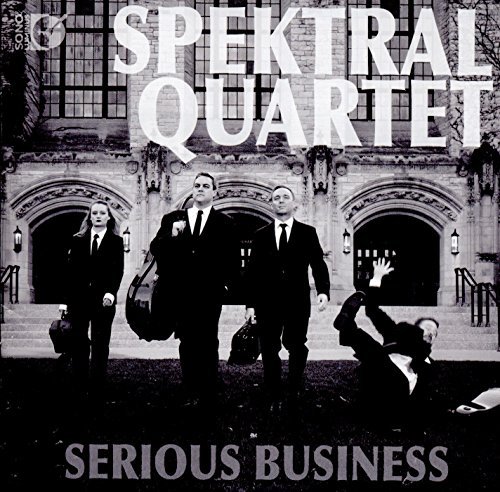
Album Review: "Serious Business" by Spektral Quartet | An Album a Day Keeps the Doctor Away

Image result for spektral serious business
And I oop--

WHO:
 Spektral Quartet
WHAT: New works by Sky Macklay, David Reminick, and Chris Fisher-Lochhead, plus a Haydn quartet
RELEASED: January 2016
LABEL: Sono Luminus

Challenge: I'm going to write this post before my oxtails come out of the pressure cooker in half an hour. For those of you who care: onions, garlic, stock, and red wine (a little bit for the oxtails, a little bit for me 😉). That's it.

Classical music is too damn serious. Have you ever dropped your program during a piece? People will literally look at you as if they want to throw you off a bridge.

Classical music hasn't always been so serious -- you can thank Richard Wagner for that -- but rarely is it overtly funny (barring opera buffa, of course). Haydn had his moments, even Mozart and Beethoven stepped into parody-land once in awhile.

For this album, The Spektral Quartet asked three composers to try their hands at "funny music" with wildly different results. Sky Macklay composed a piece that consists entirely of cadences -- Many Many Cadences as the title so creatively describes. The cadence, of course, functions as a tonal stabilizer. Macklay forces the quartet to hop between cadences with such speed that any sense of stability is lost, even though there is theoretically a "stabilization" every few seconds.

David Reminick chose absurdist poetry as his starting point; The Ancestral Mousetrap requires the quartet to sing a libretto by poet Russell Edson. They sing very well, proving my theory that instrumentalists are sometimes better singers than singers. One of the members sounds like Elvis Costello -- whoever does the bulk of the singing on the 4th movement.

The final premiere on the album, Chris Fisher-Lochhead's Hack, uses the instruments of the quartet to model the sounds produced by standup comedians during their routines. My linguist brain was intrigued. On the album, it doesn't evoke human speech so much, but it's so cool when they map the composition over the comedian's bit. Either way, cool piece.

And then in the middle of all this fun new music came the Haydn "Joke" quartet. I've played it. It's funny. But also, I kind of wish they had commissioned another new piece? I'm not exactly complaining, I'm always in favor of a good performance of a good Haydn quartet. But it also seemed a touch out of place.

Anyway, great album. Go listen. My oxtails are calling.

Wednesday, October 16, 2019

Review: Dover Quartet and Emanuel Ax at Zankel Hall (and a few updates)

Carnegie didn't have a photographer for the concert, so I'm reusing photos from Dover's
Caramoor concert this summer. Sue me. (Actually, please please don't.) [PC: Gabe Palacio]

WHO: Dover Quartet; Emanuel Ax, piano
WHAT: BRITTEN String Quartet No. 1; BRAHMS String Quartet No. 3; SCHUMANN Piano Quintet
WHERE: Zankel Hall @ Carnegie
WHEN: October 15, 2019 at 7:30pm

First update: I'm on Twitter now! Follow me at https://twitter.com/EmeryKerekes to keep up with all of CMG's adventures!

Second update: I made it to October break in (more or less) one piece. And you know what that means: another concert binge.

I know I've been making noise about a ten-concerts-in-five-days October blitz. But a couple weeks ago, after one too many nights staying up until 3am doing schoolwork, I looked at the list of ten concerts I had planned and only one thought popped into my head:

"This feels like a bad idea."

So I'm only going to seven (maybe eight) concerts this break. And I'm going to blog about all of them, but it's not going to be a formal concert blitz. I'm just going to blog for fun. You know, like a normal blogger -- quality over quantity (what the hell was I on when I thought up of #1Summer50Concerts?). The reviews will come out over the next few weeks.

I love finding ways to put off schoolwork. So, a few weeks ago, when I should have been writing papers, I reached out on a whim to the Carnegie press office, asking if they had any extra tickets for this particular concert. They were so nice, but the gist of what they said was: "Get in line."

Yesterday morning, literally the day of the concert, I got the coveted email: there's an extra ticket, it's yours if you want it, just let me know. I squealed. My breakfast date (Sarah, I know you're reading this) rolled her eyes and didn't talk to me for the rest of the meal.

I dropped my alternate concert plans (we all have those, don't we?) and booked it to Carnegie as soon as my train got in (twenty minutes late, by the way). I sat down and looked around; for the first time in who knows how long, I didn't recognize a single other person in the audience.

I see good concerts all the time. I see great concerts less often, but still regularly. But only once in a while do I see a concert and think, "Wow, that was stupid good."

Well, the Dovers are stupid good.

 PC: Carlin Ma

Okay, confession time. You may recall that I reviewed the Dover Quartet this summer for Opera News, but I couldn't really tell you guys what I thought because I didn't want to give the magazine old news. Well, that review is now in print, so I can say whatever I want. So full disclosure: I've known that the Dover Quartet was fantastic for, like, four months now. But now I can finally say it loud and proud: I'm a diehard Dover fan.

Of course, I'm glad I got to see this whole program. But I'm especially glad that I got to hear the Dovers' take on Britten. Outlandish but not wholly unfollowable, Britten's first quartet proved the perfect canvas for Dover to release their inner cheekiness. The quartet managed to invoke that dry British sense of humor in a way that was full, unfettered, and most importantly, entertaining. The tender violin duets of the first movement were so theatrically interrupted by bawdy prestos that there may as well have been a laugh track. Cellist Camden Shaw's eyebrows tracked the satire through the off-kilter scherzo. The slow movement highlighted violist Milena Pájaro-van de Stadt's flawless playing (to quote the older European gentleman sitting next to me: "Viola playing doesn't get much better than that!"). And the blazing three-minute finale brought everything to a close with adequate pomp and circumstance.

Oh yeah, the Brahms was also great. But like...the Britten.

This is how Barber originally wrote the Adagio for Strings before revising it
twice (once for string orchestra, once for choir). I think it's best for quartet.

And then there was the Schumann. It takes one hell of a quartet to be a match for Emanuel Ax, and I've seen instances where Ax plays with a chamber group that is most certainly not up to his level. But this was perfect. Dover is very new-school, Ax is very old-school, and the collaboration let each explore aspects of the other's playing. The quartet was a little bit warmer and rounder; Ax kept his crisp touch, but was lighter on the pedal than usual. The result was a harmonious tone that could only be described not as the Dover Quartet, not as Emanuel Ax, but as "the Dover Quartet with Emanuel Ax."

The performance was so fantastic that I barely noticed the faint, but ever-present sound of the NQRW trains roaring past the underground Zankel Hall. Whose bright idea was that, again?

Sunday, August 25, 2019

[50] Mostly Mozart presents Takács Quartet at Alice Tully Hall | #1Summer50Concerts

Me, finishing something I started for the first time, like, ever

WHO: Takács Quartet; Jeremy Denk, piano
WHAT: MOZART String Quartet No. 21 in D major, K. 575 "Prussian"; BEETHOVEN String Quartet No. 16 in F major, Op. 135; DOHNÁNYI Piano Quintet No. 1 in C minor, Op. 1
WHERE: Alice Tully Hall
WHEN: August 5, 2019 at 7:30pm

I'm going to spare you the gritty details, but let me just say this -- I was a little bit emotional at this final concert. And it wasn't just because of the heart-rending slow movements from the Beethoven and the Dohnányi.

As the lights dimmed, and the robo-voice over the loudspeaker told the audience to silence their cell phones, I couldn't help but notice that the sad cavern in my stomach trumped the endorphin rush of triumph.

So much for sparing you the gritty details.

I posted about concert #50 on my Snapchat and got plenty of congratulations, but as I pointed out to all of my loyal followers, it's not over until it's over. Review #50 hasn't hit the web yet. Well, here it is.

I started this project with the most niche concert I could find. Well, it appears I've sold out -- here's a review of, like, one of the most famous quartets in the world.

I went into this concert with a more or less neutral idea of Takács. I listened to one of their Beethoven quartet recordings a while ago. I may have listened to a couple movements of the Bartók cycle at some point. But that's about it.

Takács is not a quartet where you have to call into question whether they play musically, or how well they play well as a quartet. They're obviously very good. The only thing I can do is to ask myself whether they approach the program the way I would. And the answer to that is...kind of?

Takács's approach to Mozart is distinctly different from mine. I love to relish in Mozart's simplicity, striking a balance between imparting my own musical ideas and letting the bright levity of the score speak for itself. Takács erred definitively on the side of the former, and to my ear it seemed a little bit overworked. It didn't help, of course, that their interpretation seemed overly romantic -- their wide, fast vibrato was always audible, which is *probably* not how Mozart would have wanted it. Oh, and it felt like cellist András Fejér was celebrating the upcoming Bartók anniversary a few months early with his short, hatchet-y accompanying strokes. Again, these are all personal objections. Objectively, they played very very well.

Their Beethoven was a little more to my liking -- their approach wasn't so different from that for the Mozart, but it felt a bit more appropriate for the parodistic aspects of Op. 135. Plus, as I said before, that slow movement was to die for (or, in my case, to cry for). And their romantic approach to the Dohnányi was perfectly idiomatic, strengthened by Jeremy Denk's insistently emotional, yet transparent playing.

My mind wasn't blown, but I still left pleased. Takács is eminently reliable. And besides which, I wasn't *really* thinking about the music. I was crying on the inside as the lovely critic sitting next to me (whose name I didn't catch -- he had to run for a train) was waxing poetic about Pekka Kuusisto's abomination of a Four Seasons mashup with Scandinavian folk music.

And now I'm crying on the outside. Stay tuned for the summer wrap-up posts, hopefully coming before my classes start on Wednesday!

Thursday, August 22, 2019

[49] Faculty Concert at Chamber Music Conference of the East, Bennington, VT | #1Summer50Concerts #ConcertGetaway

Image result for bennington chamber music conference

WHO: Faculty of Chamber Music Conference of the East
WHAT: SCOTT WHEELER Piano Trio No. 2 "Camera Dances"; HINDEMITH Kleine Kammermusik, Op. 24 No. 2; BRAHMS Piano Quintet, Op. 34
WHERE: Greenwall Auditorium, Bennington College, Bennington, VT
WHEN: August 3, 2019 at 8:00pm

An abridged list of things I did during my week at Bennington:
  • Play the Beethoven "Ghost" trio
  • Play Shostakovich's 7th string quartet
  • Play a Beethoven quartet (Op. 18 No. 6, for those who are counting)
  • Play a Mendelssohn quartet (Op. 12)
  • Explain to my friends approximately 47 times that yes, I go to a music camp that requires me to learn four full pieces in one week, and yes, this is my idea of fun
  • Get called a masochist approximately 47 times
  • Have a conversation with the Bennington College music librarian that ended with, "I'm so glad that score of Schoenberg's Book of the Hanging Gardens (which was on sale for $2 at the annual music sale) is going to a good home." Why yes, I'll feed it and water it and turn it towards the sunlight, just like I do with the rest of my....scores?
  • Read Shostakovich's second piano trio (read: really really hard) with one of those pianists who is like "oh yeah, I'm just sightreading" and then proceeds to nail 90% of the notes at full tempo. She may be reading this. She knows who she is.
  • Eat lots of dining hall food, reminding me that yes, I am happy to have a kitchen this upcoming year
  • Pitch the #1Summer50Concerts project approximately 47 times
  • Explain approximately 47 times that yes, I went to 50 concerts and yes, I enjoyed myself
  • Get called a masochist approximately 47 times
  • Blog while sitting on a bench that overlooks miles and miles of open field (with a little path weed-whacked into it so people can go on walks through the waist-high grass) while listening to Alexandre Tharaud's recordings of the last three Beethoven piano sonatas (would recommend)
  • Explore said open field, for shits and giggles
  • Come across a mystical forest path that looked something like this:
  • Enter the forest path
  • Come out the other side to this view:
  • Scare a mama deer a little further down the path
  • Stargaze
  • Obsess over shoes and Bruno Helstroffer (the world's sexiest lute player) with a group of snarky childless 40-somethings
  • Sweat. A lot. The music building wasn't air conditioned.
An unabridged list of things I did not do during my week at Bennington:
  • Sleep

Wednesday, August 21, 2019

[48] Faculty Concert at Chamber Music Conference of the East, Bennington, VT | #1Summer50Concerts #ConcertGetaway

Image result for bennington college


WHO: Faculty of Chamber Music Conference of the East
WHAT: MENDELSSOHN String Quartet No. 6, Op. 80; MOZART String Quintet No. 3, K. 515
WHERE: Greenwall Auditorium, Bennington College, Bennington, VT
WHEN: July 31, 2019 at 8:00pm

Ultimately, I decided not to write a college essay on Kinhaven, my most formative music camp experience, for much the same reason I didn't wax poetic in my last post -- I didn't/don't think I can put words to paper that express how much that location means to me.

I also love Bennington, a weeklong summer chamber music camp for grownups in southern Vermont. But it's less emotional for me, mostly because I can keep going back summer after summer until I keel over. So I wrote a college essay about it -- nothing long, just one of the 300-word essays.

And as I was thinking about what to write for this post, I thought to myself: who better to tell you what Bennington means to me than 17-year-old me trying to pander to admissions officers? If I convinced them, then certainly I can convince you(?).

Here it is: my Bennington essay, unedited from the time I hit the "submit" button.

"It’s my first day at Bennington Chamber Music Conference in Vermont, where I’m the only teenager among several hundred amateur musicians. I take my cello out of my case and sit down. I start to leaf through the piece in front of me, the famously difficult Mendelssohn Octet. My stomach churns. I chat nervously with the other players for a while as we wait on our first violinist. We hear a knock on the door: it’s Shem Guibbory, a violinist from New York’s Metropolitan Opera Orchestra.

"Oh, brother.

"My week at Bennington was a baptism by fire. I expected a relatively low-key experience; I had just come from six weeks at another intense music camp, and I assumed I’d have some time to relax.

"I was wrong. A friend explained the schedule: in addition to two professional coachings per day on pre-practiced pieces, there were four free periods per day to sight-read. The typical day started at 9am and didn’t end until midnight. And playing with seasoned professionals was the norm, not the exception.

"That first day, I sight-read 6 full pieces, in addition to the ones on which I was being coached. By bedtime I was catatonic. But I was learning. Reading Allen Shawn’s Dreamscape cemented my love for modern music. Shostakovich’s piano quintet reminded me that as the cellist, I was responsible for driving the music forward.

"Most of all, Bennington showed me how I want to live. The enthusiastic amateur musicians around me had demanding jobs (doctors, professors, and environmental scientists, just to name a few) but all had carved a week out of their busy schedules to play chamber music in the mountains. It was here that I realized that I want music to be a part of my life forever, but I don’t want to play for a living. I want my career to challenge me intellectually and support me and my family, and I want to spend my vacations making music with friends in the mountains."

FIN

I don't know why, but when I read that in my head, it's in a pre-pubescent 12-year-old Emery voice. Does that mean that in 20 years, when I look back on these posts, I'll read it like that, too?

I should take a moment to mention that the Mendelssohn on this concert was truly astounding. Bennington's faculty have just as much fun as the participants -- because Bennington is all adults, the coaches can be more relaxed and open with the students than they could be at a high school festival. But don't be fooled -- each faculty member is alarmingly accomplished.

The Mendelssohn quartet was headed by Diana Cohen, concertmaster of the Calgary Philharmonic. Personally, I think she should quit that job and become a full-time chamber musician, she played that well -- the amount of fiery soul she managed to impart in those 25 minutes is completely beyond words. Second violinist Alex Fortes (who, it turns out, was sitting not ten feet from me at ChamberQUEER earlier this summer) mirrored her affect perfectly, providing a support network for her to soar. Violist Korinne Fujiwara (of the Carpe Diem quartet -- also a fantastic coach) and cellist Maxine Neuman (a longtime festival mainstay and Bennington College faculty member) rounded out the jaw-dropping ensemble.

That's about all I have to say for now. More on Bennington in the next post!

Thursday, August 1, 2019

[38] Chamber Music Society of Lincoln Center plays Mozart, Brahms, and Arensky at Alice Tully Hall | #1Summer50Concerts


WHO: Anthony McGill, clarinet; Bella Hristova, violin; Nicholas Canellakis, cello; Juho Pohjonen, piano
WHAT: MOZART Violin Sonata No. 32 in B-flat major, K. 454; BRAHMS Clarinet Trio in A minor, Op. 114; ARENSKY Piano Trio No. 1 in D minor, Op. 32
WHERE: Alice Tully Hall
WHEN: July 14, 2019 at 5:00pm

I have exceptional luck when it comes to getting into sold-out concerts. From Chunky in Heat at the very beginning of the summer, to Pierre Hantaï in mid-June, and a couple others pre-summer, I usually can negotiate myself into at least standing room.

I've only been turned away from one concert this summer, and that was the first of the Chamber Music Society of Lincoln Center's first summer evening concert on July 10. The Wednesday evening concert, which featured works of Schubert and Dvořák alongside Mendelssohn's rarely heard piano sextet, was sold out except for one seat which was offered to me at a premium of $85 -- to be expected considering the lineup, which included famed pianist John Kimura Parker, NY Phil principal violist Cynthia Phelps, and Tokyo Quartet cellist Clive Greensmith.

So I decided to come back with some friends and try for the next concert. Three $10 tickets later and we were sitting in the third row waiting eagerly for the downbeat.

Our anticipation was met with a heaping bowl of meh.

I mean, it wasn't unpleasant. The notes were correct, at least. But the musicians were, for the most part, dialing it in. Bella Hristova's Mozart wasn't particularly musically interesting, not that you could hear her above Juho Pohjonen's hammer-hands. I think the Mozart might have suffered from Hristova's nerves, though -- her Arensky was much looser and more refined.

Nick Canellakis's vibrato covered up anyone who he played with, most notably clarinetist Anthony McGill. From what I could hear of him, McGill played the most genuine performance of the evening, granted I could hear precious little over the opaque stylings of Canellakis and Pohjonen. And Pohjonen had possibly the most awkward stage presence I've ever seen, his face motionless and his body just kind of jerking around.

I don't want to belabor negativity, but I'll finish by saying this: I could see Canellakis being a great soloist in a thousand-seat concert hall. Pohjonen as well. I know for a fact Hristova can play the shit out of her instrument -- see the video at the top of this post. But this was simply not their day.

At least there was free wine after the performance :)

P.S. I'm no style guru, but CMS seriously needs to learn that white jacket + black tie is not an indoor look. Period.

Monday, July 29, 2019

[37] Davóne Tines and the Dover Quartet play Mendelssohn, Dvořák, Barber, and Caroline Shaw at Caramoor | #1Summer50Concerts

Perks of reviewing for legit organizations: actual professional photos (PC: Gabe Palacio)

WHO: Davóne Tines, bass-baritone; Dover Quartet
WHAT: MENDELSSOHN Theme and Variations, Scherzo, and Fugue from Four Pieces for String Quartet, Op. 81; BARBER Dover Beach; CAROLINE SHAW By and By; DVOŘÁK String Quartet No. 14 in A-flat major, Op. 105
WHERE: Spanish Courtyard at Caramoor
WHEN: July 12, 2019 at 8:00pm

I'm not going to say much about this performance -- I reviewed this concert for Opera News and I don't want to give away my opinions before it gets published. I'll link the review here once it gets published -- you can read it if you're a subscriber.

In the meanwhile, here are a few things that I didn't get to mention in my review:
  • Davóne Tines's stage outfit was a black suit with no shirt. Let me tell you, he ROCKED it.
  • There was some action with candles onstage -- Tines lit a candle in the silence between Dover Beach and By and By, and an ill-timed breeze nearly burned the stage tent down.
  • At the pre-concert Q&A session, a(n over-)zealous chamber-music camp parent chaperone asked Dover cellist Camden Shaw how he handles it when he gets lost in a performance. After a short pause, he answered in his booming, croony voice, "I don't know, look pretty?"
  • Caramoor is absolutely LOVELY. You know why? Because nature is great. NYC almost made me forget that.
  • Caroline Shaw was not there or I would have said hi to her this time. I promise.
Stay tuned for the full review!

Saturday, July 20, 2019

[31] Duplexity: Elissa Cassini and Ashley Bathgate at National Sawdust | #1Summer50Concerts

The piece is based on Bach's fourth cello suite -- see the resemblance?

WHO: Elissa Cassini, violin & Ashley Bathgate, cello
WHAT: WINKELMAN Rondo with a Janus Head; SAARIAHO Aure; NORMAN For Ashley; WINKELMAN Ciaccona; RAVEL Sonata for Violin and Cello
WHERE: National Sawdust
WHEN: June 29, 2019 at 7:00pm

I had a depressing conversation with another music critic friend the other day -- the topic was a syndrome that I like to call "critic brain." After reviewing 30 concerts, I feel jaded and hypercritical, like I never really enjoy anything to its full potential. In other words, I have started to wonder whether anything can really wow me anymore.

But every now and then a concert sets me straight, and makes me realize that my standards (which generally run a little too high) can be met. Can you guess what I'm going to say about Elissa and Ashley?

Yeah, they killed it. Like, jaw-on-the-floor.

Cassini has been spending the past couple years touring as a solo duo, so to speak. She teams up with anyone and everyone -- string players, non-string players, classical, jazz, world music -- to bring the gospel of duo music to her audience. And, what's more, she tries to engage with her audiences -- that's right, more audience participation! (Although this particular performance was not so heavy on the repeat-after-me songs I've been dishing on throughout the summer.)

Her partner this time was Ashley Bathgate, current cellist of the Bang on a Can All-Stars (one of NYC's first and foremost new music ensembles). Bathgate has always been a force of nature; critics went crazy for her first album, a 2016 recording of six new works for solo cello by Australian composer Kate Moore. She was actually what drew me to this concert in the first place, quite frankly.


But both Cassini and Bathgate played astoundingly well. They are longtime friends, and it just sort of felt like we were sitting in on another Saturday-night jam session. Smiley and energetic, the duo were in sync to the millisecond -- the NY premiere of Helena Winkelman's highly technical Rondo with a Janus Head showed off their two-as-one synergy, while Kaija Saariaho's Aure showed each's individual musical prowess a bit more.

The two performers each channeled Bach through a pairing of solo movements; the first was a Bathgate-commissioned piece by LA native Andrew Norman, the second, another NY Premiere by Helena Winkelman. The Norman was particularly cool, taking one rhythmic module and modifying it by microtones throughout. The concert finished with the Ravel duo which is sort of proto-modernist -- it uses a lot of the same harmonic language as did Andrew Norman or Kaija Saariaho.

I don't know. I feel like I'm not saying anything particularly inspiring about this concert. But I have to emphasize that it was truly fantastic. Maybe I just remember that it was fantastic and don't remember a ton of the details. But it was amazing. Trust me.

Tuesday, July 16, 2019

[30] Wadada Leo Smith and friends at The Stone @ Mannes | #1Summer50Concerts #JazzWeek

Image result for wadada leo smith


WHO: Wadada Leo Smith, trumpet; Mariel Roberts & Okkyung Lee, cello; Erika Dohi, piano; Gabriel Zucker, synthesizer
WHAT: WADADA LEO SMITH Red Autumn Gold; Silence
WHERE: The Stone @ The New School
WHEN: June 28, 2019 at 8:30pm

So here's the thing.

I loved Wadada Leo Smith's performance. I think that what he did was innovative, and cool, and kept me interested the whole time.

There's only one problem: I don't really know what he did.

I think it was some sort of free jazz. Let me try to describe it. All the musicians were reading off of graphic scores, the kind that don't really specify anything other than direction and approximate time. The keyboard played a lot of single drone notes. The pianist alternated between random, Messiaen-tinged licks and dissonant chords for which she leaned over the top of the piano to damper the strings. The cellists never really played notes so much as effects -- a lot of sliding, a lot of weird in-between harmonics. And Wadada Leo Smith would occasionally come in with a super super loud entrance that would disturb the peace like a comic book character who pops a thought bubble with a pushpin.

Free jazz isn't the right term. It was just kind of....free. I think Wadada's goal was to let the music flow for itself. He sort of vaguely conducted occasionally, but really it was up to the players how the music went. They weren't given too many instructions. They did what they wanted. Wadada nodded in approval.

I mean, I don't have a ton to say about the performance. It was exactly what I needed on a Friday night. It wasn't particularly tough to listen to. Wadada's occasional loud entrances made me jump a little bit, especially considering that the #@%$ing column in the middle of the venue (huge design flaw) kept me from seeing him half the time. The performers all had good imaginations and, even in moments with repeated modules, every note was novel.

If you want to get into new music, this is not where you should start. But if you're interested in exploring a new sound world -- my date and I concluded that it was a sound world rather than a type of music -- then give Wadada a try.

Also, one parting observation: we need more cello jazz in this world. That is all.

Wednesday, June 12, 2019

[12] Stefan Jackiw, Yoonah Kim, Zlatomir Fung, and Conrad Tao play Quartet for the End of Time at Bargemusic | #1Summer50Concerts

Note: that boat is not Bargemusic

WHO: Stefan Jackiw, violin; Yoonah Kim, clarinet; Zlatomir Fung, cello; Conrad Tao, piano
WHAT: Quatuor pour la fin du temps (Quartet for the End of Time), by Olivier Messiaen
WHERE: Bargemusic
WHEN: June 7, 2019, 7:00pm

I would like to start by saying that Conrad Tao showed up to his own concert in knee-length black capri-chinos, which is probably the biggest power move I've ever witnessed.

And now back to your regularly scheduled programming.

Bargemusic is another one of these intimate Brooklyn concert venues that makes you go "awwwwww." Right outside of the joggers-with-strollers haven that is Brooklyn Bridge Park, just down the street from the snaking lines at competing pizzerias Juliana's and Grimaldi's, is a beautiful dock with possibly the most phenomenal, up-close view of the bridges on either side of the East River (pictured above). Tethered to the dock is usually a smattering of party boats, but this Friday night all of the party boats were off loaded with drunken twenty-somethings. Tonight there was only a small white boat with an abandoned ceiling deck and a dent on every surface. That, friends, is Bargemusic.

Inside, visitors find a single, wood-paneled room with a folding table at the front for ticket sales. We slipped in behind a few tourists who were very confused at the fact that the upper deck wasn't used for concertizing (because, after all, grand pianos love nothing more than humidity and unpredictable rain-storms), and took our seats.

I don't usually go crazy for front-row seats -- as I've mentioned in a couple of my previous reviews, I like to hear the sound after it's had a chance to blend in the room. But for some reason, it seemed right for this concert.

Twinning + twin bridges

The musicians were screwing around off to the side of the stage, the only place at Bargemusic that could even mildly be construed as a "backstage area." I use quotation marks because it essentially looks like a mudroom, but without a door or walls -- a couple coat hangers and a couple benches, and the staircase (okay, it's actually like one stair) up to the stage.

For those of you who don't know, Messiaen was drafted into the French army in WWII; he was captured at Verdun and taken to a prisoner of war camp in Germany. Luckily, he had already made something of a name for himself in the musical world, so the army gave him special treatment -- he was given a composition studio with a piano. He wrote the Quatuor entirely at the camp, and it was premiered by him and three of his fellow prisoners outdoors on a rainy January evening.

This is a piece that tests not only every facet of your technique -- how fast you can play, how slow you can play, how in-between you can play -- but first and foremost how much soul and anguish you can impart into your playing. There is nothing uplifting about the Quatuor; even the most beautiful moments are sodden with dissonance and pain.

I can barely put into words the performance that these four phenomenal musicians put forth. At the end of the concerts, my friends and I could do nothing more than look at each other, tears in our eyes, and say, "Wow."

The quartet imparted every bit of distraught passion that Messiaen wrote into the score -- and then some -- into that hour-ish of playing. They were perfectly zoned into each other the whole time, even when they weren't playing. Yoonah Kim's solo clarinet movement (Abyss of the Birds) was extreme in the most wonderful of ways. The infamously long pianissisimo (very very soft) to fortissisimo (very very loud) notes lasted upwards of 30 seconds (thanks to circular breathing -- pushing air out of your mouth while taking more air in through your nose), starting so imperceptibly that I thought her instrument had broken right in front of us on stage.

The leap-of-faith climax-to-meditation moment about two minutes from the end of Zlatomir Fung's solo movement was possibly the most delicate moment of music I have heard so far this summer, save for the congruent moment in Stefan Jackiw's movement -- it's a tie. And all the while, Conrad Tao, without a solo movement for himself, in turn accompanied dutifully and tastefully and shone in his own right, his smart touch ekeing every last timbre out of Bargemusic's Steinway.

I wish I could do justice to this performance with words. But I can't. All I can say is that somehow, everything felt right. The waves sloshing against the dock, the boat rocking at what seemed to be choreographed moments (and I say that as someone who gets violently seasick), even the EDM track that was wafting through the window from afar as the final notes of the final movement sounded. June 7th, 2019, from 7pm to 8:10pm, was a perfect moment.

EDIT: Don't believe me? Cellist Zlatomir Fung just won the XIV International Tchaikovsky Competition.