Showing posts with label Austrian. Show all posts

Saturday, March 28, 2020

Album Reviews: My Liederabend | An Album a Day Keeps the Doctor Away

You may notice I haven't posted in a few days. This week, I learned that online school is still a full-time job when you procrastinate as much as I do. Oh well.

But that doesn't mean I haven't been listening -- in fact, as assignments pile up, I've been listening more than ever!

A few nights ago, I had a particularly difficult and long-winded problem set. Long enough that I feel like I can put "reconstructing sounds of proto-Quechuan" on my resumé now. I found myself hankering for lieder, so I put on one album after another and next thing I knew, I had gone through four full albums.

I figured it prudent for my time (and yours) to do a mini-reviews post rather than four full-length posts. So here you go: a summary of my liederabend.


1. The Contrast: English Poetry in Song
Carolyn Sampson, soprano; Joseph Middleton, piano. Works by Walton, Vaughan Williams, Bridge, Quilter, and Huw Watkins. Released on BIS in February 2020.

I don't believe in God. But I do believe in Carolyn Sampson. And that's kind of the same thing.

I think there might have been a time when Carolyn Sampson was a strict early music specialist, but thankfully she's branched out. Of course, her Bach solo cantatas are still my favorite out there, but her musical sensibility applies so well to everything and anything, from heavily stylized French baroque to quirkier selections like these. I'm not going to try to find words to describe her voice, but let's just say this: I sent this album to a good friend and her reaction was (verbatim): "Who is this angel, and when can I see her live?" Joseph Middleton has that perfect touch of a pianist who specializes in lieder, never overshadowing the voice and always magnifying its drama. They are the unstoppable duo.


2. A Lesson in Love
Kate Royal, soprano; Malcolm Martineau, piano. Works by pretty much anyone you can think of. Released on Warner Classics in February 2011.

The program of this album is all over the place in the best possible way. Cabaret songs, Schumann and Brahms, folk music of America, Britain, Ireland, France, all in some of the best versions I've heard. Case in point: almost every soprano has recorded "Gretchen am Spinnrade" at some point, and Royal's rendition is easily in my top three (right up there with Carolyn Sampson). Her American music is better than most American singers -- two different takes of William Bolcom's jazz-twinged "Waitin'" give the varied program a distinct contour and a resounding cadence, and a short pastorale of Copland left me halfway to tears. Malcolm Martineau accompanies the simple British airs -- think "Danny Boy" and "O Waly, Waly" -- with just as much tender attention as the more conventionally difficult music on the program.


3. Art Songs
Fiora, soprano; Paul Hankinson, piano. Works by a lot of people, look for yourself you lazy bum. Self-released in 2002.

I'm pretty sure Fiora hasn't thought about this album in awhile. She's now a successful singer-songwriter with 600,000 monthly listeners on Spotify. But before she hit her fame in that field, she released a single album of art songs -- she's a classically trained vocalist and composer. Honestly, I was really impressed. She's got this lovely syrup to her voice, fluid and unencumbered by excessive vibrato. Her program has a couple standouts, including the opening movement from Hindemith's "Das Marienleben" (a piece that makes me regret not being a soprano) and a beautiful original setting of "The Watcher" (couldn't figure out who the poet was).


4. The Divine Muse
Mary Bevan, soprano; Joseph Middleton, piano. Works by Haydn, Schubert, and Wolf. Released on Signum Classics in January 2020.

Haydn's vocal works never get the love they deserve. Recently, I've fallen in love with Arianna a Naxos, a virtuosic monodrama depicting the scene where Theseus abandons Ariadne on the island of Naxos. Fiery, passionate, and vocally demanding, the music suits Mary Bevan's full voice perfectly, Ariadne's agony clear from her frenzied inflections. She cools significantly for selections from Wolf's vast vocal opus, the crunchy harmonies providing latticework for her calming melodic overlay. And of course, you can never go wrong with Schubert. Overall, a fabulous album -- though maybe not as fabulous as her recording of Holst's set of four songs for soprano and violin, one of my favorite pieces ever (I have a lot of favorite pieces ever).

Thursday, March 19, 2020

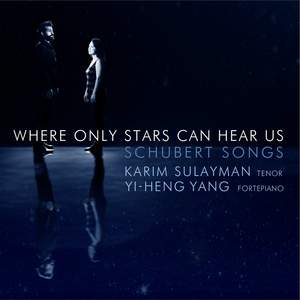
Album Review: "Where Only Stars Can Hear Us" by Karim Sulayman and Yi-heng Yang | An Album a Day Keeps the Doctor Away

Image result for where only stars can hear us schubert

WHO: Karim Sulayman, tenor; Yi-heng Yang, fortepiano
WHAT: Songs by Schubert
RELEASED: March 2020
LABEL: Avie Records

A few months ago, I had the fortune to see the Kaleidoscope Vocal Ensemble give a workshop here in New Haven as part of their inaugural performance weekend (my thoughts here). I was milling about afterwards and ended up briefly chatting with one of their tenors, Karim Sulayman.

Rewind for one second: Sulayman's first solo album (I think? Karim, feel free to correct me on this post's Twitter thread) won last year's Grammy for Best Classical Vocal Solo. That album, an Orpheus-themed program he recorded with Cleveland baroque ensemble Apollo's Fire, deserved every bit of that gold statue.

Anyway, I told him I was a sometimes-critic and that I loved his first album, and he said, "Oh, you should review my second album which comes out in March!" I'm sure he's talked to a lot of people since that September night, and I have no reason to believe he would remember this exchange six months later. But hey, I was planning to listen to the album anyway, might as well write a thing or two.

This Schubert has its priorities straight. Text comes first in Sulayman's interpretations. The small inflections in his timbre convey textual themes equally well to audiences of all German-speaking levels -- take that from me (three semesters of college German) and my best friend (a lifetime of Mahler scores and nothing else). From the seemingly bratty child in Erlkönig (RIP), to the poignantly longing fisherman of Des fischers Liebesglück, he is an actor first.

If you do nothing else, watch this video. Like, I'd rather
you watch this video than read my review. Completely serious.

But, of course, that's not to detract from his voice, clear and transparent. He barely covers his sound, allowing every ounce of that underlying emotion to shine through -- have you ever heard what a smile sounds like? Now I have.

Both performers treat these lieder as chamber music. It's unclear who leads the stretches that come so often throughout the album, but whenever one part pushes, the other follows. Yang's slightly delayed cadences gain weight with a quick breath from Sulayman. Sulayman stretches a phrase climax, Yang rolls a chord to help accent. The two work symbiotically, melding the intense drama from each of their parts into a composite, deeply affecting pathos.

I want to hear Yi-heng Yang play more Schubert on this amazing 1830 fortepiano. What are the odds someone can fund her to do a sonatas album? (Plus, her Erlkönig was....just wow. Especially considering the slow action on most fortepianos....wow. Wow wow wow.)

Schubert is parlor music. I really don't need to hear a Wagnerian heldentenor shake the walls with Winterreise. A good Schubert duo goes overboard in their story-telling, but not in their sound production -- the walls don't need to shake as long as my heart is full. Sulayman and Yang are a good Schubert duo. Perhaps even a great Schubert duo. Or maybe an unstoppable Schubert duo.

Old people, a word from the next generation: stop crying about how we'll "never have another Pavarotti" and instead listen to the immensely talented tenors that we do have. You might be pleasantly surprised.

Besides which, can you imagine Pavarotti singing Schubert? Ew.

Thursday, August 1, 2019

[38] Chamber Music Society of Lincoln Center plays Mozart, Brahms, and Arensky at Alice Tully Hall | #1Summer50Concerts


WHO: Anthony McGill, clarinet; Bella Hristova, violin; Nicholas Canellakis, cello; Juho Pohjonen, piano
WHAT: MOZART Violin Sonata No. 32 in B-flat major, K. 454; BRAHMS Clarinet Trio in A minor, Op. 114; ARENSKY Piano Trio No. 1 in D minor, Op. 32
WHERE: Alice Tully Hall
WHEN: July 14, 2019 at 5:00pm

I have exceptional luck when it comes to getting into sold-out concerts. From Chunky in Heat at the very beginning of the summer, to Pierre Hantaï in mid-June, and a couple others pre-summer, I usually can negotiate myself into at least standing room.

I've only been turned away from one concert this summer, and that was the first of the Chamber Music Society of Lincoln Center's first summer evening concert on July 10. The Wednesday evening concert, which featured works of Schubert and Dvořák alongside Mendelssohn's rarely heard piano sextet, was sold out except for one seat which was offered to me at a premium of $85 -- to be expected considering the lineup, which included famed pianist John Kimura Parker, NY Phil principal violist Cynthia Phelps, and Tokyo Quartet cellist Clive Greensmith.

So I decided to come back with some friends and try for the next concert. Three $10 tickets later and we were sitting in the third row waiting eagerly for the downbeat.

Our anticipation was met with a heaping bowl of meh.

I mean, it wasn't unpleasant. The notes were correct, at least. But the musicians were, for the most part, dialing it in. Bella Hristova's Mozart wasn't particularly musically interesting, not that you could hear her above Juho Pohjonen's hammer-hands. I think the Mozart might have suffered from Hristova's nerves, though -- her Arensky was much looser and more refined.

Nick Canellakis's vibrato covered up anyone who he played with, most notably clarinetist Anthony McGill. From what I could hear of him, McGill played the most genuine performance of the evening, granted I could hear precious little over the opaque stylings of Canellakis and Pohjonen. And Pohjonen had possibly the most awkward stage presence I've ever seen, his face motionless and his body just kind of jerking around.

I don't want to belabor negativity, but I'll finish by saying this: I could see Canellakis being a great soloist in a thousand-seat concert hall. Pohjonen as well. I know for a fact Hristova can play the shit out of her instrument -- see the video at the top of this post. But this was simply not their day.

At least there was free wine after the performance :)

P.S. I'm no style guru, but CMS seriously needs to learn that white jacket + black tie is not an indoor look. Period.

Saturday, June 1, 2019

[3] New York Philharmonic plays Brahms, Mozart, and Corigliano at David Geffen Hall | #1Summer50Concerts

WHO: New York Philharmonic; Jaap van Zweden, conductor; David Fray, piano
WHAT: BRAHMS Tragic Overture; MOZART Piano Concerto No. 24; CORIGLIANO Symphony No. 1
WHERE: David Geffen Hall
WHEN: May 30, 2019, 7:30pm

I've been known in the past to give tepid, if not negative reviews of the NY Philharmonic in the past. I saw them a couple times in their last season with Alan Gilbert, and their affect often seemed listless at best. It seemed like a group of accomplished soloists each playing without much regard for what the rest of the orchestra was doing.

I'm glad to say that era is on its way out. Jaap van Zweden, the notoriously fierce Dutch conductor who took over as the Phil's music director this year, is fixing them. The orchestra will almost certainly be back to its Bernstein-era glory in a few years.

Still, though, the Phil is in an intermediate period. There are moments where everything clicks and they sound like the most expressive, polished orchestra on this side of the Atlantic. One of those moments was at the beginning of the Brahms's Tragic Overture, which started this concert. Quite frankly, I find the piece to be very take-it-or-leave-it. Is it better than I could have written? Absolutely. Is it Brahms's magnum opus? Nowhere near. But the Phil brought certain moments to life -- the opening (and the recap) sounded almost like a period ensemble, with hard-sticked timpani and vibrato-less strings, a timbre that van Zweden clearly thought out well. The rest? It was fine.

I suppose I should mention the caveat that I had a TERRIBLE seat for the first half of the concert. The box office refused to sell me a student-priced ticket (even though there were empty seats everywhere?????), so I was stuck with the only other seat that was in my budget: top floor, side boxes, partial view. And it was still twice as expensive. UGH. I moved to a top-floor front-facing seat for the Corigliano (and thank god I did -- that partial view would have blocked out the mandolinists!).

To give you an idea of where I was sitting...Fray, van Zweden, and the orchestra

Both of Mozart soloist David Fray's last two albums have been Bach interpretations -- his concerti for multiple keyboards in 2018 followed by his sonatas with star French violinist Renaud Capuçon. I've like his Bach (much as I usually prefer my Bach on harpsichord), so I was interested to hear his Mozart. His Mozart (the 24th piano concerto) struck me as a little far removed from his Bach; his use of pedal was a little more liberal than I would have liked, though not totally outlandish. That being said, his slow movement was incredible: heartfelt, musical, and not too soupy. Special mention to the wind section Phil for that same slow movement.

I was proven wrong. But I still don't think the mandolins were *totally* necessary.
I really didn't want to like the Corigliano. At first glance, the orchestra seemed too big, almost big for the sake of being big. But John Corigliano himself came onstage and gave some verbal program notes, on the verge of tears as he remembered the people this piece eulogizes, friends of his who died in the AIDS epidemic. Once the piece started, I understood why that orchestra was so huge. Corigliano accurately encompasses so many emotions in this piece -- terror, sadness, wistfulness, nostalgia -- that even the most emotionless of listeners is moved.

The highlight of the piece was the opening of the third movement, in which principal cellist Carter Brey delivered a solo (in commemoration of a cellist friend) that was not only polished, but also so deeply felt that a cavern opened up in my stomach and I was fighting back tears. Overall, a tremendous performance.

If you get a chance to see the NY Phil, certainly do it. While they are not necessarily the best orchestra in NYC (that honor goes to the MET Orchestra), they are definitely worth a visit, even in their acoustically dead hall. But, more importantly, if you get a chance to see John Corigliano's Symphony No. 1, jump at it. I hear the Chelsea Symphony is doing it at the end of this month (June 29-30), who's going with me?