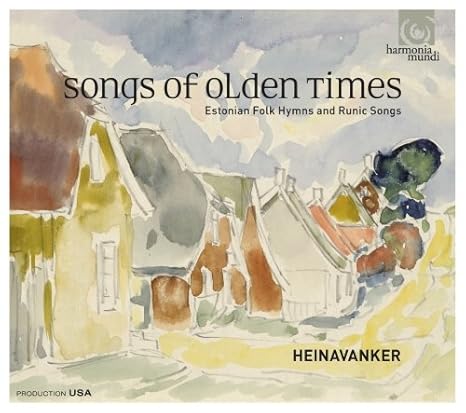
WHO: Heinavanker; Margo Kõlar, director WHAT: Estonian runic songs RELEASED: September 2013 LABEL: Harmonia Mundi
I've mentioned this album more than once before. I know that.
But this morning, I woke up to day umpteen of isolation and it was slushy and gray and blah outside. It put me in a bad mood. This album was all I could think to listen to. So I listened as I was cooking, and it hit the spot.
Frankly, now that I'm through the album, I still can't think of listening to anything else. I may start from the beginning and listen through again.
Happy first day back to "school," guys. Stay strong.
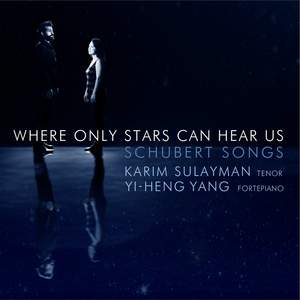
WHO: Karim Sulayman, tenor; Yi-heng Yang, fortepiano WHAT: Songs by Schubert RELEASED: March 2020 LABEL: Avie Records
A few months ago, I had the fortune to see the Kaleidoscope Vocal Ensemble give a workshop here in New Haven as part of their inaugural performance weekend (my thoughts here). I was milling about afterwards and ended up briefly chatting with one of their tenors, Karim Sulayman.
Rewind for one second: Sulayman's first solo album (I think? Karim, feel free to correct me on this post's Twitter thread) won last year's Grammy for Best Classical Vocal Solo. That album, an Orpheus-themed program he recorded with Cleveland baroque ensemble Apollo's Fire, deserved every bit of that gold statue.
Anyway, I told him I was a sometimes-critic and that I loved his first album, and he said, "Oh, you should review my second album which comes out in March!" I'm sure he's talked to a lot of people since that September night, and I have no reason to believe he would remember this exchange six months later. But hey, I was planning to listen to the album anyway, might as well write a thing or two.
This Schubert has its priorities straight. Text comes first in Sulayman's interpretations. The small inflections in his timbre convey textual themes equally well to audiences of all German-speaking levels -- take that from me (three semesters of college German) and my best friend (a lifetime of Mahler scores and nothing else). From the seemingly bratty child in Erlkönig (RIP), to the poignantly longing fisherman of Des fischers Liebesglück, he is an actor first.
If you do nothing else, watch this video. Like, I'd rather
you watch this video than read my review. Completely serious.
But, of course, that's not to detract from his voice, clear and transparent. He barely covers his sound, allowing every ounce of that underlying emotion to shine through -- have you ever heard what a smile sounds like? Now I have.
Both performers treat these lieder as chamber music. It's unclear who leads the stretches that come so often throughout the album, but whenever one part pushes, the other follows. Yang's slightly delayed cadences gain weight with a quick breath from Sulayman. Sulayman stretches a phrase climax, Yang rolls a chord to help accent. The two work symbiotically, melding the intense drama from each of their parts into a composite, deeply affecting pathos.
I want to hear Yi-heng Yang play more Schubert on this amazing 1830 fortepiano. What are the odds someone can fund her to do a sonatas album? (Plus, her Erlkönig was....just wow. Especially considering the slow action on most fortepianos....wow. Wow wow wow.)
Schubert is parlor music. I really don't need to hear a Wagnerian heldentenor shake the walls with Winterreise. A good Schubert duo goes overboard in their story-telling, but not in their sound production -- the walls don't need to shake as long as my heart is full. Sulayman and Yang are a good Schubert duo. Perhaps even a great Schubert duo. Or maybe an unstoppable Schubert duo.
Old people, a word from the next generation: stop crying about how we'll "never have another Pavarotti" and instead listen to the immensely talented tenors that we do have. You might be pleasantly surprised.
Besides which, can you imagine Pavarotti singing Schubert? Ew.
"From runic songs to Pärt," could mean just about anything. I mean, I sort of assumed that the nucleus of their program would be....runic songs....and Pärt. But safe to say that this was the only concert from my October break where I didn't really know what I was getting myself into.
Well, the first thing I noticed, and the first thing I should say: god, I wish my choir robes were that cool.
Heinavanker's program did, indeed, include runic songs and Pärt, along with some 14th-century polyphony. A couple of anonymous French mass movements went off well, as did a Te Deum by artistic director Margo Kõlar, who sang while conducting minimally. The Pärt was also quite good.
But for now, I'm going to dismiss those pieces, because I remember almost nothing of them. Even right after I left, my mind was full of one thing and one thing only: Estonian runic song.
And here's the crazy thing -- Estonian runic song is so, so, so repetitive. Much of it is the same couple lines of music that just keep coming back to different text; occasionally the music changes a bit, but the changes are really very little, barely discernible. But thirty seconds in and you're entranced.
Heinavanker incorporated some simple choreography into their set, mostly stepping behind one another in some sort of hypnotized, down-beat conga line. As soon as they brought out their first runic song, the Kõlar arrangement that leads their 2013 album (which I've listened to at least four times since the performance [and may or may not be listening to now]), it as if this wash of calm descended over the audience. Something about the cyclic repetition combined with the kind of music that is just so....comfortable. No one's voice was stretched, no one's ear was challenged. It was just nice, good music.
I seriously cannot recommend this enough. Seriously.
And they were so in the zone. The verses and verses of text were second-nature to the ensemble, who performed mostly from memory. The voices blended effortlessly in the boomy-but-not-overly-so chapel; the plain chords were perfectly in tune.
I want to make one thing clear -- Heinavanker's program contained some of the simplest music I've ever reviewed. But they showed that simple does not necessarily equal unimpressive. They performed these simple runic pieces with the same focus and accuracy that they might have used for something fifteen times its difficulty.
This was another of those times that I came out of a concert and said: "I would sit through that again in a heartbeat." I was speechless. It's one thing to go into a concert knowing full well it's going to be fantastic; but the feeling of euphoria that follows uncertainty is even better.
Please, Heinavanker. Come back to the US. Pretty please, with Estonian runes on top.
P.S. This is one of their basses. Turns out he's an Estonian pop star. Who woulda thunk it?
Peep: Shick and Lewis trying to explain the meaning of music
in half an hour, in terms that a middle schooler could understand
WHO: International Contemporary Ensemble; Vimbayi Kaziboni, conductor; Steven Schick, percussion and orator
WHAT: GEORGE LEWIS Soundlines; P. Multitudinis
WHERE: Skirball Center for the Performing Arts @ NYU
WHEN: October 18, 2019 at 7:30pm
One of my friends told me I should drop everything to see this concert. By the time he finished telling me why, my tickets were already bought. I'm easily swayed.
The first amazing thing about this concert was the sheer density of objects and individuals onstage. In addition to the large Skirball stage, a large vertical platform stood front and center -- the kind of platform off of which I flung (and broke) a bow in my freshman year of high school while playing in the orchestra for Pippin. (That was my second broken bow that year. I broke the first by literally sitting on it during an orchestra rehearsal. I was a clumsy child.)
Spilling out of the pitch-black underbelly of said raised platform was a smattering of unusual percussion instruments -- drums, various shakers and rainsticks and whatnot. The conductor sat in the partially-lowered orchestra pit, visible to both those on the platform and on the stage. Basically, I'm trying to say that the setup was weird.
Within the first few measures of Soundlines, two LED panels lit up the dark underside of the platform, revealing the rest of the percussion setup surrounding a blank-faced Steven Schick.
Schick proceeded to tell the tale of an artistic mission upon which he embarked a few years ago: a daring seven-hundred-mile walk from San Diego to San Francisco. George Lewis designates his musical setting of Schick's memoir as a melodrama, but Schick's performance was anything but hyperdramatic. His face remained largely neutral through the piece, one of the more impressive feats of solo performance I've seen in the last year.
Lewis used the vast percussion set to emphasize Schick's oration syllable-for-syllable -- that was where the melodrama of this piece came from. The instrumental accents did not always match the syllable stress of the speech. That was part of the fun. Schick took it all in stride. His body was one, and the hands that operated the mallets were one with the mouth that narrated.
The rest of the ensemble snuck onstage at the end of the piece, and they seamlessly transitioned into P. Multitudinis, more a soundscape than a piece with distinct melody and harmony. The musicians were divided into distinct instrumental groups -- a wind quintet atop the platform, a string quartet stage right, a pianist stage left, a couple of hodgepodge ensembles in the side balconies. Each group had some discrete number of musical modules to play; it wasn't clear exactly how they decided when to switch, but from what I could tell motion was predicated on finger-numbers and Macarena-like hand signals. Conductor Vimbayi Kaziboni kept things moving by slinking around between groups, checking in as a waiter does on a table of guests. Amusing, and who am I to argue with results?
And the best thing about it all was the speech that George Lewis gave afterwards. He was very, very happy. And for me, that enhances the experience so very much. Satisfied composer + satisfied audience = satisfied critic.