Showing posts with label song. Show all posts

Saturday, March 28, 2020

Album Reviews: My Liederabend | An Album a Day Keeps the Doctor Away

You may notice I haven't posted in a few days. This week, I learned that online school is still a full-time job when you procrastinate as much as I do. Oh well.

But that doesn't mean I haven't been listening -- in fact, as assignments pile up, I've been listening more than ever!

A few nights ago, I had a particularly difficult and long-winded problem set. Long enough that I feel like I can put "reconstructing sounds of proto-Quechuan" on my resumé now. I found myself hankering for lieder, so I put on one album after another and next thing I knew, I had gone through four full albums.

I figured it prudent for my time (and yours) to do a mini-reviews post rather than four full-length posts. So here you go: a summary of my liederabend.


1. The Contrast: English Poetry in Song
Carolyn Sampson, soprano; Joseph Middleton, piano. Works by Walton, Vaughan Williams, Bridge, Quilter, and Huw Watkins. Released on BIS in February 2020.

I don't believe in God. But I do believe in Carolyn Sampson. And that's kind of the same thing.

I think there might have been a time when Carolyn Sampson was a strict early music specialist, but thankfully she's branched out. Of course, her Bach solo cantatas are still my favorite out there, but her musical sensibility applies so well to everything and anything, from heavily stylized French baroque to quirkier selections like these. I'm not going to try to find words to describe her voice, but let's just say this: I sent this album to a good friend and her reaction was (verbatim): "Who is this angel, and when can I see her live?" Joseph Middleton has that perfect touch of a pianist who specializes in lieder, never overshadowing the voice and always magnifying its drama. They are the unstoppable duo.


2. A Lesson in Love
Kate Royal, soprano; Malcolm Martineau, piano. Works by pretty much anyone you can think of. Released on Warner Classics in February 2011.

The program of this album is all over the place in the best possible way. Cabaret songs, Schumann and Brahms, folk music of America, Britain, Ireland, France, all in some of the best versions I've heard. Case in point: almost every soprano has recorded "Gretchen am Spinnrade" at some point, and Royal's rendition is easily in my top three (right up there with Carolyn Sampson). Her American music is better than most American singers -- two different takes of William Bolcom's jazz-twinged "Waitin'" give the varied program a distinct contour and a resounding cadence, and a short pastorale of Copland left me halfway to tears. Malcolm Martineau accompanies the simple British airs -- think "Danny Boy" and "O Waly, Waly" -- with just as much tender attention as the more conventionally difficult music on the program.


3. Art Songs
Fiora, soprano; Paul Hankinson, piano. Works by a lot of people, look for yourself you lazy bum. Self-released in 2002.

I'm pretty sure Fiora hasn't thought about this album in awhile. She's now a successful singer-songwriter with 600,000 monthly listeners on Spotify. But before she hit her fame in that field, she released a single album of art songs -- she's a classically trained vocalist and composer. Honestly, I was really impressed. She's got this lovely syrup to her voice, fluid and unencumbered by excessive vibrato. Her program has a couple standouts, including the opening movement from Hindemith's "Das Marienleben" (a piece that makes me regret not being a soprano) and a beautiful original setting of "The Watcher" (couldn't figure out who the poet was).


4. The Divine Muse
Mary Bevan, soprano; Joseph Middleton, piano. Works by Haydn, Schubert, and Wolf. Released on Signum Classics in January 2020.

Haydn's vocal works never get the love they deserve. Recently, I've fallen in love with Arianna a Naxos, a virtuosic monodrama depicting the scene where Theseus abandons Ariadne on the island of Naxos. Fiery, passionate, and vocally demanding, the music suits Mary Bevan's full voice perfectly, Ariadne's agony clear from her frenzied inflections. She cools significantly for selections from Wolf's vast vocal opus, the crunchy harmonies providing latticework for her calming melodic overlay. And of course, you can never go wrong with Schubert. Overall, a fabulous album -- though maybe not as fabulous as her recording of Holst's set of four songs for soprano and violin, one of my favorite pieces ever (I have a lot of favorite pieces ever).

Tuesday, November 12, 2019

Review: Heinavanker at The Cloisters

Image result for heinavanker
I bet their shoulders are really warm.

WHO: Heinavanker; Margo Kõlar, artistic director
WHAT: "From runic songs to Pärt"
WHERE: Fuentidueña Chapel at The Met Cloisters
WHEN: October 20, 2019, 8:00pm

"From runic songs to Pärt," could mean just about anything. I mean, I sort of assumed that the nucleus of their program would be....runic songs....and Pärt. But safe to say that this was the only concert from my October break where I didn't really know what I was getting myself into.

Well, the first thing I noticed, and the first thing I should say: god, I wish my choir robes were that cool.

Heinavanker's program did, indeed, include runic songs and Pärt, along with some 14th-century polyphony. A couple of anonymous French mass movements went off well, as did a Te Deum by artistic director Margo Kõlar, who sang while conducting minimally. The Pärt was also quite good.

But for now, I'm going to dismiss those pieces, because I remember almost nothing of them. Even right after I left, my mind was full of one thing and one thing only: Estonian runic song.

And here's the crazy thing -- Estonian runic song is so, so, so repetitive. Much of it is the same couple lines of music that just keep coming back to different text; occasionally the music changes a bit, but the changes are really very little, barely discernible. But thirty seconds in and you're entranced.

Heinavanker incorporated some simple choreography into their set, mostly stepping behind one another in some sort of hypnotized, down-beat conga line. As soon as they brought out their first runic song, the Kõlar arrangement that leads their 2013 album (which I've listened to at least four times since the performance [and may or may not be listening to now]), it as if this wash of calm descended over the audience. Something about the cyclic repetition combined with the kind of music that is just so....comfortable. No one's voice was stretched, no one's ear was challenged. It was just nice, good music.

I seriously cannot recommend this enough. Seriously.

And they were so in the zone. The verses and verses of text were second-nature to the ensemble, who performed mostly from memory. The voices blended effortlessly in the boomy-but-not-overly-so chapel; the plain chords were perfectly in tune.

I want to make one thing clear -- Heinavanker's program contained some of the simplest music I've ever reviewed. But they showed that simple does not necessarily equal unimpressive. They performed these simple runic pieces with the same focus and accuracy that they might have used for something fifteen times its difficulty.

This was another of those times that I came out of a concert and said: "I would sit through that again in a heartbeat." I was speechless. It's one thing to go into a concert knowing full well it's going to be fantastic; but the feeling of euphoria that follows uncertainty is even better.

Please, Heinavanker. Come back to the US. Pretty please, with Estonian runes on top.

P.S. This is one of their basses. Turns out he's an Estonian pop star. Who woulda thunk it?

Wednesday, July 24, 2019

[34] shadows of love at Bethesda Lutheran Church, New Haven | #1Summer50Concerts


WHO: Matthew Cramer, bass-baritone; Stephen Gamboa-Diaz, harpsichord; Michael Rigsby, viola da gamba
WHAT: Works by Dowland, Lambert, d'Ambruys, Purcell, and Bach
WHERE: Bethesda Lutheran Church, New Haven CT
WHEN: July 7, 2019 at 4:00pm

Concert #34: In Which I Immediately Review Someone Else I Know, Even Though I Just Said That It's A Bad Idea

I discovered this 4th-of-July weekend that New Haven is a ghost town in the summer. Some students stay behind for research; a moderate horde of high schoolers come for summer sessions. But when you walk around, the thing that strikes you is the quiet -- other than the cars, there's no student chatter around campus. It's part eerie and part relaxing.

I was only there for three days (I took a day go to visit my brother in Boston), but by the time my trip was ending it had been five days since I had seen a concert. Far too long, in my humble opinion.

Luckily, a couple of friends decided to beat the summer boredom (not the heat, mind you -- there is no air conditioning at Bethesda) with a half-hour concert of renaissance and baroque music. It was an intimate affair -- maybe twenty people in the audience, half of them wearing shorts and/or crocs (myself included).

I think Matt Cramer sang it in a better key, to be honest, but this is the best recording out there.

So, again with the reviewing-people-I-know thing -- it feels weird to write formal reviews about friends and colleagues, but here goes nothing. The programming for the concert was fantastic, full of tunes that I heard for the first time that afternoon and am still humming right now. Matt Cramer, though a choral conductor by trade, lent inventive and clearly-sung ornamentations. Stephen Gamboa-Diaz showed his harpsichord prowess both as an accompanist and as a soloist; Michael Rigsby rounded out the crew.

But the charm of this concert came not in the music-making, but in the purpose. This wasn't part of a summer concert series or anything like that. When I asked Stephen what compelled him to put on a concert like this, he shrugged and said, "I don't know, Matt was in town for a little while and it was time to do something other than sightread in our living room." And if that's not inspirational, I don't know what is.

Sunday, June 23, 2019

[20] Dalit Hadass Warshaw's "The Letters of Mademoiselle C." at National Opera Center | #1Summer50Concerts

It specifically reminded me of one of those neon candy orange slices -- does that make me a terrible person?

WHO: Dalit Hadass Warshaw, composer and piano; Nancy Allen Lundy, soprano; Beth Greenberg, director
WHAT: The Letters of Mademoiselle C., by Dalit Hadass Warshaw (world premiere)
WHERE: Marc Scorca Hall at the National Opera Center
WHEN: June 17, 2019 at 7:00pm

I am an opera nut. We have established this before.

You'd think I would have at least heard of a place called the National Opera Center. Where the organization OPERA AMERICA is based. But I hadn't. My date made fun of me for that one -- rightfully so.

Anyway, the NOC is on the sixth or seventh floor of your average Gramercy office building, above a couple bodegas and a payroll services shop. It looks like a pretty average office lobby until you step into the concert hall. I mean, no office space has a concert hall, but this is probably the weirdest venue I've been in so far. Imagine if you took an orange slice and modeled a concert hall after it -- sort of like if you sliced a cylinder and then sliced those slices in half lengthwise, and then put in a wood paneled floor and a stage and painted the walls blue. Weird.

But my date sent me the Facebook event attached to a message that said, "We're going to this." So it's not like I had much of a choice.

I suppose I should be glad that my friends know to forward me any and all concerts. But hey, I'm an ingrate. That's why I'm going into music criticism.

So, I'm terribly illiterate, and I had only heard the name Camille Claudel once or twice. From what I gathered from the program notes, the performance, and S2E1 of Marvelous Mrs. Maisel, she was a sculptor who had an affair with Auguste Rodin and was subsequently committed to an asylum on dubious suspicions that she was mentally ill. That kind of story arc makes for a perfect song cycle, I will concede.


I think her primary instrument is theremin -- what a legend

The program started with three composers that would have been ringing in Claudel's ears: Germaine Tailleferre, Lili Boulanger, and finally a prelude of her dear friend Claude Debussy. Warshaw's performance was sound indeed -- it was almost invocative of jazz in the way that the individual lines were phrased in relation to one another. The product was an interesting interpretation that traded absolute readings of dynamics in favor of a sense of relativity, which was, in my opinion, a novel and refreshing.

And then, as the Debussy ended, soprano Nancy Allen Lundy, as the disheveled Claudel, slowly and trepidly walked down the center aisle of the audience. Onstage were a couple of chairs and a shawl; director Beth Greenberg made the most of a sparse staging.

The music itself was tremendous -- imagine all of the rhythmic uncertainty of Schoenberg or Webern, but with a color palette similar to that of Debussy and ilk. Warshaw played beautifully, not just because it was her piece; she clearly had a stylistic goal in mind, and she executed it beautifully. One would have thought the music emerged straight from a table at Les Deux Magots or another Parisian intellectual haunt.

Lundy's performance had its ups and downs. Her climactic high notes were right on target, impassioned and drenched in a thick coating of manic sorrow. Most of her tessitura, though, was underwhelming; her tone was breathy, and her diction was barely there. One of the movements had a refrain that repeated the word "chisel", which invariably came out as "shizzle" or "jizzle."

Because of the diction issues and the lack of subtitles, I don't think I got as much out of this premiere as I could have. The piece was obviously very well thought-out, and I'd like to see it performed again once it's had the opportunity to go through some stages of performance workshopping -- hopefully, the performers will tour it and give it the chance it really deserves.

Monday, June 17, 2019

[16] Camille Bertault Quartet and Friends at Birdland | # 1Summer50Concerts


WHO: Camille Bertault Quartet and Friends
WHAT: "Pas de Géant" Project
WHEN: Wednesday, June 12, 9:45pm

"You knew you were coming to see jazz, but you didn't know you were coming to see CRAZY JAZZ!!!!!"

And some crazy jazz was exactly what I needed on that night.

For the first two weeks of this project, I was sticking to a very strict regimen: one concert per day, two on Saturdays, a matinee on Sundays so I can grocery shop and meal prep for the week.

I'm glad to say I didn't fully burn out. But last Sunday, I decided that I needed to take a couple of concert-free days. One night I stayed in and did nothing (I mean, I tried to blog, but that didn't work so well). The next night, I went for a stroll with a professor. And Wednesday, I finally went back to the concert scene, but not before a lengthy family dinner.

Just goes to show you that you CAN get tired of things you love. I mean, that shouldn't surprise me, but sometimes I forget.

Anyway, this show was the perfect potpourri to get me back in the swing of things. Not that I expected it to be a potpourri -- I've seen many of Bertault's YouTube videos, starting with the viral one in which she scats along to the solo from Giant Steps ("Pas de Géant" in French -- that's kind of her thing), so I know she knows her way around the classical canon. She's scatted the first variation of Goldberg, she's done Doctor Gradus ad Parnassum from Debussy's Children's Corner suite, all sorts of stuff. So naturally, after a short original song for her introduction, she launched into a "tribute track" to the composers who had influenced her over the years; apparently, her father started her on piano at the ripe old age of three years old.

"Un, deux, un deux trois quatre"

And she launches into Goldberg at...help me here Moranis!

                                         Image result for ludicrous speed

Bertault had obviously done this a million times before. Her pianist, Vitor Gonçalves, looked petrified, but kept his cool to play a musically and technically impressive Bach. She followed with a series of mutations on the first movement of Ravel's Tombeau de Couperin, and then a whole song based on Satie's first Gymnopédie.

So at this point we know she does classical well. She goes into a short phase of French standards, including a Serge Gainsbourg song that starts, "I drink regularly to forget my wife's friends." Charming. That one ended up with a stone-cold sober Bertault lying on the floor "drunkenly" babbling on in French about all of her problems, and eventually falling asleep on the ground -- I gather the band was a group of New York ringers, because they seemed bewildered.

Almost as bewildered as when Bertault shooed them offstage after that chart, and invited up a piano professor from the Manhattan School of Music (god help me if I can figure out which one -- Solomon Mikowski rings a bell?) who is apparently a Birdland regular. And they played. Four-hands. A movement of Ravel's Mother Goose suite. He was sightreading. She hadn't practiced. And you know what? It was fantastic. More fun was had in that room in those four minutes than at the entire Renee Rosnes show I had seen the previous week.

Please someone tell me the name of this bassist!

The combo came back on after that -- I should take this opportunity to mention that the combo she had behind her was AMAZING. Though I'm pretty sure the trio was hired for the occasion, they knew the charts well, looking up and smiling at each other as if they were....having fun? GASP! Gonçalves's solos were the perfect character foils to Bertault's; where her solos were restricted by the technical capabilities of the human voice (even a voice as agile as Bertault's has its limits) his picked up slack, and vice versa. The bassist, whose name I couldn't catch from the stage (I think I might have heard Eduardo? Google produced no results for me) had a smirk on his face that showed he knew EXACTLY what he was doing the whole time. And the drummer, John Hadfield, was equally at home in jazz and bossa styles -- Bertault is a self-professed Brazilian music obsessor -- and his playing had the perfect balance of reliability and pizzazz.

Speaking of Brazilian music, she kicked her combo off AGAIN and brought on guitarist Diego Figueiredo, with whom she did the Carmen Miranda Radio Days bossa classic Tico-Tico no Fubá. Bertault and Figueiredo were doing a show at Birdland the next night -- I seriously considered canceling my plans and going, their rendition was so fantastic.

The moral of the story is, next time Camille Bertault is in NYC, get your butt on out to see her. Whether she's solo with a pianist or guitarist, or with a larger group, she's incredibly fun to watch, not to mention a fabulous singer. Besides which, you basically get three shows for the price of one!

Friday, June 7, 2019

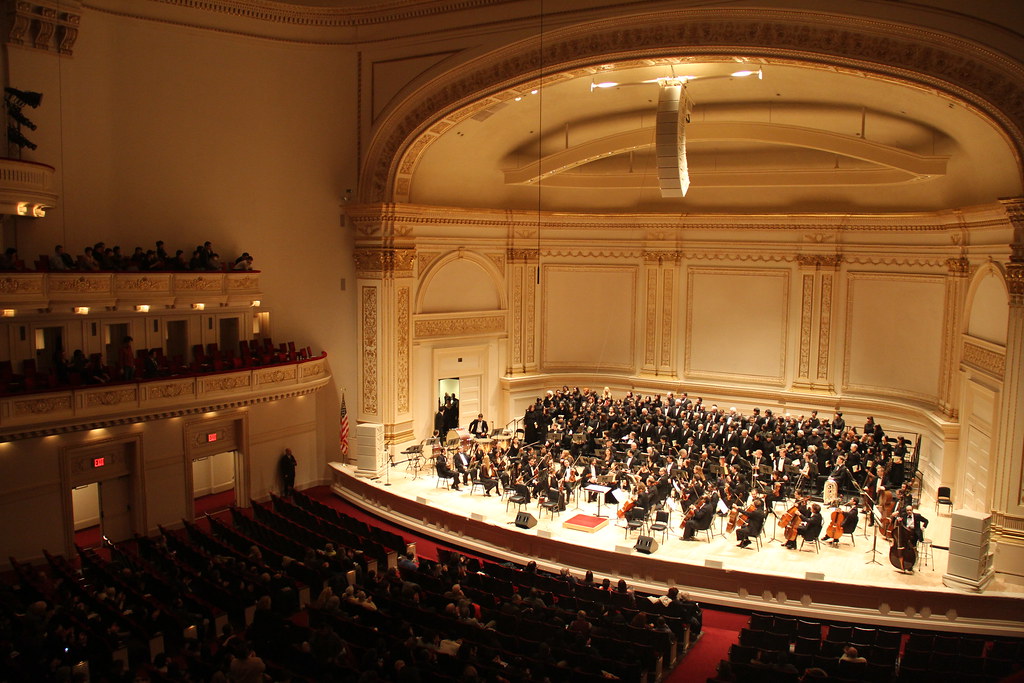
[8] The MET Orchestra and Isabel Leonard perform Debussy, Dutilleux, and Ravel | #1Summer50Concerts


Image result for carnegie hall


WHAT: DEBUSSY La mer; DUTILLEUX Le temps l'horloge; RAVEL Shéhérazade; RAVEL Suite No. 2 from Daphnis and Chloé
WHERE: Carnegie Hall
WHEN: June 3, 2019, 7:30pm

This past March, I was lucky enough to go see Richard Wagner's Die Walküre at the Metropolitan Opera. For those of you who don't know, Wagner operas are often all-day affairs, especially at the Met where intermissions are 30 minutes long. The show started at noon; I eventually walked out of the opera house at 5:10pm. The first thing that ran through my head after five hours of watching ladies in breastplates and horns howl their hearts out (yes, really):

"Gee, I want to go see another opera tonight!"

The fact that I had to be awake and singing in New Haven (about a 2hr train ride) at 9am the next day notwithstanding, I bought my standing room ticket for the 8:30pm showing of Mozart's La clemenza di Tito, hiked to the top of the Metropolitan Opera House (what is it with me and concerts that require climbing?) and stood at the top for the full two hours. And I loved every second of it.

Yeah, you could say I'm obsessed. Or you could say that I'm a passionate young adult who is invigorated by the intellectual stimulation that opera lends its listeners.

You know, I just read over that again. Let's just go with obsessed.

The most reliable part of the Metropolitan Opera is the orchestra. No matter if it's Mozart or Bartók, the MET orchestra always has their act together, whether they're in hour six of a Wagner or are playing the second show in a double-header.

Unlike most other American opera houses, the MET ends their season early (their last production was in the first week of May or so) because the MET orchestra gives a three-concert series to finish Carnegie Hall's year. Usually, at least one of the concerts has something to do with opera -- usually, they'll invite a couple of MET regulars to sing with the orchestra.

For this concert, the soloist was soprano Isabel Leonard, coming hot off of her recent smash success in Poulenc's Dialogues of the Carmelites (think French Revolution, but also nuns, and then everyone dies). I had the opportunity to see her as Mélisande in Debussy's Pelléas et Mélisande (think love affair, and then everyone dies) earlier this year, and my opinion was pretty ambivalent -- her performance was perfectly fine, but was overshadowed by the sub-par performance of tenor Paul Appleby as Pelléas and the stellar performance of baritone Kyle Ketelsen as Golaud.

I'm sure some French pop star has ripped off the name of that last Dutilleux song...

I think she must have been having a bad night at that performance, because she knocked this one out of the park. Her voice floated easily above the orchestra -- not quite unmoored, but certainly well-lodged in the fantasy realm that French music craves. Gossamer, never heavy, and simply sublime, even in a highly technical passage like at the end of the Dutilleux. The start of her Ravel was also tremendous -- strong, but also supple and soft.

The orchestra's La mer was admittedly mediocre -- it felt like none of the players were taking the responsibility to make the music that Yannick was so expressively conducting. It almost seemed that the orchestra didn't know how to be in the limelight, a common ailment with opera orchestras, though not one that usually plagues the MET.

Luckily, that was just a fluke. Behind Leonard, they were able to spend the next two pieces recalibrating, and their Daphnis and Chloe was absolutely stunning. Special recognition to principal flautist Chelsea Knox, whose solos in both Ravel pieces were about as close to perfect as one can get. Also, she was like 23 when she won the principal spot with the MET orchestra. Feel inadequate yet?

If you haven't been to the MET, go. Standing room tickets are $20, and other tickets occasionally start at $35. And while you're there, I have a game that I like to play, developed with one of my best friends from school. The hoity-toity people at the MET like to spectate the in-house restaurant, which serves one course at each intermission. Stand one or two levels up on the terraces that overlook the restaurant, then try to come up with a backstory for each person. There are only so many business-people you can go through before you decide which of the necktie-wearing old people in the restaurant is the next Walter White.