Showing posts with label 20th century. Show all posts

Wednesday, December 25, 2019

Virgil Thomson's Roast Lamb: An Experiment in Gastro-Musicology


One thing I have not made clear enough in my reviews: I am a foodie. The only thing that rivals my love for a good, cheap concert is a good, cheap meal. Not shockingly, it's much easier to find the former around NYC -- I'm pretty sure if I waltzed into Katz's Deli and asked for the "student discount" I'd get a laugh and a proverbial kick in the shins (then again, it's hard to do anything at Katz's without getting made fun of, that's kind of their brand).

Now that I live in an apartment, I've finally been able to get back into cooking regularly. I've had some interesting experiments in my tiny one-person kitchenette. A moderately successful crispy pork belly. Beef rendang with a paste I bought at a hole-in-the-wall Indonesian market in Forest Hills -- the paste had so much chili that it kinda gassed out my apartment even with all the windows open. A five-ingredient butter-soy-garlic braised enoki mushroom dish that I now swear by.

My friend Amanda is my cooking buddy. We grocery shop together, we exchange recipes, sometimes we even eat together. A couple months ago, Amanda texted me a picture from a ratty spiral-bound cookbook and said, "Project?"

The recipe was from Amanda's old copy of the Chicago Symphony Orchestra Cookbook (out of print, but available on Amazon) from the time when her father played trumpet with the CSO. A compilation of exceedingly 1970s-esque recipes, the book includes favorites from musicians, conductors, spouses, and composers.

I'm not sure which I love more: the fact that he wishes us luck at the end,
or the fact that he signs with "Warmly everbest"

Our project: American composer Virgil Thomson's (1896-1989) recipe for roast leg of lamb. Thomson's musical oeuvre has largely been forgotten; he's remembered most fondly as a father figure for composers of the next generation, most notably Leonard Bernstein and Ned Rorem. According to academics, the trio was "united as much by their shared homosexuality as by their similar compositional sensibilities." His most famous works include three operas (two with libretti by Gertrude Stein, one of which the NY Phil is doing later this year) and a handful of Ken Burns-style PBS film scores.

His lamb recipe looked edible. Huge leg of lamb. Cut all the fat off. Rub with crushed garlic and rosemary (no salt, he's very clear about that). 550°F oven. 8.5 minutes per pound. Easy enough, I suppose.

So Amanda and I checked our GCals and penciled in a date around finals -- what better way to celebrate the holidays (and procrastinate on my final papers) than with a huge hunk of Roast Beast™? (please don't sue me Dr. Seuss Trust please please please)

I showed up to Amanda's house around 6:45 on a Monday night. We poured ourselves glasses of wine (I had written most of a 12-page paper that day, I damn well deserved it) and set to work trimming the six-pound leg of lamb of all of its fat. Yes, all of it, or else, Virgil assured us, we'd set our oven on fire. Nice.

I suppose I should say now that we committed ourselves to following Thomson's recipe exactly, so help us god. This is important, because we made some steps that we knew would produce wonky results. But we did it for science!

We crushed some rosemary and garlic and rubbed it on. Just like we were supposed to. And then we stuck it in the oven. And, predictably, the garlic and rosemary torched almost immediately and set off the smoke alarm for the first time that night. We dismantled the smoke detector after that, but that was definitely not the last time the smoke alarm should have gone off.

smoke alarm: BEEP
me: *goes to fan smoke alarm*
Amanda: "Do you want me to take a video of this for your blog?"
Me: "I mean....I guess so?"
Virgil Thomson's Four Saints in Three Acts: *playing in the background, if you listen closely*

The original plan was to make an entire Chicago Symphony dinner, but we looked through the book and decided that everything looked too....well, too 1970s. Lay off the gelatin, guys.

After smoking out the apartment three times (though admittedly those last two were thanks to our complete and utter incompetence at making Yorkshire pudding), we pulled the lamb out of the oven. It looked nice enough. We carved it according to Virgil's instructions (ALWAYS perpendicular to the bone -- he was very particular) and sat down to eat. We ended up with:
  • Virgil's lamb, which was juicy but had a prominent essence of burnt garlic and that distinct 1970s gray color. Oh, and why didn't they ever salt anything in the 1970s? Literally, rub the outside with salt instead of garlic and rosemary and we wouldn't have had a problem with flavor or garlic charcoal.
  • Sautéed Brussels sprouts with bacon. Mmmm, bacon.
  • Arugula "salad" with olive oil and kosher salt, that's it (Virgil's instructions were actually watercress, but arugula is so much better).
  • Amanda's mother's delicious almond torte recipe
Overall not too bad. But Amanda and I looked at each other after enduring three smoke-outs and more than our fair share of other hilarity and said, "We are obviously better cooks than Virgil Thomson. Let's just use our own recipe next time."

An evening of musicology at its most amusing, if you ask me.

Thursday, August 22, 2019

[49] Faculty Concert at Chamber Music Conference of the East, Bennington, VT | #1Summer50Concerts #ConcertGetaway

Image result for bennington chamber music conference

WHO: Faculty of Chamber Music Conference of the East
WHAT: SCOTT WHEELER Piano Trio No. 2 "Camera Dances"; HINDEMITH Kleine Kammermusik, Op. 24 No. 2; BRAHMS Piano Quintet, Op. 34
WHERE: Greenwall Auditorium, Bennington College, Bennington, VT
WHEN: August 3, 2019 at 8:00pm

An abridged list of things I did during my week at Bennington:
  • Play the Beethoven "Ghost" trio
  • Play Shostakovich's 7th string quartet
  • Play a Beethoven quartet (Op. 18 No. 6, for those who are counting)
  • Play a Mendelssohn quartet (Op. 12)
  • Explain to my friends approximately 47 times that yes, I go to a music camp that requires me to learn four full pieces in one week, and yes, this is my idea of fun
  • Get called a masochist approximately 47 times
  • Have a conversation with the Bennington College music librarian that ended with, "I'm so glad that score of Schoenberg's Book of the Hanging Gardens (which was on sale for $2 at the annual music sale) is going to a good home." Why yes, I'll feed it and water it and turn it towards the sunlight, just like I do with the rest of my....scores?
  • Read Shostakovich's second piano trio (read: really really hard) with one of those pianists who is like "oh yeah, I'm just sightreading" and then proceeds to nail 90% of the notes at full tempo. She may be reading this. She knows who she is.
  • Eat lots of dining hall food, reminding me that yes, I am happy to have a kitchen this upcoming year
  • Pitch the #1Summer50Concerts project approximately 47 times
  • Explain approximately 47 times that yes, I went to 50 concerts and yes, I enjoyed myself
  • Get called a masochist approximately 47 times
  • Blog while sitting on a bench that overlooks miles and miles of open field (with a little path weed-whacked into it so people can go on walks through the waist-high grass) while listening to Alexandre Tharaud's recordings of the last three Beethoven piano sonatas (would recommend)
  • Explore said open field, for shits and giggles
  • Come across a mystical forest path that looked something like this:
  • Enter the forest path
  • Come out the other side to this view:
  • Scare a mama deer a little further down the path
  • Stargaze
  • Obsess over shoes and Bruno Helstroffer (the world's sexiest lute player) with a group of snarky childless 40-somethings
  • Sweat. A lot. The music building wasn't air conditioned.
An unabridged list of things I did not do during my week at Bennington:
  • Sleep

Saturday, August 17, 2019

[46] American Modern Opera Company presents "Veils for Desire" at Caramoor | #1Summer50Concerts

One moment before God decides that the Abraham-and-Isaac 
telenovela doesn't need to end like Orange is the New Black did
(intentionally vague to avoid spoilers -- if you know, you know)

WHO: American Modern Opera Company (Anthony Roth-Costanzo, countertenor; Paul Appleby, tenor; Matthew Aucoin, piano; Wayne Koestenbaum, narrator)
WHAT: Veils for Desire: Works by Britten, Monteverdi, Bach, and Aucoin
WHERE: Spanish Courtyard at Caramoor
WHEN: July 25, 2019 at 7:00pm

Poolside blogging. I think I've reached a new low.

Just a short one for today, because I reviewed this concert for Opera News (I think it'll be published in October along with my last one?) and I can't release any spoilers! So here are a few things that didn't make it into my review:
  • I think short-sleeved button downs are the concert dress of the future, especially when they're bright pink like Wayne Koestenbaum's was. Too bad I can't pull one off to save my life.
  • ARC and Paul Appleby had an interesting father-son chemistry in Britten's Canticle II: Abraham and Isaac -- it worked, to say the least.
  • Wayne Koestenbaum is a badass. He didn't sing, so I couldn't say much about him in my review. But he had such a cadence to his speech...love at first word.
  • Caramoor is still absolutely LOVELY. Nature for the win.
  • I wish trains ran from Katonah more than hourly because I waited on that platform for, like, half an hour and I had about 973 bug bites to show for it.
The review should drop soon! I'll link to it when it does, and you can read it (if you're a subscriber).

Monday, July 29, 2019

[37] Davóne Tines and the Dover Quartet play Mendelssohn, Dvořák, Barber, and Caroline Shaw at Caramoor | #1Summer50Concerts

Perks of reviewing for legit organizations: actual professional photos (PC: Gabe Palacio)

WHO: Davóne Tines, bass-baritone; Dover Quartet
WHAT: MENDELSSOHN Theme and Variations, Scherzo, and Fugue from Four Pieces for String Quartet, Op. 81; BARBER Dover Beach; CAROLINE SHAW By and By; DVOŘÁK String Quartet No. 14 in A-flat major, Op. 105
WHERE: Spanish Courtyard at Caramoor
WHEN: July 12, 2019 at 8:00pm

I'm not going to say much about this performance -- I reviewed this concert for Opera News and I don't want to give away my opinions before it gets published. I'll link the review here once it gets published -- you can read it if you're a subscriber.

In the meanwhile, here are a few things that I didn't get to mention in my review:
  • Davóne Tines's stage outfit was a black suit with no shirt. Let me tell you, he ROCKED it.
  • There was some action with candles onstage -- Tines lit a candle in the silence between Dover Beach and By and By, and an ill-timed breeze nearly burned the stage tent down.
  • At the pre-concert Q&A session, a(n over-)zealous chamber-music camp parent chaperone asked Dover cellist Camden Shaw how he handles it when he gets lost in a performance. After a short pause, he answered in his booming, croony voice, "I don't know, look pretty?"
  • Caramoor is absolutely LOVELY. You know why? Because nature is great. NYC almost made me forget that.
  • Caroline Shaw was not there or I would have said hi to her this time. I promise.
Stay tuned for the full review!

Saturday, July 20, 2019

[31] Duplexity: Elissa Cassini and Ashley Bathgate at National Sawdust | #1Summer50Concerts

The piece is based on Bach's fourth cello suite -- see the resemblance?

WHO: Elissa Cassini, violin & Ashley Bathgate, cello
WHAT: WINKELMAN Rondo with a Janus Head; SAARIAHO Aure; NORMAN For Ashley; WINKELMAN Ciaccona; RAVEL Sonata for Violin and Cello
WHERE: National Sawdust
WHEN: June 29, 2019 at 7:00pm

I had a depressing conversation with another music critic friend the other day -- the topic was a syndrome that I like to call "critic brain." After reviewing 30 concerts, I feel jaded and hypercritical, like I never really enjoy anything to its full potential. In other words, I have started to wonder whether anything can really wow me anymore.

But every now and then a concert sets me straight, and makes me realize that my standards (which generally run a little too high) can be met. Can you guess what I'm going to say about Elissa and Ashley?

Yeah, they killed it. Like, jaw-on-the-floor.

Cassini has been spending the past couple years touring as a solo duo, so to speak. She teams up with anyone and everyone -- string players, non-string players, classical, jazz, world music -- to bring the gospel of duo music to her audience. And, what's more, she tries to engage with her audiences -- that's right, more audience participation! (Although this particular performance was not so heavy on the repeat-after-me songs I've been dishing on throughout the summer.)

Her partner this time was Ashley Bathgate, current cellist of the Bang on a Can All-Stars (one of NYC's first and foremost new music ensembles). Bathgate has always been a force of nature; critics went crazy for her first album, a 2016 recording of six new works for solo cello by Australian composer Kate Moore. She was actually what drew me to this concert in the first place, quite frankly.


But both Cassini and Bathgate played astoundingly well. They are longtime friends, and it just sort of felt like we were sitting in on another Saturday-night jam session. Smiley and energetic, the duo were in sync to the millisecond -- the NY premiere of Helena Winkelman's highly technical Rondo with a Janus Head showed off their two-as-one synergy, while Kaija Saariaho's Aure showed each's individual musical prowess a bit more.

The two performers each channeled Bach through a pairing of solo movements; the first was a Bathgate-commissioned piece by LA native Andrew Norman, the second, another NY Premiere by Helena Winkelman. The Norman was particularly cool, taking one rhythmic module and modifying it by microtones throughout. The concert finished with the Ravel duo which is sort of proto-modernist -- it uses a lot of the same harmonic language as did Andrew Norman or Kaija Saariaho.

I don't know. I feel like I'm not saying anything particularly inspiring about this concert. But I have to emphasize that it was truly fantastic. Maybe I just remember that it was fantastic and don't remember a ton of the details. But it was amazing. Trust me.

Sunday, June 23, 2019

[19] Downtown Voices and NOVUS NY perform Bartók and Orff at St. Paul's Chapel | #1Summer50Concerts

                                         Image result for st paul's chapel nyc

WHO: Downtown Voices; NOVUS NY; Stephen Sands, conductor
WHAT: BARTÓK Sonata for Two Pianos and Percussion; ORFF Carmina burana
WHERE: St. Paul's Chapel
WHEN: June 16, 2019, 3:00pm

"Blessed are those who make classical music accessible by putting on free Sunday matinee concerts."
-- God, probably

I had a good hour and a half to kill before the concert started, so I decided to pop into a Starbucks and blog a bit. I sauntered on over to the chapel with plenty of time to spare -- it was maybe 25 minutes until the concert started -- and I arrived to find out that a) there were no full-view seats left and I had to go sit in the balcony and b) St. Paul's Chapel has free wifi, so I could have sat in the front row and worked while I waited for the concert to start.

It was just not my day, I guess.

When I got up to the balcony, I looked out over the audience and any shred of resent I had immediately melted. The great thing about a matinee concert is that it isn't too early or too late for anyone. That meant that parents brought their children, all sat in a row and clad in frilly dresses and bows and cute little button-down shirts. I felt a little underdressed in my usual t-shirt and jeans ensemble, but then a guy wearing shorts sat down next to me. Phew.

I don't know what Trinity Wall Street's worship services are like, but I can tell you one thing: their music programs are outstanding. Their flagship ensembles are a full professional choir and one of the leading baroque orchestras in NYC, but they also have burgeoning new music, youth, and community programs.

One of the best things about the Trinity music program is that all of their different levels collaborate often. This particular concert drew from almost all of their programs; the age range was approximately 6 (the youngest members of the Carmina children's choir) to 86 (the oldest members of Downtown Voices).

Needless to say, most of the audience was there for Carmina burana, but that didn't stop NOVUS NY from delivering a compelling version of the Bartók sonata (in this case, more like Bartok's Sonata for Two Pianos, Percussion, Police Sirens, and Brooklyn-Bound 6 Train -- but that's not their fault). Pianists Daniel Schlosberg and Lee Dionne had their backs to each other, but it was blatantly obvious that their heartbeats and pulses had synced -- it was as if one person was playing two parts. Percussionists Ian Rosenbaum and Victor Caccese worked as an impressive team, pushing the unpitched percussion parts to the front, almost treating them as melody instead of emphasis.

                               Image result for wind gif spongebob
Me at the beginning of Carmina burana, colorized (2019)

At the start of Carmina, it became clear that Downtown Voices was not just any community choir. I would have been content seeing them on stage with the New York Philharmonic, or with any visiting orchestra at Carnegie Hall -- in fact, I think I liked their performance more than I usually like the NY Phil's house choir. They felt well-rehearsed, but still interested; no one was 'dialing it in' and everyone looked like they couldn't imagine being anywhere else at that moment in time.

Soloist-wise, tenor Brian Giebler stole the show with his roasted swan-song ("Olim lacus colueram"). He paraded onstage in a black-and-red reversible sequined jacket and proceeded to full-voice the entire movement, which is a feat in and of itself. What made his version particularly impressive was how he delivered it -- it read almost like a country ballad, the way he occupied the back of the conductor's podium and swung his legs off. Country-classical crossover -- talk about a thing I never thought I'd enjoy.

Baritone soloist Christopher Dylan Herbert shouldered the largest musical load of any of the soloists, and did so with grace and accuracy. His "Estuans interius" was particularly noteworthy, his passionate high range not buckling under the emotional weight of the movement. Also of particular note was the children's chorus, which wrenched the hearts of audience members with their toothy-grinned "Amor volat undique."

There was not a single person in that room that wasn't having fun. From the pianists, to the four percussionists, to the choir and soloists, to the audience, even to Trinity's music director Julian Wachner, who did nothing but work the microphone the whole time -- the energy in the room was electric. Even the youngest children in the audience sat wide-eyed the whole time, as if under Carl Orff's spell.

This concert just cemented a hunch that I've had for awhile: if Trinity puts it on, then it's bound to be good. Trinity doesn't deal in mediocre music, but it's not like that's a prohibitive factor. They have perfected the art of getting the most out of every musician, and making every musician feel like they're giving the most they can. And if that doesn't satisfy you, then consult a doctor: you might be a sociopath.

Wednesday, June 12, 2019

[12] Stefan Jackiw, Yoonah Kim, Zlatomir Fung, and Conrad Tao play Quartet for the End of Time at Bargemusic | #1Summer50Concerts

Note: that boat is not Bargemusic

WHO: Stefan Jackiw, violin; Yoonah Kim, clarinet; Zlatomir Fung, cello; Conrad Tao, piano
WHAT: Quatuor pour la fin du temps (Quartet for the End of Time), by Olivier Messiaen
WHERE: Bargemusic
WHEN: June 7, 2019, 7:00pm

I would like to start by saying that Conrad Tao showed up to his own concert in knee-length black capri-chinos, which is probably the biggest power move I've ever witnessed.

And now back to your regularly scheduled programming.

Bargemusic is another one of these intimate Brooklyn concert venues that makes you go "awwwwww." Right outside of the joggers-with-strollers haven that is Brooklyn Bridge Park, just down the street from the snaking lines at competing pizzerias Juliana's and Grimaldi's, is a beautiful dock with possibly the most phenomenal, up-close view of the bridges on either side of the East River (pictured above). Tethered to the dock is usually a smattering of party boats, but this Friday night all of the party boats were off loaded with drunken twenty-somethings. Tonight there was only a small white boat with an abandoned ceiling deck and a dent on every surface. That, friends, is Bargemusic.

Inside, visitors find a single, wood-paneled room with a folding table at the front for ticket sales. We slipped in behind a few tourists who were very confused at the fact that the upper deck wasn't used for concertizing (because, after all, grand pianos love nothing more than humidity and unpredictable rain-storms), and took our seats.

I don't usually go crazy for front-row seats -- as I've mentioned in a couple of my previous reviews, I like to hear the sound after it's had a chance to blend in the room. But for some reason, it seemed right for this concert.

Twinning + twin bridges

The musicians were screwing around off to the side of the stage, the only place at Bargemusic that could even mildly be construed as a "backstage area." I use quotation marks because it essentially looks like a mudroom, but without a door or walls -- a couple coat hangers and a couple benches, and the staircase (okay, it's actually like one stair) up to the stage.

For those of you who don't know, Messiaen was drafted into the French army in WWII; he was captured at Verdun and taken to a prisoner of war camp in Germany. Luckily, he had already made something of a name for himself in the musical world, so the army gave him special treatment -- he was given a composition studio with a piano. He wrote the Quatuor entirely at the camp, and it was premiered by him and three of his fellow prisoners outdoors on a rainy January evening.

This is a piece that tests not only every facet of your technique -- how fast you can play, how slow you can play, how in-between you can play -- but first and foremost how much soul and anguish you can impart into your playing. There is nothing uplifting about the Quatuor; even the most beautiful moments are sodden with dissonance and pain.

I can barely put into words the performance that these four phenomenal musicians put forth. At the end of the concerts, my friends and I could do nothing more than look at each other, tears in our eyes, and say, "Wow."

The quartet imparted every bit of distraught passion that Messiaen wrote into the score -- and then some -- into that hour-ish of playing. They were perfectly zoned into each other the whole time, even when they weren't playing. Yoonah Kim's solo clarinet movement (Abyss of the Birds) was extreme in the most wonderful of ways. The infamously long pianissisimo (very very soft) to fortissisimo (very very loud) notes lasted upwards of 30 seconds (thanks to circular breathing -- pushing air out of your mouth while taking more air in through your nose), starting so imperceptibly that I thought her instrument had broken right in front of us on stage.

The leap-of-faith climax-to-meditation moment about two minutes from the end of Zlatomir Fung's solo movement was possibly the most delicate moment of music I have heard so far this summer, save for the congruent moment in Stefan Jackiw's movement -- it's a tie. And all the while, Conrad Tao, without a solo movement for himself, in turn accompanied dutifully and tastefully and shone in his own right, his smart touch ekeing every last timbre out of Bargemusic's Steinway.

I wish I could do justice to this performance with words. But I can't. All I can say is that somehow, everything felt right. The waves sloshing against the dock, the boat rocking at what seemed to be choreographed moments (and I say that as someone who gets violently seasick), even the EDM track that was wafting through the window from afar as the final notes of the final movement sounded. June 7th, 2019, from 7pm to 8:10pm, was a perfect moment.

EDIT: Don't believe me? Cellist Zlatomir Fung just won the XIV International Tchaikovsky Competition.

Friday, June 7, 2019

[8] The MET Orchestra and Isabel Leonard perform Debussy, Dutilleux, and Ravel | #1Summer50Concerts


Image result for carnegie hall


WHAT: DEBUSSY La mer; DUTILLEUX Le temps l'horloge; RAVEL Shéhérazade; RAVEL Suite No. 2 from Daphnis and Chloé
WHERE: Carnegie Hall
WHEN: June 3, 2019, 7:30pm

This past March, I was lucky enough to go see Richard Wagner's Die Walküre at the Metropolitan Opera. For those of you who don't know, Wagner operas are often all-day affairs, especially at the Met where intermissions are 30 minutes long. The show started at noon; I eventually walked out of the opera house at 5:10pm. The first thing that ran through my head after five hours of watching ladies in breastplates and horns howl their hearts out (yes, really):

"Gee, I want to go see another opera tonight!"

The fact that I had to be awake and singing in New Haven (about a 2hr train ride) at 9am the next day notwithstanding, I bought my standing room ticket for the 8:30pm showing of Mozart's La clemenza di Tito, hiked to the top of the Metropolitan Opera House (what is it with me and concerts that require climbing?) and stood at the top for the full two hours. And I loved every second of it.

Yeah, you could say I'm obsessed. Or you could say that I'm a passionate young adult who is invigorated by the intellectual stimulation that opera lends its listeners.

You know, I just read over that again. Let's just go with obsessed.

The most reliable part of the Metropolitan Opera is the orchestra. No matter if it's Mozart or Bartók, the MET orchestra always has their act together, whether they're in hour six of a Wagner or are playing the second show in a double-header.

Unlike most other American opera houses, the MET ends their season early (their last production was in the first week of May or so) because the MET orchestra gives a three-concert series to finish Carnegie Hall's year. Usually, at least one of the concerts has something to do with opera -- usually, they'll invite a couple of MET regulars to sing with the orchestra.

For this concert, the soloist was soprano Isabel Leonard, coming hot off of her recent smash success in Poulenc's Dialogues of the Carmelites (think French Revolution, but also nuns, and then everyone dies). I had the opportunity to see her as Mélisande in Debussy's Pelléas et Mélisande (think love affair, and then everyone dies) earlier this year, and my opinion was pretty ambivalent -- her performance was perfectly fine, but was overshadowed by the sub-par performance of tenor Paul Appleby as Pelléas and the stellar performance of baritone Kyle Ketelsen as Golaud.

I'm sure some French pop star has ripped off the name of that last Dutilleux song...

I think she must have been having a bad night at that performance, because she knocked this one out of the park. Her voice floated easily above the orchestra -- not quite unmoored, but certainly well-lodged in the fantasy realm that French music craves. Gossamer, never heavy, and simply sublime, even in a highly technical passage like at the end of the Dutilleux. The start of her Ravel was also tremendous -- strong, but also supple and soft.

The orchestra's La mer was admittedly mediocre -- it felt like none of the players were taking the responsibility to make the music that Yannick was so expressively conducting. It almost seemed that the orchestra didn't know how to be in the limelight, a common ailment with opera orchestras, though not one that usually plagues the MET.

Luckily, that was just a fluke. Behind Leonard, they were able to spend the next two pieces recalibrating, and their Daphnis and Chloe was absolutely stunning. Special recognition to principal flautist Chelsea Knox, whose solos in both Ravel pieces were about as close to perfect as one can get. Also, she was like 23 when she won the principal spot with the MET orchestra. Feel inadequate yet?

If you haven't been to the MET, go. Standing room tickets are $20, and other tickets occasionally start at $35. And while you're there, I have a game that I like to play, developed with one of my best friends from school. The hoity-toity people at the MET like to spectate the in-house restaurant, which serves one course at each intermission. Stand one or two levels up on the terraces that overlook the restaurant, then try to come up with a backstory for each person. There are only so many business-people you can go through before you decide which of the necktie-wearing old people in the restaurant is the next Walter White.

Saturday, June 1, 2019

[3] New York Philharmonic plays Brahms, Mozart, and Corigliano at David Geffen Hall | #1Summer50Concerts

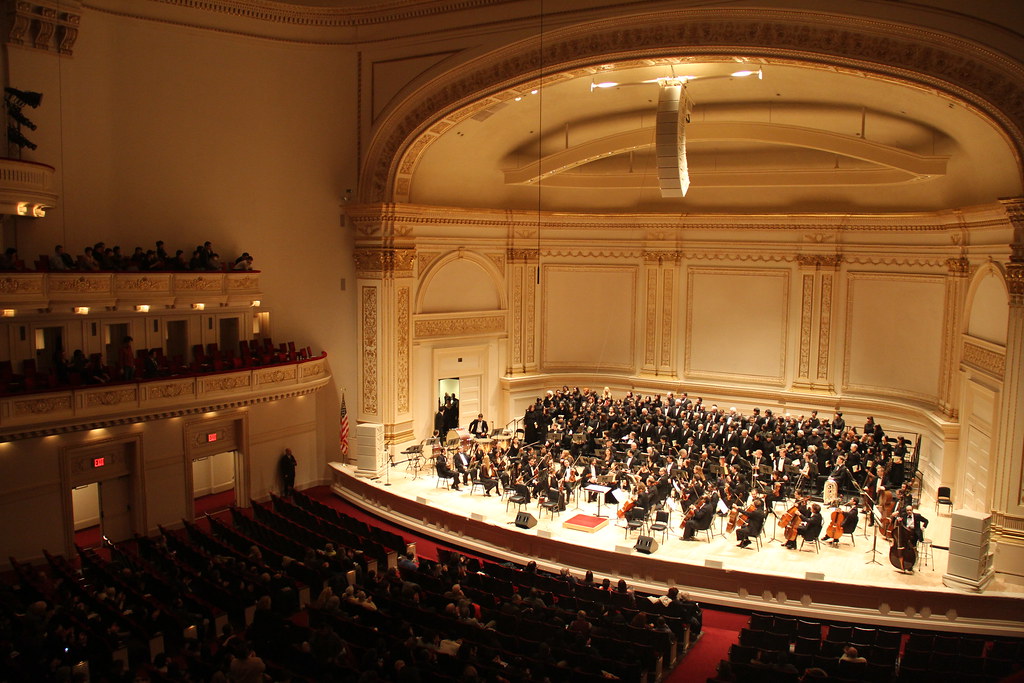
WHO: New York Philharmonic; Jaap van Zweden, conductor; David Fray, piano
WHAT: BRAHMS Tragic Overture; MOZART Piano Concerto No. 24; CORIGLIANO Symphony No. 1
WHERE: David Geffen Hall
WHEN: May 30, 2019, 7:30pm

I've been known in the past to give tepid, if not negative reviews of the NY Philharmonic in the past. I saw them a couple times in their last season with Alan Gilbert, and their affect often seemed listless at best. It seemed like a group of accomplished soloists each playing without much regard for what the rest of the orchestra was doing.

I'm glad to say that era is on its way out. Jaap van Zweden, the notoriously fierce Dutch conductor who took over as the Phil's music director this year, is fixing them. The orchestra will almost certainly be back to its Bernstein-era glory in a few years.

Still, though, the Phil is in an intermediate period. There are moments where everything clicks and they sound like the most expressive, polished orchestra on this side of the Atlantic. One of those moments was at the beginning of the Brahms's Tragic Overture, which started this concert. Quite frankly, I find the piece to be very take-it-or-leave-it. Is it better than I could have written? Absolutely. Is it Brahms's magnum opus? Nowhere near. But the Phil brought certain moments to life -- the opening (and the recap) sounded almost like a period ensemble, with hard-sticked timpani and vibrato-less strings, a timbre that van Zweden clearly thought out well. The rest? It was fine.

I suppose I should mention the caveat that I had a TERRIBLE seat for the first half of the concert. The box office refused to sell me a student-priced ticket (even though there were empty seats everywhere?????), so I was stuck with the only other seat that was in my budget: top floor, side boxes, partial view. And it was still twice as expensive. UGH. I moved to a top-floor front-facing seat for the Corigliano (and thank god I did -- that partial view would have blocked out the mandolinists!).

To give you an idea of where I was sitting...Fray, van Zweden, and the orchestra

Both of Mozart soloist David Fray's last two albums have been Bach interpretations -- his concerti for multiple keyboards in 2018 followed by his sonatas with star French violinist Renaud Capuçon. I've like his Bach (much as I usually prefer my Bach on harpsichord), so I was interested to hear his Mozart. His Mozart (the 24th piano concerto) struck me as a little far removed from his Bach; his use of pedal was a little more liberal than I would have liked, though not totally outlandish. That being said, his slow movement was incredible: heartfelt, musical, and not too soupy. Special mention to the wind section Phil for that same slow movement.

I was proven wrong. But I still don't think the mandolins were *totally* necessary.
I really didn't want to like the Corigliano. At first glance, the orchestra seemed too big, almost big for the sake of being big. But John Corigliano himself came onstage and gave some verbal program notes, on the verge of tears as he remembered the people this piece eulogizes, friends of his who died in the AIDS epidemic. Once the piece started, I understood why that orchestra was so huge. Corigliano accurately encompasses so many emotions in this piece -- terror, sadness, wistfulness, nostalgia -- that even the most emotionless of listeners is moved.

The highlight of the piece was the opening of the third movement, in which principal cellist Carter Brey delivered a solo (in commemoration of a cellist friend) that was not only polished, but also so deeply felt that a cavern opened up in my stomach and I was fighting back tears. Overall, a tremendous performance.

If you get a chance to see the NY Phil, certainly do it. While they are not necessarily the best orchestra in NYC (that honor goes to the MET Orchestra), they are definitely worth a visit, even in their acoustically dead hall. But, more importantly, if you get a chance to see John Corigliano's Symphony No. 1, jump at it. I hear the Chelsea Symphony is doing it at the end of this month (June 29-30), who's going with me?

Wednesday, May 29, 2019

[1] S.E.M. Ensemble at Bohemian National Hall | #1Summer50Concerts

WHO: S.E.M. Ensemble
WHAT: New York - Ostrava: Influences and Initiatives
WHERE: Bohemian National Hall
WHEN: May 28, 2019, 7:30pm

Yes, last night I chose a new music concert over the New York Phil playing Beethoven's Eroica. But I saw the Phil do Eroica last season. And at this rate, I'll probably get to see it next season. And the next season. Ad nauseum.

Besides which, this concert had the universal college-student trump card: it was free.

As New York's new music ensembles go, S.E.M. is ancient. Founded shortly after Czech composer Petr Kotík moved stateside in 1969, they were -- and are -- closely linked with the American experimentalists that make baby boomers wrinkle their noses. They now perform regularly, mostly in Brooklyn Heights's Willow Place Auditorium (best described as a cross between a parochial school auditorium and a YMCA basketball court -- one of my favorite quirky concert venues in NYC).


Not pictured: the gymnastics mats piled in the back left corner

The program was composed of new pieces written by students of S.E.M.'s biennial Ostrava Days festival along with older stalwarts of the ensemble's repertoire. Particularly of note was violist-and-composer-on-the-side Anna Heflin's Included/Excluded (2019), which found a string quartet sitting with their backs to one another, each playing a fiendishly difficult and independent line. Then, all of a sudden, one of the violinists shouted: "CHAIR!"
"CHAIR!"

I was sort of confused -- maybe she said "share" or something like that? No, she said it again, "CHAIR!" at which point the cellist began clapping at rhythmically constant, but seemingly arbitrary intervals. A couple minutes later, the cellist launched into a tirade about how people who drop dead on the street are still expected to make polite banter with passers-by. It was absurdism at its finest; I found myself scratching my head, but oddly and thoroughly satisfied.

Other highlights included Alvin Lucier's Navigations for Strings (1991), a piece which consists primarily of ever-so-slightly compressing and widening microtones; if you listen carefully, you can hear the sound oscillations getting faster and slower with the changing dissonances. Kotík and Wolff's pairings of pieces each displayed a very distinct narrative of their compositional evolutions.

But, perhaps most amusing of all was the final piece, Earle Brown's Available Forms I (1961). The sheet music of the piece takes the form of six unbound pages, each with five "events." The events can happen in any order, the pages can be played in any order, with any number of repetitions. Kotík had constructed a nifty music stand-mounted cardboard contraption with which he could show the orchestra how to move between pages; the events were shown with the fingers of his non-baton hand.

Overall, a great start to the project. If you're in the mood for something a little weirder, S.E.M. is your group. Oh, and be sure to take a visit to the Bohemian National Hall on E 73rd St -- it's the only consulate-plus-cultural-center-plus-restaurant you'll ever visit, I assure you.