Showing posts with label Italian. Show all posts

Wednesday, March 18, 2020

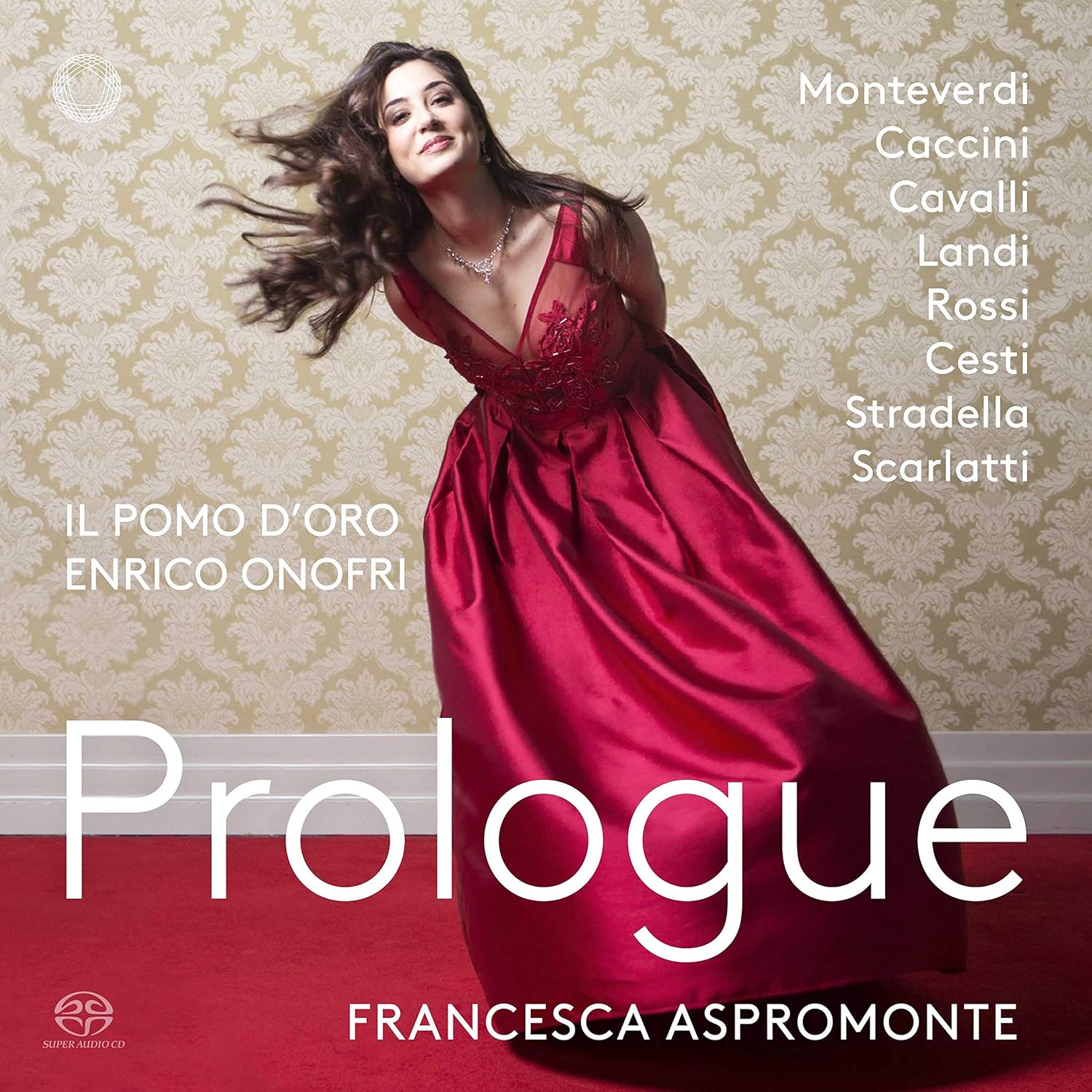
Album Review: "Prologue" by Francesca Aspromonte and Il Pomo d'Oro | An Album a Day Keeps the Doctor Away

Image result for aspromonte prologue

WHO: Francesca Aspromonte, soprano; Il Pomo d'Oro; Enrico Onofri, director
WHAT: Prologues to operas by Monteverdi, Caccini, Cavalli, Landi, Rossi, Cesti, Stradella, and A. Scarlatti
RELEASED: May 2018
LABEL: Pentatone

Guys, I'm really fucking bored. My brain is kinda turning to mush. I've turned to practicing cello to give myself something to do. Do you know how much I hate practicing? A lot. I hate practicing a lot.

Anyway, one thing I think we could all use during this weird, crazy time is music to listen to -- according to an email that one of my professors sent a couple hours ago, "music can be at its most powerful in times of crisis and uncertainty." Musicians always know how to cheer up a crowd, huh?

So I'm going to try to review an album every day that I'm stuck inside. No particular theme, just what I happen to be listening to at the moment. They're not going to be long, but hopefully they'll keep me busy and give you some new music to try out.

One thing that you should know about me is that I organize all the music I have yet to listen to into 60 or so playlists according to instrumentation and time period. "Romantic Keyboard"; "20th-Century Choral"; you get the idea. My "Baroque Solo Vocal" list is on the long side -- up around 170 hours (but I'm also terrible about clearing out what I've already listened to).

Today, I wanted Italian baroque opera, probably because I'm mourning the cancellation of Yale's annual baroque opera project (Cavalli's Doriclea, for anyone who cares -- good luck finding a recording). Luckily, this was near the top of my list.

Though prologues have fallen out of fashion in opera today, they were among the most important parts of early operatic structure. An allegorical character -- usually just named "Prologue" -- would come onstage and address the audience directly, breaking the fourth wall and foreshadowing the overarching themes of the plot to come. Usually, this takes the form of a recitative (imagine you're speaking, but while singing one note over and over again) with instrumental interludes (usually ornamented versions of a single theme).

Owning a recitative is hard. I've tried (and failed) myself -- it takes a lot of energy to make a repeated note interesting. You wouldn't know that from Francesca Aspromonte's performance. Recitative is clearly second-nature to her; her text stresses land with gravity, but don't halt forward momentum. Her voice is clear and sweet, blooming beautifully in the brief arias where she has less text to worry about.

Il Pomo d'Oro somehow put out six albums in 2018 alone, and all of the ones I've listened to are fantastic. This pared-down ensemble of a couple violins and a continuo section hits the mark; the violinists clearly play together rather than following one another, and the harpsichordist's improvisations combine pinpoint precision with wild, unhinged improvisation.

Great album, would recommend.

Saturday, August 17, 2019

[46] American Modern Opera Company presents "Veils for Desire" at Caramoor | #1Summer50Concerts

One moment before God decides that the Abraham-and-Isaac 
telenovela doesn't need to end like Orange is the New Black did
(intentionally vague to avoid spoilers -- if you know, you know)

WHO: American Modern Opera Company (Anthony Roth-Costanzo, countertenor; Paul Appleby, tenor; Matthew Aucoin, piano; Wayne Koestenbaum, narrator)
WHAT: Veils for Desire: Works by Britten, Monteverdi, Bach, and Aucoin
WHERE: Spanish Courtyard at Caramoor
WHEN: July 25, 2019 at 7:00pm

Poolside blogging. I think I've reached a new low.

Just a short one for today, because I reviewed this concert for Opera News (I think it'll be published in October along with my last one?) and I can't release any spoilers! So here are a few things that didn't make it into my review:
  • I think short-sleeved button downs are the concert dress of the future, especially when they're bright pink like Wayne Koestenbaum's was. Too bad I can't pull one off to save my life.
  • ARC and Paul Appleby had an interesting father-son chemistry in Britten's Canticle II: Abraham and Isaac -- it worked, to say the least.
  • Wayne Koestenbaum is a badass. He didn't sing, so I couldn't say much about him in my review. But he had such a cadence to his speech...love at first word.
  • Caramoor is still absolutely LOVELY. Nature for the win.
  • I wish trains ran from Katonah more than hourly because I waited on that platform for, like, half an hour and I had about 973 bug bites to show for it.
The review should drop soon! I'll link to it when it does, and you can read it (if you're a subscriber).

Wednesday, August 7, 2019

[41] Teatro Nuovo presents Rossini's "La gazza ladra" at the Rose Theater @ Jazz at Lincoln Center | #1Summer50Concerts

Hannah Ludwig welcoming the audience as Pippo (PC: Steven Pisano)

WHO: Soloists, Chorus, and Orchestra of Teatro Nuovo; Rachelle Jonck, maestro al cembalo; Jakob Lehmann, primo violino e capo d'orchestra
WHAT: ROSSINI La gazza ladra
WHERE: Rose Theater @ Jazz at Lincoln Center
WHEN: July 18, 2019 at 7:30pm

Concert #41: In Which I See a Three-And-A-Half-Hour Opera That Usually Gets Cut Down to Two Hours for a Reason

Don't get me wrong, I'm not faulting Teatro Nuovo for this. I totally understand wanting to play every note that the composer wrote.

But Rossini wrote this opera for a different audience. Back in the early 1800s, the opera was as much a place for social hour as it was a place for musical edification. The 20-minute scenes sung by the protagonist's first cousin's husband's servant were the perfect opportunity for Signore and Signora Garganelli to go over and play cards with their aristocratic friends.

But it's the 21st century. Friends are obsolete. Our phones are the new "friends."

Okay, maybe that's kind of a dystopian read on things. But Wagner invented this idea that music should be all-consuming and everyone should be quiet and do nothing but listen. And now we just sit and listen and roll our eyes at people who cough (don't lie, I do it too -- concert halls literally provide free cough drops, but you can't be bothered to pick a few up before the performance?).

Anyway, this is all a long-winded way of saying that I understand why The Met cuts Gazza ladra to two hours. But I'm glad I got to see the whole thing -- again with that reproducibility factor!

You've definitely at least heard the overture to La gazza ladra ("The Thieving Magpie"). It's a favorite among film producers, most notably used in A Clockwork Orange. Couldn't tell you where in the movie -- I don't do psycho-crime movies.

ANYWAY, now that my anti-establishment cynicism is out of the way, I really really enjoyed Teatro Nuovo's performance. The orchestra sounded as great as ever, and I think they saved their real A-cast for this performance. The acting was more acute, though that could possibly be because the staging was slightly more...well, staged. There was a long table in the middle of the stage that at least gave the performers something to work with.

The many faces of Hans Tashjian (PC: Steven Pisano)

The highlight of the performance was mezzo Hannah Ludwig as Pippo, the cheeky trouser-role servant who eventually exonerates the protagonist from her execution (have I mentioned that Italian tragedies are indistinguishable from Italian comedies until the last ten minutes?). Not only did she sing beautifully, but she sparkled in the role, at once naive and all-knowing. Bass Erik van Heyningen's constantly-concerned portrayal of the defected soldier Fernando Villabella was poignant, coupled with a sweetly roaring bass. Hans Tashjian, the main villain, brought an intentional apathy to his character, reinforcing his nuanced vocal technique with an impressive repertoire of cunning smirks, each distinct from the last. And of course, I'd be remiss if I didn't mention the sorrowful song of the protagonist herself, Alisa Jordheim as the condemned (then not) Ninetta.

To the uncredited chorus member who played the magpie: the feather-boa-plus-tuxedo look is a keeper. He managed to be the funniest character, even though he only sang two solo lines -- the way he raced around the stage had a Road Runner-esque flair.

The orchestra, as usual, sounded great; a few of them even joined in on some of the buffo fun, the principal flautist and oboist each in their own little solo world until the oboist "realized" that everyone was concentrating on the flute player's thirty-second notes instead of her quarter notes.

So yes, I sat through three and a half hours of opera on this one Thursday night. But I don't have a single regret. I've said it once, and I'll say it again: reproducibility factor never steers me wrong!

Monday, August 5, 2019

[40] Teatro Nuovo presents Bellini's "La straniera" at Rose Theater @ Jazz at Lincoln Center | #1Summer50Concerts

PC: Steven Pisano

WHO: Soloists, Chorus, and Orchestra of Teatro Nuovo; Will Crutchfield, maestro al cembalo; Jakob Lehmann, primo violino e capo d'orchestra
WHAT: BELLINI La straniera
WHERE: Rose Theater @ Jazz at Lincoln Center
WHEN: July 17, 2019 at 7:30pm

I open my computer. My stomach is in knots. The clock is counting down. Sweat pours down my face. I begin to hyperventilate. The stress is killing me. My hand, shaking violently, reaches for the mouse.

Yeah, that's what happened last time I had to choose between two concerts I really wanted to go see. Sometimes I think I'm too invested, y'know?

Anyway, I know I said at the beginning of the summer that I was choosing concerts based on what thought I would like most. Unfortunately, I like a lot of things, and sometimes I can't choose. So I've had to rely on another metric for deciding on concerts: the reproducibility factor. I always take into account the likelihood of getting to see a given concert (or one similar) at some point in the future. That's why I decided to go see the SEM Ensemble instead of Beethoven's Eroica at the NY Phil for the first concert in this series; why I went to go see ChamberQUEER instead of Boston Early Music Festival at Caramoor; why (in part) I decided to go see Vivica Genaux instead of going to NYC Pride.

So, when Teatro Nuovo's staged operas rolled around, I cleared my schedule, put on a tie, and walked up the five flights of stairs to the Jazz at Lincoln Center lobby.

Okay no, not really. I took the elevator. But the necktie part is real.

The formal-clad choir (PC: Steven Pisano)

Bellini's La straniera ("The Stranger") barely ever gets performed, falling at the feet of his more famous Norma, Puritani, and Sonnambula. The plot, as with many bel canto operas, is predicated upon a misunderstood love triangle -- Arturo loves Alaïde (the straniera in question), but thinks she is having an affair with Valdeburgo. Arturo tries to kill Valdeburgo until the "oh shit!" moment when he realizes that Valdeburgo is Alaïde's brother. Valdeburgo survives the attempt, Alaïde is dragged off for the murder, Arturo is urged to marry the woman he was originally planning to marry before any of this started (her name is Isoletta, she's only mildly relevant).

Except then it turns out that Alaïde is actually queen of France. So when Arturo botches his own wedding to beg Alaïde to run off with him, she is summoned back to the throne. Arturo is understandably sad. He kills himself. Alaïde is also sad. She threatens to kill herself. Curtain.

Ah yes, the Italian tragedy: only distinguishable from the Italian comedy in that, at the end, everyone dies instead of marrying each other.

So, I'm going to go out on a limb here and say something. I think comparing the Teatro Nuovo orchestra and choir is unfair. The singers are part of a young artists' program, still gaining valuable experience in the operatic field. The orchestra is the usual circuit of period-performance freelancers, many of whom I've already seen elsewhere this summer. So here are their separate reviews:

THE SINGERS: Great voices up on that stage. Tenor Derrek Stark was a poignant and relatable Arturo; soprano Christine Lyons's arias brought Alaïde's alienation to the forefront; baritone Steven LaBrie's Valdeburgo was rich and sweet, but not overly covered; mezzo Alina Tamborini rocked a confused Isoletta. But, for the great singing tone, the acting was somewhat anemic. Perhaps if there had been more staging to work off of, it would have been better, but the body movements were muted and awkward, the facial expressions barely expressive at all. Only LaBrie seemed to occupy the full character of his role. The chorus, made up of the rest of the young artists in the program, sounded as good as any professional opera chorus, their Italian perfect even in those infamous tongue-twister passages.

LaBrie as Valdeburgo (PC: Steven Pisano)

THE ORCHESTRA: Teatro Nuovo has a 60-piece orchestra that functions as a chamber ensemble. The concertmaster, sitting on the podium at the front, shares conducting responsibility with the maestro, sitting at a keyboard instrument (a late-model fortepiano, in this case) in the middle of the orchestra. The configuration of the orchestra is strange, to say the least -- the violins face each other (firsts facing the stage, seconds with their backs to the singers), the winds sit in an octet in the middle, the basses are split on either side of the ensemble. It made for an interesting sound, from the audience's perspective. The first violins and wind soloists are the center of attention in a bel canto orchestra, and they came through loud and clear. I'm not going to pretend that the modern configuration, with a real conductor serving solely as a musical interpreter and everyone facing the same way, isn't an innovation -- there's a reason the MET orchestra doesn't sit like Teatro Nuovo. But the orchestra's seating didn't seem to affect their accuracy and poise; they were fantastic in every sense of the word. I buy the configuration both as a musical and intellectual exercise. Special nod to harpist Parker Ramsay, who sat onstage to accompany two arias with very, VERY prominent parts.

Overall, an enjoyable evening. The entire concept had a novel sparkle to it, enough to offset any blandness in the acting. I was entirely satisfied -- the reproducibility factor seldom steers me wrong.

Monday, July 22, 2019

[32] Vivica Genaux and New York Baroque Incorporated at Caramoor | #1Summer50Concerts

Her outfits are to die for

WHO: Vivica Genaux, mezzo-soprano; Aisslinn Nosky, violin; New York Baroque Incorporated
WHAT: Works by Corelli, Vivaldi, Handel, Hasse, and Geminiani
WHERE: The Venetian Theater at Caramoor
WHEN: June 30, 2019 at 4pm

Concert #32: In Which I Was a Bad Gay

June 30, 2019 was World Pride. Four million people poured into the lower quadrant of Manhattan and celebrated with rainbows and glitter and hoopla. I was not one of them. This could just be me, but being stuck in a four-million person crowd with no place to go to the bathroom doesn't exactly sound like my idea of a good day.

Plus, I rationalized, it's not like I hadn't been prideful for the entire month leading up to World Pride. I will direct you to concerts #23 and #25, which literally had the word queer in their names.

The truth is, I actually just made a dumb scheduling mistake. I was 100% convinced that the pride march was on Saturday 6/29, so I made plans with a friend's mother to go see this concert on 6/30 (yes, I'm that kid who makes plans with his friends' parents). Turns out I was wrong, and I decided that I wanted to see Vivica more than I wanted to buy a rainbow shirt and ruin it in one go by standing for eight hours in the sauna that is the West Village. Sue me.

Anyway, I think I made the right choice. Katonah is absolutely gorgeous. Everything is green. The air smells less like garbage (why doesn't NYC have dumpsters???? anyone????). I love NYC, but it's anything but a relaxing place. I took one step off the greenery-lined platform at the Katonah Metro-North stop and it was as if my responsibilities vanished -- crazy considering that I was probably ten concert reviews behind at that point.

Weirdly enough, Vivica Genaux never comes to the US. She made only two appearances stateside this year, and she has not a single one scheduled for the 2019-2020 season. Based out of Italy, she gives most of her concerts in western Europe.

The concert, at face value, looked like old-people bait. That one Corelli concerto grosso that everyone knows (D major, Op. 6, No. 4). The obligatory concerto from The Four Seasons. Vivaldi. Handel. Vivaldi knockoff. You know.

But New York Baroque Incorporated did a great job of treading the line between crowd- and connoisseur-pleasing. Their Corelli was whimsy and spontaneous as concertmaster Aisslinn Nosky  goaded solo second violin Alana Youssefian with a twinkle in her eye; on passages of repeated notes, Nosky dared Youssefian to rival her creative ornamentations (Youssefian obliged with a smirk).

The video looks a little bit like one of my fifth-grade iMovie projects, but the playing is top-notch!

Aisslinn Nosky stole the instrumental portion of the show. When I saw her in ChamberQUEER a few weeks before, her motions were moderate (the audience, after all, was about five feet in front of her), but her playing still effectively colored her the badass-du-jour. On the stage of the Venetian Theater, she let loose. Her stylings on "Winter" from The Four Seasons were agitated and overflowing a controlled, but chaotic energy; Nosky's emotion seemed more like that of a rock guitarist than that of a baroque violinist, her blood-red hair barely keeping its faux-hawk. And though harpsichordist Avi Stein was sitting in the conductor's chair, it was obvious throughout the concert that Nosky actually wore the pants in the ensemble -- once again the badass-du-jour.

Badass-du-jour, of course, apart from Vivica Genaux. As soon as she (and her dress-tail) swept on-stage, the presence was palpable. She alternated with facility between the opera seria archetypes: from lovesick, woebegone, and hopeless to oozing bravura at the very touch. Her technique was a little weird -- she produced vibrato and pitch changes by wobbling her lower lip, so even in the arie di bravura she still looked a little bit sad. But close your eyes, and you couldn't tell the difference. In the second half of the concert, she changed to a white pant-suit to sing Handel's cantata Armida abbandonata, the heart-rending story of a Saracen queen's lost love. She continued on with two encores written for Handel's favorite castrato (look it up if you don't know what it is) Farinelli, each delivered with joy and pizzazz.

Did you know one of the B's in ABBA stands for baroque? True story.

So TL;DR, no, I don't regret my decision. I came back to the city in the late evening and I was hydrated, fed, and had Handel in my ear. I heard World Pride was a spectacle to behold. But honestly, my biggest regret was not seeing the MET float, complete with Anthony Roth-Costanzo in drag and Stephanie Blythe in flashy surrealist garb. All the other corporate BS, I was happy to do without.

Caramoor's summer is almost over -- make sure you stop by before the end of the summer festival or for one of their precious few year-round performances!

Monday, July 15, 2019

[29] Teatro Nuovo performs Donizetti and Rossini at Church of the Heavenly Rest | #1Summer50Concerts

That's an ophicleide, the love-child between a tuba and a bassoon, but cooler (PC: Gregory D'Agostino)

WHO: Teatro Nuovo soloists, chorus, and orchestra
WHAT: DONIZETTI Symphony in E minor; ROSSINI Stabat mater
WHERE: Church of the Heavenly Rest
WHEN: June 27, 2019 at 8:00pm

I always feel a little bit mean when I review young artist programs. Like, I'm not currently a powerful reviewer by any stretch of the imagination, but what if a review of mine goes viral and ruins someone's career? I don't know. I could discuss the what-ifs of music criticism all day. But we just have to keep in mind what the wise Ratatouille character Anton Ego once said: "The bitter truth we critics must face is that, in the grand scheme of things, the average piece of junk is more meaningful than our criticism designating it so."

Now that I'm done being angsty and self-deprecating, I should say that I loved this performance. The young artists were great. No one's career is getting ruined tonight.
Everyone loves to perform German early romantic music as it might have sounded in Beethoven or Schubert's day. There are some fabulous period Beethoven recordings out there -- my go-to is the fiery symphony-and-overture cycle from Anima Eterna Brugge. But no one considers the historical sound of their counterparts down in southern Europe; Rossini's Barber of Seville premiered in the same year as Beethoven's seventh symphony! Perhaps it's that whole opera aesthetic -- howling is howling!

Listen to the beginning of Coriolan. Your soul will be seared.
Anyway, Will Crutchfield's Teatro Nuovo performs bel canto opera as it might have been at the time. Usually that means no conductor -- more on that when I go to see the fully staged operas. But this time, they were seated as an orchestra usually sits (except the bassists were divided, two on each side), conductor in front, just like usual.

The orchestra, made up of NYC's finest period-performance freelancers (i.e. all the same ones that played on all the other period performance concerts), started with a Crutchfield-led performance of a Donizetti symphony, one that hadn't seen the light of day since the bel canto-ist's heyday. The orchestra clearly had a lot of technical talent, but it was clear their opinion of the piece was similar to mine: perhaps it should be re-buried.

But the orchestra perked up for the Rossini Stabat mater, because everyone likes that piece. It's kind of like if Rossini wrote an opera in Latin. Is it the most pious work? Hell no. Did Rossini go to hell for setting a series of corny cabalettas to biblical text? Probably. But is it kind of fun? Yeah.

At the helm for the Rossini was Jakob Lehmann, who has regularly played with and conducted Anima Eterna Brugge in similar repertoire. His gesture was clear, his interpretation vibrant; he elicited something different out of the orchestra (or maybe that was Rossini, who knows?). The chorus ranks were filled with the Teatro Nuovo students, each of whom is an opera singer. The sound, while somewhat wobbly and unblended, felt authentic to the 19th-century Italian opera chorus that probably premiered the piece.
Lehmann staring daggers at the violin section (PC: Gregory D'Agostino)

Of the soloists, tenor Derrek Stark stood out with his "Cujus animam gementem" -- the frequent octave-plus leaps sounded like no skin off of his back. The next movement's duo was equally memorable, with cheery soprano Christine Lyons and mezzo-soprano profundo Hannah Ludwig blending their vibrato perfectly. Ludwig, unlike most mezzos I've seen, took her cadenza to the lowest part of her voice instead of the highest part; she convincingly hit a note low enough that mezzos don't usually sing it.

Teatro Nuovo is an incredible project, and they execute their mission flawlessly. I know this is short notice, but if you can you should go see Teatro Nuovo, this Wednesday and Thursday, doing Bellini's La straniera and Rossini's La gazza ladra, respectively. I know I'm going to be there.

Friday, June 14, 2019

[13] Cavalieri's "Rappresentatione di Anima, et di Corpo" at Saint Peter's Church | #1Summer50Concerts

Very Authentic™

WHO: Choir and Period Orchestra of Saint Peter's
WHAT: Rappresentatione di Anima, et di Corpo by Emilio de' Cavalieri
WHEN: June 8, 2019, 4:00pm

My religion of choice is music.

I know it's a little weird to think of music as a religion, but in my mind it makes perfect sense. I love music unconditionally. Music is often my first thought when I wake up in the morning, and my last thought when I go to sleep. I follow music to great lengths, even when it wrongs me and almost leaves me stranded in Riverdale after a concert because did you know NYC express buses cost $6.25 a pop?

Anyway, where was I? Ah yes, religion.

My preferred place of worship for the Church of the Holy Harmonies™ is, naturally, the concert hall. But, sometimes I find myself engaging in religious crossover, so to speak. And that's how I found myself at Saint Peter's for their annual Memorial Vespers service.

What is a memorial vespers? I didn't really know then, and quite frankly I don't really know now. Here's what I do know: I walked into the sanctuary at 4:02pm, after I stupidly chose to climb the stairs at the 53rd/Lex E train station instead of taking the escalator, and we immediately launched into a hymn -- not the Cavalieri itself, mind you, but the thing that was like "okay God, it's Cavalieri time" I guess? At least, that's my agnostic view of it.

No one really performs this Cavalieri, but it has a crucial role in music history as the "first" of so many things: first opera, first sacred opera, first explanation of figured bass notation, the list goes on and on, as I found out by reading the 30 pages of program notes at the back of the 60-page church bulletin.

For what this performance was, I was absolutely blown away. Often, church choirs do a great job of contributing to the worship service, but don't really satisfy beyond that. Cantor Bálint Karosi, a doctoral candidate in composition at Yale, must be a miracle worker, because the mostly-amateur choir sounded fabulous -- prepared, confident, and like they were having the time of their lives.

I'm not really sure what this space is supposed to be -- it's vaguely octagonal at the top, but then
pares down to...a diamond? A square? I don't know, it kinda looks like a sci-fi escape pod.

The professional section leaders from the choir sang most of the solos, but they hired out for a few extra singers to round out the cast. Baritone Anicet Castel (Corpo) and soprano Nola Richardson (Anima) sang and bickered convincingly as the dueling desires of the soul and the body; soaring tenor Elliot Encarnación (Intelletto) set the scene perfectly as an omniscient, intellectual character. The smaller parts of virtues and concepts were all well-sung by members of the choir.

But the highlight came in the form of Filipino-American tenor Enrico Lagasca. I briefly heard Lagasca sing earlier this year in TENET and The Sebastians' performance of Bach's St. Matthew Passion. He only had a couple small parts in addition to his role in the choir, but when he sang those three or four lines (he was, like, third Nazarene or Pilate after he's eaten but before he's crucified Jesus or something like that), my eyes widened, my ears perked up, and I whispered a big fat "holy SH*T" to the friend sitting next to me. Lagasca, despite his small role in this Cavalieri, gave a performance to remember, his rich bass commanding the attention of the audience without a second thought. He's still pretty young -- I truly can't wait until he (inevitably) makes it big and we can go see him as the headliner on concerts.

The orchestra was mostly area freelancers; they sounded extremely well-polished under Karosi, who conducted from the harpsichord. The continuo team, despite being distributed all over the stage, played like a well-oiled machine, and the Italian wind- and viol-consorts provided impressive variety in color. Violinist Isabelle Seula Lee opened the work with an impressive solo from the top of the choir risers, as if an angel coming down from heaven (at least that's what I assume it's supposed to represent? don't quote me on that).

Overall, big fat yes to this concert. Saint Peter's is programming music that other people don't program, and it's not only expanding the minds of church-goers, but appealing to the musical community as well. Keep on the lookout for their season next year -- I'm expecting great things.