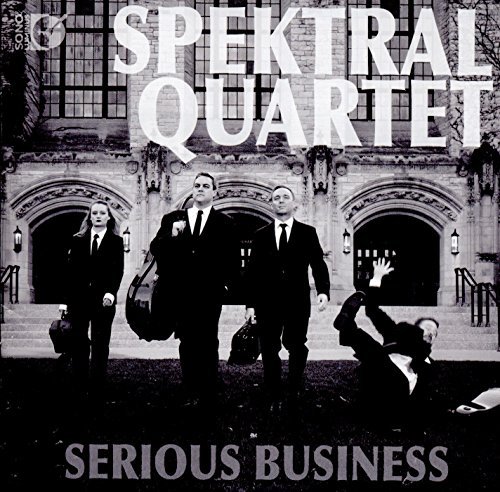
WHO: Spektral Quartet WHAT: New works by Sky Macklay, David Reminick, and Chris Fisher-Lochhead, plus a Haydn quartet RELEASED: January 2016 LABEL: Sono Luminus
Challenge: I'm going to write this post before my oxtails come out of the pressure cooker in half an hour. For those of you who care: onions, garlic, stock, and red wine (a little bit for the oxtails, a little bit for me 😉). That's it.
Classical music is too damn serious. Have you ever dropped your program during a piece? People will literally look at you as if they want to throw you off a bridge.
Classical music hasn't always been so serious -- you can thank Richard Wagner for that -- but rarely is it overtly funny (barring opera buffa, of course). Haydn had his moments, even Mozart and Beethoven stepped into parody-land once in awhile.
For this album, The Spektral Quartet asked three composers to try their hands at "funny music" with wildly different results. Sky Macklay composed a piece that consists entirely of cadences -- Many Many Cadences as the title so creatively describes. The cadence, of course, functions as a tonal stabilizer. Macklay forces the quartet to hop between cadences with such speed that any sense of stability is lost, even though there is theoretically a "stabilization" every few seconds.
David Reminick chose absurdist poetry as his starting point; The Ancestral Mousetrap requires the quartet to sing a libretto by poet Russell Edson. They sing very well, proving my theory that instrumentalists are sometimes better singers than singers. One of the members sounds like Elvis Costello -- whoever does the bulk of the singing on the 4th movement.
The final premiere on the album, Chris Fisher-Lochhead's Hack, uses the instruments of the quartet to model the sounds produced by standup comedians during their routines. My linguist brain was intrigued. On the album, it doesn't evoke human speech so much, but it's so cool when they map the composition over the comedian's bit. Either way, cool piece.
And then in the middle of all this fun new music came the Haydn "Joke" quartet. I've played it. It's funny. But also, I kind of wish they had commissioned another new piece? I'm not exactly complaining, I'm always in favor of a good performance of a good Haydn quartet. But it also seemed a touch out of place.
Anyway, great album. Go listen. My oxtails are calling.
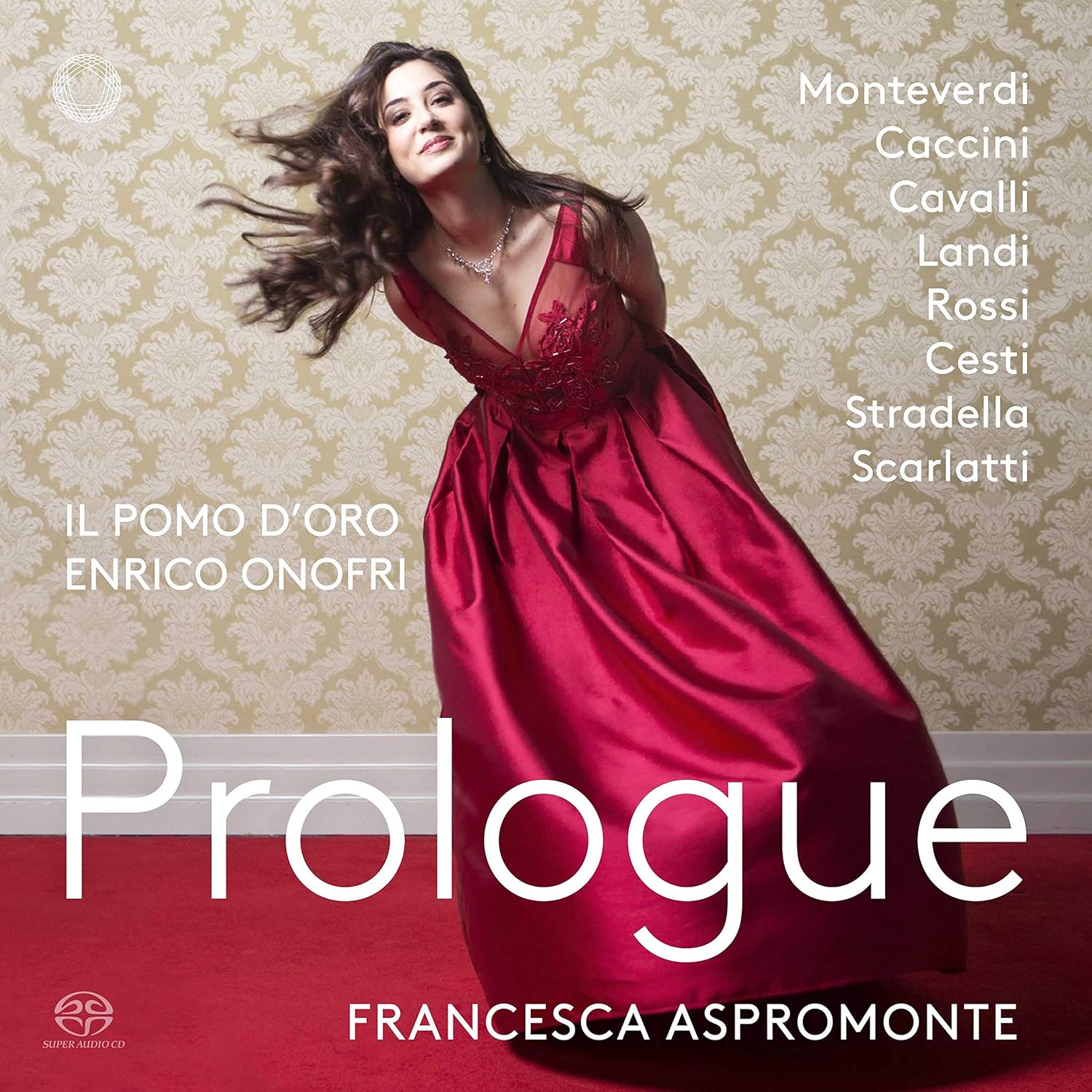
WHO: Francesca Aspromonte, soprano; Il Pomo d'Oro; Enrico Onofri, director WHAT: Prologues to operas by Monteverdi, Caccini, Cavalli, Landi, Rossi, Cesti, Stradella, and A. Scarlatti RELEASED: May 2018 LABEL: Pentatone
Guys, I'm really fucking bored. My brain is kinda turning to mush. I've turned to practicing cello to give myself something to do. Do you know how much I hate practicing? A lot. I hate practicing a lot.
Anyway, one thing I think we could all use during this weird, crazy time is music to listen to -- according to an email that one of my professors sent a couple hours ago, "music can be at its most powerful in times of crisis and uncertainty." Musicians always know how to cheer up a crowd, huh?
So I'm going to try to review an album every day that I'm stuck inside. No particular theme, just what I happen to be listening to at the moment. They're not going to be long, but hopefully they'll keep me busy and give you some new music to try out.
One thing that you should know about me is that I organize all the music I have yet to listen to into 60 or so playlists according to instrumentation and time period. "Romantic Keyboard"; "20th-Century Choral"; you get the idea. My "Baroque Solo Vocal" list is on the long side -- up around 170 hours (but I'm also terrible about clearing out what I've already listened to).
Today, I wanted Italian baroque opera, probably because I'm mourning the cancellation of Yale's annual baroque opera project (Cavalli's Doriclea, for anyone who cares -- good luck finding a recording). Luckily, this was near the top of my list.
Though prologues have fallen out of fashion in opera today, they were among the most important parts of early operatic structure. An allegorical character -- usually just named "Prologue" -- would come onstage and address the audience directly, breaking the fourth wall and foreshadowing the overarching themes of the plot to come. Usually, this takes the form of a recitative (imagine you're speaking, but while singing one note over and over again) with instrumental interludes (usually ornamented versions of a single theme).
Owning a recitative is hard. I've tried (and failed) myself -- it takes a lot of energy to make a repeated note interesting. You wouldn't know that from Francesca Aspromonte's performance. Recitative is clearly second-nature to her; her text stresses land with gravity, but don't halt forward momentum. Her voice is clear and sweet, blooming beautifully in the brief arias where she has less text to worry about.
Il Pomo d'Oro somehow put out six albums in 2018 alone, and all of the ones I've listened to are fantastic. This pared-down ensemble of a couple violins and a continuo section hits the mark; the violinists clearly play together rather than following one another, and the harpsichordist's improvisations combine pinpoint precision with wild, unhinged improvisation.
WHO: The Juilliard Orchestra; Jeffrey Milarsky, conductor; Jaewon Wee, violin WHAT: ANNA THORVALDSDOTTIR Metacosmos; PROKOFIEV Violin Concerto No. 2; BARTÓK Concerto for Orchestra WHERE: Alice Tully Hall WHEN: October 17, 2019 at 7:30pm
God, why is the music world so small?
I think I jinxed it by mentioning that I didn't see anyone I knew at the Dover Quartet the other day. But every concert since then, I've randomly run into at least one person I know.
As soon as I'm through Alice Tully security check, I run into a music camp friend. Then another. Then I sit down, and I find out that no fewer than five close music camp friends are in the Juilliard Orchestra for this concert.
Anyway, my last two reviews have been really, really long, so I'm going to try to keep this one relatively short. I saw the Juilliard Orchestra last year with phenom conductor Barbara Hannigan (who was giving a recital across town at the Park Avenue Armory -- sold out to the rafters, naturally), and they sounded tremendous. The centerpiece of that program was also Bartók (his suite from The Miraculous Mandarin), so I figured, why not?
From my sample size of two (2) concerts, I've come to a conclusion about the Juilliard Orchestra: they'll never be bad. It's an orchestra comprised of the best young musicians around. The intention, the musicality, that will always be there.
But sometimes, Juilliard students have busy weeks. That's what this concert sounded like: an orchestra of phenomenal musicians, each of whom had fifteen million other things on their minds this week.
Consequently, the Thorvaldsdottir was probably the best-played thing on the program, and my favorite. Metacosmos sort of smears time in a way, blurring the lines between beats such that precision is not so important as transparent, visceral emotion. That's kind of a given for most of the musicians at Juilliard -- another day at the office.
But the orchestra began to fall apart behind Jaewon Wee's Prokofiev. Some of the orchestra knew the parts, but there was a critical mass of musicians who failed to look at the conductor's beat, resulting in a slow, but steady phasing effect between strings, winds, and brass. Luckily, Wee put up a well-polished performance that all but covered the missteps of the orchestra. I didn't necessarily feel like I was in the palm of her hand, but hey, we can probably blame that on the orchestra.
The Bartók was vigorous, if a little sloppy. The couples in the giuoco delle coppie ("game of the couples" were coordinated and well-rehearsed; the trumpets and trombones deserve a special mention for the chorale at the midpoint of that movement. The principals were all so very well-prepared, every solo sending my jaw straight to the floor. But once again, that phasing effect was persistent and ever-present. Maybe that burden falls on the conductor -- Milarsky's conducting seemed serviceable, though not particularly clear.
So, in conclusion, the Juilliard Orchestra is always worth seeing, even when they're not at their finest. When they bring in big name conductors, the quality is usually better (a friend was telling me about a few weeks ago, when Karina Canellakis conducted Ein Heldenleben -- best concert he'd ever been to). But when it's a staff conductor, just be warned: a bunch of great musicians do not an orchestra make.
For the love of god, Juilliard Orchestra, treat yourselves to a glass of wine, some Real Housewives, and a nap before your next concert. You all deserve it.
Second update: I made it to October break in (more or less) one piece. And you know what that means: another concert binge.
I know I've been making noise about a ten-concerts-in-five-days October blitz. But a couple weeks ago, after one too many nights staying up until 3am doing schoolwork, I looked at the list of ten concerts I had planned and only one thought popped into my head:
"This feels like a bad idea."
So I'm only going to seven (maybe eight) concerts this break. And I'm going to blog about all of them, but it's not going to be a formal concert blitz. I'm just going to blog for fun. You know, like a normal blogger -- quality over quantity (what the hell was I on when I thought up of #1Summer50Concerts?). The reviews will come out over the next few weeks.
I love finding ways to put off schoolwork. So, a few weeks ago, when I should have been writing papers, I reached out on a whim to the Carnegie press office, asking if they had any extra tickets for this particular concert. They were so nice, but the gist of what they said was: "Get in line."
Yesterday morning, literally the day of the concert, I got the coveted email: there's an extra ticket, it's yours if you want it, just let me know. I squealed. My breakfast date (Sarah, I know you're reading this) rolled her eyes and didn't talk to me for the rest of the meal.
I dropped my alternate concert plans (we all have those, don't we?) and booked it to Carnegie as soon as my train got in (twenty minutes late, by the way). I sat down and looked around; for the first time in who knows how long, I didn't recognize a single other person in the audience.
I see good concerts all the time. I see great concerts less often, but still regularly. But only once in a while do I see a concert and think, "Wow, that was stupid good."
Well, the Dovers are stupid good.
PC: Carlin Ma
Okay, confession time. You may recall that I reviewed the Dover Quartet this summer for Opera News, but I couldn't really tell you guys what I thought because I didn't want to give the magazine old news. Well, that review is now in print, so I can say whatever I want. So full disclosure: I've known that the Dover Quartet was fantastic for, like, four months now. But now I can finally say it loud and proud: I'm a diehard Dover fan.
Of course, I'm glad I got to see this whole program. But I'm especially glad that I got to hear the Dovers' take on Britten. Outlandish but not wholly unfollowable, Britten's first quartet proved the perfect canvas for Dover to release their inner cheekiness. The quartet managed to invoke that dry British sense of humor in a way that was full, unfettered, and most importantly, entertaining. The tender violin duets of the first movement were so theatrically interrupted by bawdy prestos that there may as well have been a laugh track. Cellist Camden Shaw's eyebrows tracked the satire through the off-kilter scherzo. The slow movement highlighted violist Milena Pájaro-van de Stadt's flawless playing (to quote the older European gentleman sitting next to me: "Viola playing doesn't get much better than that!"). And the blazing three-minute finale brought everything to a close with adequate pomp and circumstance.
Oh yeah, the Brahms was also great. But like...the Britten.
This is how Barber originally wrote the Adagio for Strings before revising it
twice (once for string orchestra, once for choir). I think it's best for quartet.
And then there was the Schumann. It takes one hell of a quartet to be a match for Emanuel Ax, and I've seen instances where Ax plays with a chamber group that is most certainly not up to his level. But this was perfect. Dover is very new-school, Ax is very old-school, and the collaboration let each explore aspects of the other's playing. The quartet was a little bit warmer and rounder; Ax kept his crisp touch, but was lighter on the pedal than usual. The result was a harmonious tone that could only be described not as the Dover Quartet, not as Emanuel Ax, but as "the Dover Quartet with Emanuel Ax."
The performance was so fantastic that I barely noticed the faint, but ever-present sound of the NQRW trains roaring past the underground Zankel Hall. Whose bright idea was that, again?
Me, finishing something I started for the first time, like, ever
WHO: Takács Quartet; Jeremy Denk, piano
WHAT: MOZART String Quartet No. 21 in D major, K. 575 "Prussian"; BEETHOVEN String Quartet No. 16 in F major, Op. 135; DOHNÁNYI Piano Quintet No. 1 in C minor, Op. 1
WHERE: Alice Tully Hall
WHEN: August 5, 2019 at 7:30pm
I'm going to spare you the gritty details, but let me just say this -- I was a little bit emotional at this final concert. And it wasn't just because of the heart-rending slow movements from the Beethoven and the Dohnányi.
As the lights dimmed, and the robo-voice over the loudspeaker told the audience to silence their cell phones, I couldn't help but notice that the sad cavern in my stomach trumped the endorphin rush of triumph.
So much for sparing you the gritty details.
I posted about concert #50 on my Snapchat and got plenty of congratulations, but as I pointed out to all of my loyal followers, it's not over until it's over. Review #50 hasn't hit the web yet. Well, here it is.
I started this project with the most niche concert I could find. Well, it appears I've sold out -- here's a review of, like, one of the most famous quartets in the world.
I went into this concert with a more or less neutral idea of Takács. I listened to one of their Beethoven quartet recordings a while ago. I may have listened to a couple movements of the Bartók cycle at some point. But that's about it.
Takács is not a quartet where you have to call into question whether they play musically, or how well they play well as a quartet. They're obviously very good. The only thing I can do is to ask myself whether they approach the program the way I would. And the answer to that is...kind of?
Takács's approach to Mozart is distinctly different from mine. I love to relish in Mozart's simplicity, striking a balance between imparting my own musical ideas and letting the bright levity of the score speak for itself. Takács erred definitively on the side of the former, and to my ear it seemed a little bit overworked. It didn't help, of course, that their interpretation seemed overly romantic -- their wide, fast vibrato was always audible, which is *probably* not how Mozart would have wanted it. Oh, and it felt like cellist András Fejér was celebrating the upcoming Bartók anniversary a few months early with his short, hatchet-y accompanying strokes. Again, these are all personal objections. Objectively, they played very very well.
Their Beethoven was a little more to my liking -- their approach wasn't so different from that for the Mozart, but it felt a bit more appropriate for the parodistic aspects of Op. 135. Plus, as I said before, that slow movement was to die for (or, in my case, to cry for). And their romantic approach to the Dohnányi was perfectly idiomatic, strengthened by Jeremy Denk's insistently emotional, yet transparent playing.
My mind wasn't blown, but I still left pleased. Takács is eminently reliable. And besides which, I wasn't *really* thinking about the music. I was crying on the inside as the lovely critic sitting next to me (whose name I didn't catch -- he had to run for a train) was waxing poetic about Pekka Kuusisto's abomination of a Four Seasons mashup with Scandinavian folk music.
And now I'm crying on the outside. Stay tuned for the summer wrap-up posts, hopefully coming before my classes start on Wednesday!
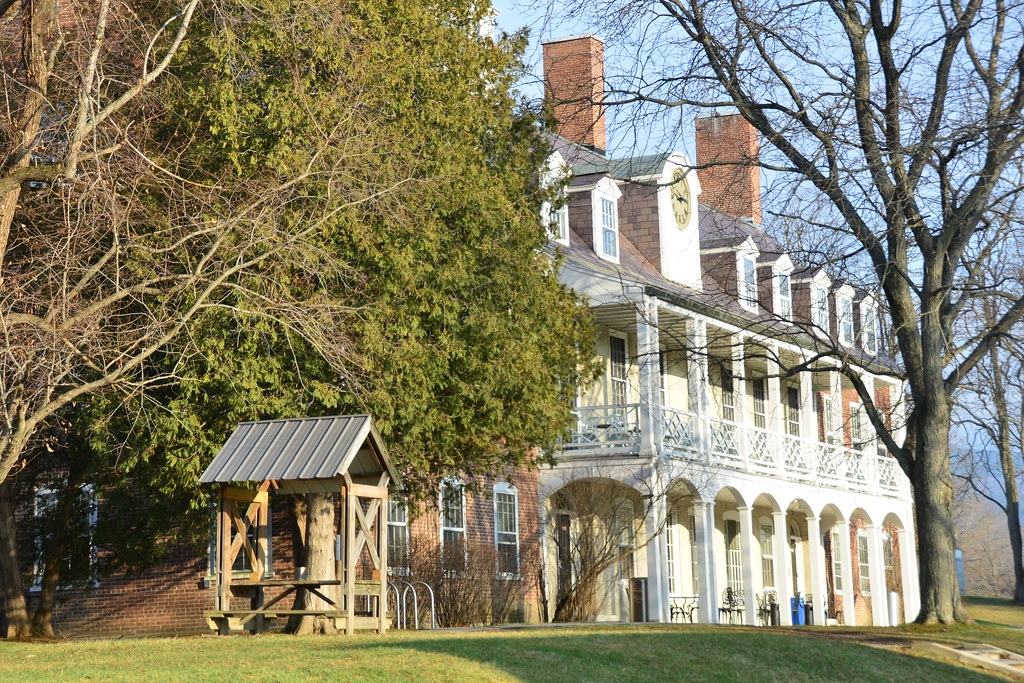
WHO: Faculty of Chamber Music Conference of the East WHAT: SCOTT WHEELER Piano Trio No. 2 "Camera Dances"; HINDEMITH Kleine Kammermusik, Op. 24 No. 2; BRAHMS Piano Quintet, Op. 34 WHERE: Greenwall Auditorium, Bennington College, Bennington, VT WHEN: August 3, 2019 at 8:00pm
An abridged list of things I did during my week at Bennington:
Play the Beethoven "Ghost" trio
Play Shostakovich's 7th string quartet
Play a Beethoven quartet (Op. 18 No. 6, for those who are counting)
Play a Mendelssohn quartet (Op. 12)
Explain to my friends approximately 47 times that yes, I go to a music camp that requires me to learn four full pieces in one week, and yes, this is my idea of fun
Get called a masochist approximately 47 times
Have a conversation with the Bennington College music librarian that ended with, "I'm so glad that score of Schoenberg's Book of the Hanging Gardens (which was on sale for $2 at the annual music sale) is going to a good home." Why yes, I'll feed it and water it and turn it towards the sunlight, just like I do with the rest of my....scores?
Read Shostakovich's second piano trio (read: really really hard) with one of those pianists who is like "oh yeah, I'm just sightreading" and then proceeds to nail 90% of the notes at full tempo. She may be reading this. She knows who she is.
Eat lots of dining hall food, reminding me that yes, I am happy to have a kitchen this upcoming year
Pitch the #1Summer50Concerts project approximately 47 times
Explain approximately 47 times that yes, I went to 50 concerts and yes, I enjoyed myself
Get called a masochist approximately 47 times
Blog while sitting on a bench that overlooks miles and miles of open field (with a little path weed-whacked into it so people can go on walks through the waist-high grass) while listening to Alexandre Tharaud's recordings of the last three Beethoven piano sonatas (would recommend)
Explore said open field, for shits and giggles
Come across a mystical forest path that looked something like this:
Enter the forest path
Come out the other side to this view:
Scare a mama deer a little further down the path
Stargaze
Obsess over shoes and Bruno Helstroffer (the world's sexiest lute player) with a group of snarky childless 40-somethings
Sweat. A lot. The music building wasn't air conditioned.
An unabridged list of things I did not do during my week at Bennington:
WHO: Faculty of Chamber Music Conference of the East WHAT: MENDELSSOHN String Quartet No. 6, Op. 80; MOZART String Quintet No. 3, K. 515 WHERE: Greenwall Auditorium, Bennington College, Bennington, VT WHEN: July 31, 2019 at 8:00pm
Ultimately, I decided not to write a college essay on Kinhaven, my most formative music camp experience, for much the same reason I didn't wax poetic in my last post -- I didn't/don't think I can put words to paper that express how much that location means to me.
I also love Bennington, a weeklong summer chamber music camp for grownups in southern Vermont. But it's less emotional for me, mostly because I can keep going back summer after summer until I keel over. So I wrote a college essay about it -- nothing long, just one of the 300-word essays.
And as I was thinking about what to write for this post, I thought to myself: who better to tell you what Bennington means to me than 17-year-old me trying to pander to admissions officers? If I convinced them, then certainly I can convince you(?).
Here it is: my Bennington essay, unedited from the time I hit the "submit" button.
"It’s my first day at Bennington Chamber Music Conference in Vermont, where I’m the only teenager among several hundred amateur musicians. I take my cello out of my case and sit down. I start to leaf through the piece in front of me, the famously difficult Mendelssohn Octet. My stomach churns. I chat nervously with the other players for a while as we wait on our first violinist. We hear a knock on the door: it’s Shem Guibbory, a violinist from New York’s Metropolitan Opera Orchestra.
"Oh, brother.
"My week at Bennington was a baptism by fire. I expected a relatively low-key experience; I had just come from six weeks at another intense music camp, and I assumed I’d have some time to relax.
"I was wrong. A friend explained the schedule: in addition to two professional coachings per day on pre-practiced pieces, there were four free periods per day to sight-read. The typical day started at 9am and didn’t end until midnight. And playing with seasoned professionals was the norm, not the exception.
"That first day, I sight-read 6 full pieces, in addition to the ones on which I was being coached. By bedtime I was catatonic. But I was learning. Reading Allen Shawn’s Dreamscape cemented my love for modern music. Shostakovich’s piano quintet reminded me that as the cellist, I was responsible for driving the music forward.
"Most of all, Bennington showed me how I want to live. The enthusiastic amateur musicians around me had demanding jobs (doctors, professors, and environmental scientists, just to name a few) but all had carved a week out of their busy schedules to play chamber music in the mountains. It was here that I realized that I want music to be a part of my life forever, but I don’t want to play for a living. I want my career to challenge me intellectually and support me and my family, and I want to spend my vacations making music with friends in the mountains."
FIN
I don't know why, but when I read that in my head, it's in a pre-pubescent 12-year-old Emery voice. Does that mean that in 20 years, when I look back on these posts, I'll read it like that, too?
I should take a moment to mention that the Mendelssohn on this concert was truly astounding. Bennington's faculty have just as much fun as the participants -- because Bennington is all adults, the coaches can be more relaxed and open with the students than they could be at a high school festival. But don't be fooled -- each faculty member is alarmingly accomplished.
The Mendelssohn quartet was headed by Diana Cohen, concertmaster of the Calgary Philharmonic. Personally, I think she should quit that job and become a full-time chamber musician, she played that well -- the amount of fiery soul she managed to impart in those 25 minutes is completely beyond words. Second violinist Alex Fortes (who, it turns out, was sitting not ten feet from me at ChamberQUEER earlier this summer) mirrored her affect perfectly, providing a support network for her to soar. Violist Korinne Fujiwara (of the Carpe Diem quartet -- also a fantastic coach) and cellist Maxine Neuman (a longtime festival mainstay and Bennington College faculty member) rounded out the jaw-dropping ensemble.
That's about all I have to say for now. More on Bennington in the next post!
WHO: Mostly Mozart Festival Orchestra; Andrew Manze, conductor; Vilde Frang, violin WHAT: BEETHOVEN Violin Concerto; Symphony No. 3, "Eroica" WHERE: David Geffen Hall WHEN: July 23, 2019 at 7:30pm
Not gonna lie, I've been a scaredy cat this summer. I chickened out of talking to Caroline Shaw. I haven't gone up to talk to any artists after concerts unless I know them.
Well, I decided that was going to change a couple weeks ago. After this concert, I spotted someone with a violin a couple feet ahead of me. The strange thing was that she wasn't in concert black, even though the concert had ended not five minutes before.
And then I looked at her hair and had a light-bulb moment. I turned to my friend and said, "I recognize those beautiful blonde highlights."
It was Vilde Frang, walking back to the subway. As one does when in New York.
Yeah, I accosted Vilde Frang on the street to tell her what a great performance she gave. We talked for all of 30 seconds. I found out that the cello is her favorite instrument (not that I asked that specifically -- what am I, a middle schooler at an open rehearsal Q&A session?). It was moderately awkward. She seemed flattered. I would have been intimidated, butt then again, a chubby 20-year-old outwardly gay concertgoer with two days' worth of five o'clock shadow isn't exactly something to be scared of.
But of course, I didn't tell her I was reviewing the performance. Maybe should would have been a little more intimidated by me then.
Me at, like, every single concert so far this summer
Everything I said to her was well-deserved. Her performance was one that satisfied my inner musician. She didn't show off; it felt like her mission was to deliver the most honest, enjoyable interpretation she could muster. Vilde Frang served the music, which is something that so few of the big popular soloists do effectively. During the orchestral interludes, she seemed to get lost in the texture, staring off into the distance, making way for her colleagues -- she treated the orchestra as equals, not inferiors -- to work their magic. Her playing was aggressively precise, but didn't sacrifice any of that introspective simplicity that I crave from middle Beethoven.
I walked out of the first half of the concert convinced that the Beethoven violin concerto was the best piece ever written. I kind of get that way every time I hear the Beethoven concerto. I'm not sure if that opinion is defensible, or even if I believe it. But you know, even if I don't truly believe it, I'd be happy to defend that opinion any day.
In my first post of the summer, when I went to see the S.E.M. ensemble, I mentioned that I turned down an opportunity to see the NY Phil playing Beethoven's Third™ because I knew I'd get to see it again in the near future. The fact that, not even two months later, a different orchestra is playing the same piece in the same hall should validate my decision.
That said, I'm pretty sure the MMFO did a better job than the NY Phil would have. I mean, the orchestra gets together every year to play *mostly* Mozart (oh, that's why they call it that!), so it felt like they were in a more appropriate mindset for that late-classical style. The word that Andrew Manze's interpretation drew to mind was light -- even in the loudest climaxes, there was still a wind blowing the orchestra from underneath, keeping them bobbing along to the sometimes-rollicking, sometimes-sagging beat. Special mention should go to the first oboist of the orchestra, Katherine Needleman, whose solos contributed to the levity from atop the orchestral texture. All of her solos, whether twenty measures or two, made me feel that amazing shiver up my spine.
God, I'm so glad I went. And now I've proven to myself that I have the balls to approach performers after concerts. Now, I try to rationalize it by assuming that people like to hear how great they are. But is that actually true? Do performers actually like being approached by strangers?
I don't know, maybe my *good friend* Vilde Frang will be able to answer that!
WHO: Anthony McGill, clarinet; Bella Hristova, violin; Nicholas Canellakis, cello; Juho Pohjonen, piano WHAT: MOZART Violin Sonata No. 32 in B-flat major, K. 454; BRAHMS Clarinet Trio in A minor, Op. 114; ARENSKY Piano Trio No. 1 in D minor, Op. 32 WHERE: Alice Tully Hall WHEN: July 14, 2019 at 5:00pm
I have exceptional luck when it comes to getting into sold-out concerts. From Chunky in Heat at the very beginning of the summer, to Pierre Hantaï in mid-June, and a couple others pre-summer, I usually can negotiate myself into at least standing room.
I've only been turned away from one concert this summer, and that was the first of the Chamber Music Society of Lincoln Center's first summer evening concert on July 10. The Wednesday evening concert, which featured works of Schubert and Dvořák alongside Mendelssohn's rarely heard piano sextet, was sold out except for one seat which was offered to me at a premium of $85 -- to be expected considering the lineup, which included famed pianist John Kimura Parker, NY Phil principal violist Cynthia Phelps, and Tokyo Quartet cellist Clive Greensmith.
So I decided to come back with some friends and try for the next concert. Three $10 tickets later and we were sitting in the third row waiting eagerly for the downbeat.
Our anticipation was met with a heaping bowl of meh.
I mean, it wasn't unpleasant. The notes were correct, at least. But the musicians were, for the most part, dialing it in. Bella Hristova's Mozart wasn't particularly musically interesting, not that you could hear her above Juho Pohjonen's hammer-hands. I think the Mozart might have suffered from Hristova's nerves, though -- her Arensky was much looser and more refined.
Nick Canellakis's vibrato covered up anyone who he played with, most notably clarinetist Anthony McGill. From what I could hear of him, McGill played the most genuine performance of the evening, granted I could hear precious little over the opaque stylings of Canellakis and Pohjonen. And Pohjonen had possibly the most awkward stage presence I've ever seen, his face motionless and his body just kind of jerking around.
I don't want to belabor negativity, but I'll finish by saying this: I could see Canellakis being a great soloist in a thousand-seat concert hall. Pohjonen as well. I know for a fact Hristova can play the shit out of her instrument -- see the video at the top of this post. But this was simply not their day.
At least there was free wine after the performance :)
P.S. I'm no style guru, but CMS seriously needs to learn that white jacket + black tie is not an indoor look. Period.
Perks of reviewing for legit organizations: actual professional photos (PC: Gabe Palacio)
WHO: Davóne Tines, bass-baritone; Dover Quartet WHAT: MENDELSSOHN Theme and Variations, Scherzo, and Fugue from Four Pieces for String Quartet, Op. 81; BARBER Dover Beach; CAROLINE SHAW By and By; DVOŘÁK String Quartet No. 14 in A-flat major, Op. 105 WHERE: Spanish Courtyard at Caramoor WHEN: July 12, 2019 at 8:00pm
I'm not going to say much about this performance -- I reviewed this concert for Opera News and I don't want to give away my opinions before it gets published. I'll link the review here once it gets published -- you can read it if you're a subscriber.
In the meanwhile, here are a few things that I didn't get to mention in my review:
Davóne Tines's stage outfit was a black suit with no shirt. Let me tell you, he ROCKED it.
There was some action with candles onstage -- Tines lit a candle in the silence between Dover Beach and By and By, and an ill-timed breeze nearly burned the stage tent down.
At the pre-concert Q&A session, a(n over-)zealous chamber-music camp parent chaperone asked Dover cellist Camden Shaw how he handles it when he gets lost in a performance. After a short pause, he answered in his booming, croony voice, "I don't know, look pretty?"
Caramoor is absolutely LOVELY. You know why? Because nature is great. NYC almost made me forget that.
Caroline Shaw was not there or I would have said hi to her this time. I promise.
WHO: Pauline Kim Harris, violin; Spencer Topel, electronics WHAT: HARRIS/TOPEL Ambient Chaconne; Deo WHERE: The Stone @ The New School WHEN: July 11, 2019 at 8:30pm
In theory, going to concerts shouldn't be tiring. You get to sit. In air-conditioning, usually. Other people do the work of filling your ears with beautiful music. It's all included in the ticket price -- you just sit back and relax.
But going back to what I said a couple posts ago about not being able to turn my critic brain off -- concerts are tiring for me. In my mind, listening to music is synonymous with forming judgments. I don't see that as either a good thing or a bad thing. It just kind of is how I work.
Occasionally, though, I wish that I could lose myself in a concert. Turn off my brain for a few minutes.
I'm not going to tell you that I succeeded. But I came damn close at this concert.
I'm usually not a huge consumer of ambient music, but there are some great classical-ambient crossovers. I think that the Harris/Topel duet is going to join the greats of the genre when their new album comes out in September. Armed with only a violin, a microphone, and a soundboard, the two presented a refreshing take on Bach (and also another composer -- I'll explain in a second).
I can't tell you a whole lot about the music itself. It moved slowly, sometimes changing so slightly over such a long period of time that I couldn't detect the transformation until after it had already happened. There were no jagged new-music-characteristic jump scares; just the sweet tone of Harris's violin, looped and amplified and augmented.
The first piece, Ambient Chaconne, was a transformation of the famous chaconne from Bach's D minor violin partita; bits and pieces were recognizable throughout, but the already-long piece was lengthened from 15 minutes to almost half an hour with a range of clever electronic fillers. (Side note: I turned to my trumpet-playing friend after the performance and asked if he'd heard the original chaconne. Blank stare.)
The second piece was based on a Deo gratias -- I heard the composer as Lachenmann, my friends heard Bach. Neither of those people wrote Deo gratias settings. Phooey. But it was great.
Update: I just looked at the album's liner notes. It was Ockeghem's Deo gratias. I think I was closer.
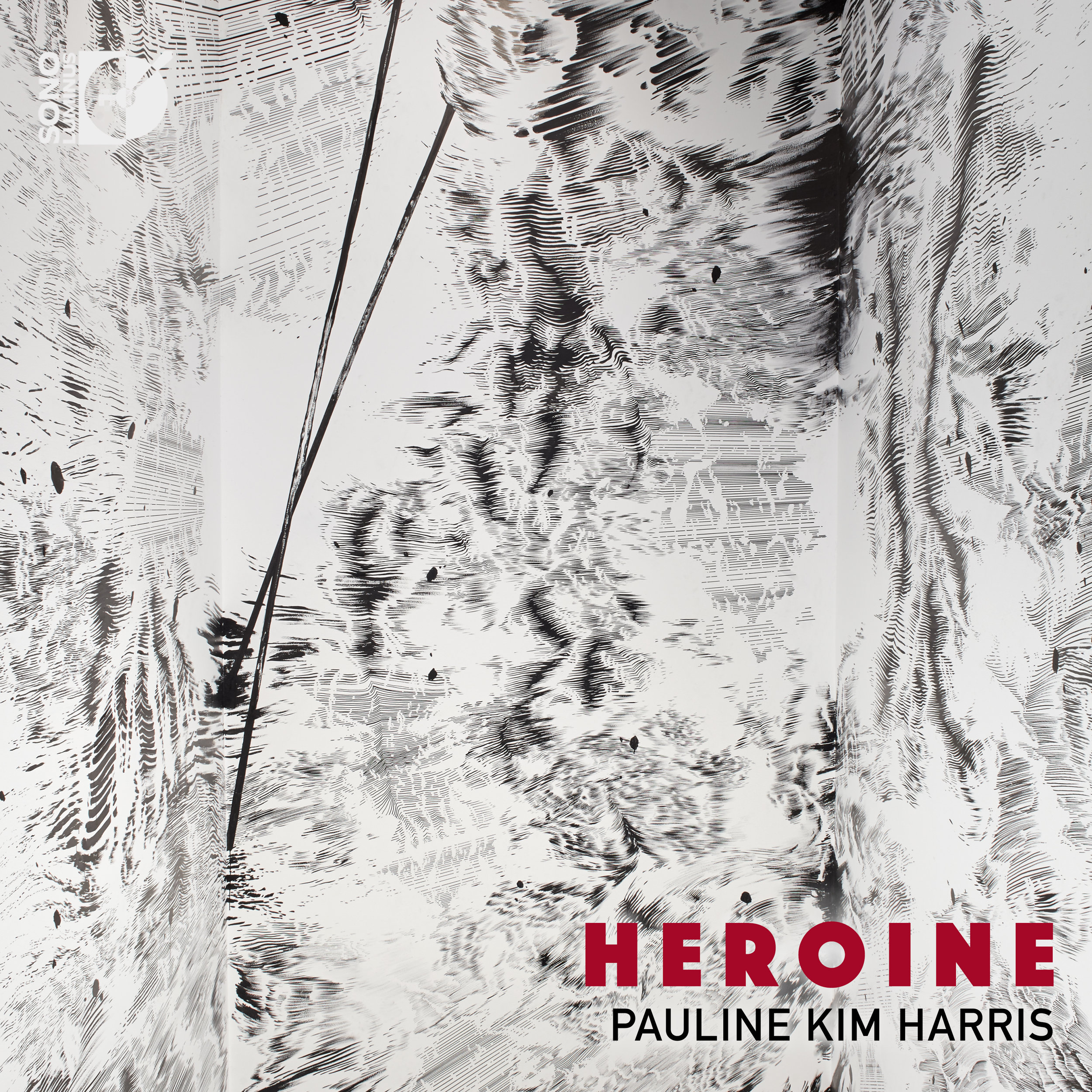
You can pre-order the album, Heroine, here, or just wait until September 27, when it will hopefully be available on Spotify. Fingers crossed.
EDIT: It's September 27, and the album dropped and is just as good as the live version was!
WHO: Pauline Kim Harris, violin; Christopher Otto, violin; Ches Smith, drums WHAT: JOHN ZORN Passagen for solo violin; Apophthegms for two violins; Ceremonial Magic for violin and drums WHERE: The Stone @ The New School WHEN: July 9, 2019 at 8:30pm
So this is my third concert so far at The Stone, and I have to say it's one of my favorite new concert venues in Manhattan. They run on a jazz-club schedule: artists take up weekly residency from Tuesday to Saturday and play a different hour-long show each night at 8:30pm. I have to imagine it's hard for the artists, but I've never seen any player at The Stone that looks like they don't want to be there, so they must be doing something right.
But even though they started as a jazz club of sorts (before they went under and The New School picked them up), the conservatory atmosphere has been infusing more experimental classical music into their ranks. Pauline Kim Harris was the first artist this summer who I would confidently say falls firmly in the classical camp, but she started her residency with a program from John Zorn, a composer who treads the line between experimental classical and experimental jazz.
Zorn's music is the most organized chaos you've ever heard. After a few minutes, you sort of write off any possibility that the instrumentalists are still in the correct place in the music -- of course, as soon as you do that, they come to some sort of serendipitous moment with *gasp* a consonant major chord or something like that and you realize that all of that chaos was just a means to an end (or vice versa?).
Pauline Kim Harris's playing was great, although her sound felt a little bit stifled by the red velvet curtains that were drawn around the audience and stage. Of course, that's not her fault -- her instrument has a quieter setup, so it needs a hard shell around the stage. But, for her sound problems, her playing was still vivacious and accurate.
Her co-conspirators didn't overshadow her, but were tremendous in their own right. JACK Quartet violinist Christopher Otto, armed with a louder instrument than Harris's, performed that Apophthegms as if it were encoded in some collective strand of DNA that he and Harris shared (it became eminently clear that their friendship was primarily musical by the awkward hug they shared after the performance). Ches Smith's drumming was possibly the highlight of the program -- the paradox between his sticks playing passages that would make Whiplash go pale, contrasted with the calm, slackjawed look on his face, was especially amusing.
Go to The Stone. That's all I'm going to say. Best $20 you'll ever spend.
WHO: Vivica Genaux, mezzo-soprano; Aisslinn Nosky, violin; New York Baroque Incorporated WHAT: Works by Corelli, Vivaldi, Handel, Hasse, and Geminiani WHERE: The Venetian Theater at Caramoor WHEN: June 30, 2019 at 4pm
Concert #32: In Which I Was a Bad Gay
June 30, 2019 was World Pride. Four million people poured into the lower quadrant of Manhattan and celebrated with rainbows and glitter and hoopla. I was not one of them. This could just be me, but being stuck in a four-million person crowd with no place to go to the bathroom doesn't exactly sound like my idea of a good day.
Plus, I rationalized, it's not like I hadn't been prideful for the entire month leading up to World Pride. I will direct you to concerts #23 and #25, which literally had the word queer in their names.
The truth is, I actually just made a dumb scheduling mistake. I was 100% convinced that the pride march was on Saturday 6/29, so I made plans with a friend's mother to go see this concert on 6/30 (yes, I'm that kid who makes plans with his friends' parents). Turns out I was wrong, and I decided that I wanted to see Vivica more than I wanted to buy a rainbow shirt and ruin it in one go by standing for eight hours in the sauna that is the West Village. Sue me.
Anyway, I think I made the right choice. Katonah is absolutely gorgeous. Everything is green. The air smells less like garbage (why doesn't NYC have dumpsters???? anyone????). I love NYC, but it's anything but a relaxing place. I took one step off the greenery-lined platform at the Katonah Metro-North stop and it was as if my responsibilities vanished -- crazy considering that I was probably ten concert reviews behind at that point.
Weirdly enough, Vivica Genaux never comes to the US. She made only two appearances stateside this year, and she has not a single one scheduled for the 2019-2020 season. Based out of Italy, she gives most of her concerts in western Europe.
The concert, at face value, looked like old-people bait. That one Corelli concerto grosso that everyone knows (D major, Op. 6, No. 4). The obligatory concerto from TheFour Seasons. Vivaldi. Handel. Vivaldi knockoff. You know.
But New York Baroque Incorporated did a great job of treading the line between crowd- and connoisseur-pleasing. Their Corelli was whimsy and spontaneous as concertmaster Aisslinn Nosky goaded solo second violin Alana Youssefian with a twinkle in her eye; on passages of repeated notes, Nosky dared Youssefian to rival her creative ornamentations (Youssefian obliged with a smirk).
The video looks a little bit like one of my fifth-grade iMovie projects, but the playing is top-notch!
Aisslinn Nosky stole the instrumental portion of the show. When I saw her in ChamberQUEER a few weeks before, her motions were moderate (the audience, after all, was about five feet in front of her), but her playing still effectively colored her the badass-du-jour. On the stage of the Venetian Theater, she let loose. Her stylings on "Winter" from The Four Seasons were agitated and overflowing a controlled, but chaotic energy; Nosky's emotion seemed more like that of a rock guitarist than that of a baroque violinist, her blood-red hair barely keeping its faux-hawk. And though harpsichordist Avi Stein was sitting in the conductor's chair, it was obvious throughout the concert that Nosky actually wore the pants in the ensemble -- once again the badass-du-jour.
Badass-du-jour, of course, apart from Vivica Genaux. As soon as she (and her dress-tail) swept on-stage, the presence was palpable. She alternated with facility between the opera seria archetypes: from lovesick, woebegone, and hopeless to oozing bravura at the very touch. Her technique was a little weird -- she produced vibrato and pitch changes by wobbling her lower lip, so even in the arie di bravura she still looked a little bit sad. But close your eyes, and you couldn't tell the difference. In the second half of the concert, she changed to a white pant-suit to sing Handel's cantata Armida abbandonata, the heart-rending story of a Saracen queen's lost love. She continued on with two encores written for Handel's favorite castrato (look it up if you don't know what it is) Farinelli, each delivered with joy and pizzazz.
Did you know one of the B's in ABBA stands for baroque? True story.
So TL;DR, no, I don't regret my decision. I came back to the city in the late evening and I was hydrated, fed, and had Handel in my ear. I heard World Pride was a spectacle to behold. But honestly, my biggest regret was not seeing the MET float, complete with Anthony Roth-Costanzo in drag and Stephanie Blythe in flashy surrealist garb. All the other corporate BS, I was happy to do without.
Caramoor's summer is almost over -- make sure you stop by before the end of the summer festival or for one of their precious few year-round performances!
The piece is based on Bach's fourth cello suite -- see the resemblance?
WHO: Elissa Cassini, violin & Ashley Bathgate, cello WHAT: WINKELMAN Rondo with a Janus Head; SAARIAHO Aure; NORMAN For Ashley; WINKELMAN Ciaccona; RAVEL Sonata for Violin and Cello WHERE: National Sawdust WHEN: June 29, 2019 at 7:00pm
I had a depressing conversation with another music critic friend the other day -- the topic was a syndrome that I like to call "critic brain." After reviewing 30 concerts, I feel jaded and hypercritical, like I never really enjoy anything to its full potential. In other words, I have started to wonder whether anything can really wow me anymore.
But every now and then a concert sets me straight, and makes me realize that my standards (which generally run a little too high) can be met. Can you guess what I'm going to say about Elissa and Ashley?
Yeah, they killed it. Like, jaw-on-the-floor.
Cassini has been spending the past couple years touring as a solo duo, so to speak. She teams up with anyone and everyone -- string players, non-string players, classical, jazz, world music -- to bring the gospel of duo music to her audience. And, what's more, she tries to engage with her audiences -- that's right, more audience participation! (Although this particular performance was not so heavy on the repeat-after-me songs I've been dishing on throughout the summer.)
Her partner this time was Ashley Bathgate, current cellist of the Bang on a Can All-Stars (one of NYC's first and foremost new music ensembles). Bathgate has always been a force of nature; critics went crazy for her first album, a 2016 recording of six new works for solo cello by Australian composer Kate Moore. She was actually what drew me to this concert in the first place, quite frankly.
But both Cassini and Bathgate played astoundingly well. They are longtime friends, and it just sort of felt like we were sitting in on another Saturday-night jam session. Smiley and energetic, the duo were in sync to the millisecond -- the NY premiere of Helena Winkelman's highly technical Rondo with a Janus Head showed off their two-as-one synergy, while Kaija Saariaho's Aure showed each's individual musical prowess a bit more.
The two performers each channeled Bach through a pairing of solo movements; the first was a Bathgate-commissioned piece by LA native Andrew Norman, the second, another NY Premiere by Helena Winkelman. The Norman was particularly cool, taking one rhythmic module and modifying it by microtones throughout. The concert finished with the Ravel duo which is sort of proto-modernist -- it uses a lot of the same harmonic language as did Andrew Norman or Kaija Saariaho.
I don't know. I feel like I'm not saying anything particularly inspiring about this concert. But I have to emphasize that it was truly fantastic. Maybe I just remember that it was fantastic and don't remember a ton of the details. But it was amazing. Trust me.
I would like to start by saying that Conrad Tao showed up to his own concert in knee-length black capri-chinos, which is probably the biggest power move I've ever witnessed.
And now back to your regularly scheduled programming.
Bargemusic is another one of these intimate Brooklyn concert venues that makes you go "awwwwww." Right outside of the joggers-with-strollers haven that is Brooklyn Bridge Park, just down the street from the snaking lines at competing pizzerias Juliana's and Grimaldi's, is a beautiful dock with possibly the most phenomenal, up-close view of the bridges on either side of the East River (pictured above). Tethered to the dock is usually a smattering of party boats, but this Friday night all of the party boats were off loaded with drunken twenty-somethings. Tonight there was only a small white boat with an abandoned ceiling deck and a dent on every surface. That, friends, is Bargemusic.
Inside, visitors find a single, wood-paneled room with a folding table at the front for ticket sales. We slipped in behind a few tourists who were very confused at the fact that the upper deck wasn't used for concertizing (because, after all, grand pianos love nothing more than humidity and unpredictable rain-storms), and took our seats.
I don't usually go crazy for front-row seats -- as I've mentioned in a couple of my previous reviews, I like to hear the sound after it's had a chance to blend in the room. But for some reason, it seemed right for this concert.
Twinning + twin bridges
The musicians were screwing around off to the side of the stage, the only place at Bargemusic that could even mildly be construed as a "backstage area." I use quotation marks because it essentially looks like a mudroom, but without a door or walls -- a couple coat hangers and a couple benches, and the staircase (okay, it's actually like one stair) up to the stage.
For those of you who don't know, Messiaen was drafted into the French army in WWII; he was captured at Verdun and taken to a prisoner of war camp in Germany. Luckily, he had already made something of a name for himself in the musical world, so the army gave him special treatment -- he was given a composition studio with a piano. He wrote the Quatuor entirely at the camp, and it was premiered by him and three of his fellow prisoners outdoors on a rainy January evening.
This is a piece that tests not only every facet of your technique -- how fast you can play, how slow you can play, how in-between you can play -- but first and foremost how much soul and anguish you can impart into your playing. There is nothing uplifting about the Quatuor; even the most beautiful moments are sodden with dissonance and pain.
I can barely put into words the performance that these four phenomenal musicians put forth. At the end of the concerts, my friends and I could do nothing more than look at each other, tears in our eyes, and say, "Wow."
The quartet imparted every bit of distraught passion that Messiaen wrote into the score -- and then some -- into that hour-ish of playing. They were perfectly zoned into each other the whole time, even when they weren't playing. Yoonah Kim's solo clarinet movement (Abyss of the Birds) was extreme in the most wonderful of ways. The infamously long pianissisimo (very very soft) to fortissisimo (very very loud) notes lasted upwards of 30 seconds (thanks to circular breathing -- pushing air out of your mouth while taking more air in through your nose), starting so imperceptibly that I thought her instrument had broken right in front of us on stage.
The leap-of-faith climax-to-meditation moment about two minutes from the end of Zlatomir Fung's solo movement was possibly the most delicate moment of music I have heard so far this summer, save for the congruent moment in Stefan Jackiw's movement -- it's a tie. And all the while, Conrad Tao, without a solo movement for himself, in turn accompanied dutifully and tastefully and shone in his own right, his smart touch ekeing every last timbre out of Bargemusic's Steinway.
I wish I could do justice to this performance with words. But I can't. All I can say is that somehow, everything felt right. The waves sloshing against the dock, the boat rocking at what seemed to be choreographed moments (and I say that as someone who gets violently seasick), even the EDM track that was wafting through the window from afar as the final notes of the final movement sounded. June 7th, 2019, from 7pm to 8:10pm, was a perfect moment.
EDIT: Don't believe me? Cellist Zlatomir Fung just won the XIV International Tchaikovsky Competition.
Telemann came at an unfortunate time in music history, at least from a modern perspective. His music is, for the most part, tremendously well-written and creative, but he's been wholly overshadowed by a composer we all know and love: Bach.
The two are, on paper, very similar. They both lived around the same time (though Telemann has a few years over Bach on either end); in fact, Telemann was the first choice for the job of cantor of the Thomaskirche in Leipzig, the job that eventually went to Bach and caused him to write so much of his sacred organ and vocal works. Telemann ended up with a similar, better-paid job in Hamburg.
Twelve solo violin works to Bach's six; twelve solo flute works to Bach's one; twelve fantasias for solo bass instrument (viola da gamba as opposed to Bach's cello) to Bach's six; there is no question that Telemann was equally prolific to Bach. And I would argue that Bach is not "better" in the strictest sense, he was just lucky enough to have fiery revivalists on his side (namely Felix Mendelssohn in the 1820s).
I'm always thrilled when people choose to put on Telemann concerts. It feels to me like they're uncovering a hidden gem, one that people don't hear nearly often enough. So I dragged my friend to this lovely, free (free!) Sunday afternoon concert in the West Village. From what I gathered, the concert was another effort of the fine folks over at Gotham Early Music Scene: bringing early music to the masses since who knows when.
On tap were a smattering of Telemann's Paris Quartets, published in two volumes (1730 and 1738). The catch is that Telemann didn't actually visit Paris until 1737; the first set of quartets is no more Parisian than anything else coming out of Hamburg at the time. But, the second set was so associated with Telemann's celebrity visit to Paris that they were all sort of lumped together in history's ever-reductive eye. A few of Telemann's aforementioned solo works rounded out the program.
"What do you mean you've never heard of me? I'll have you know I'm VERY famous in Paris."
Can you tell I resent the fact that we didn't learn about Telemann in my music history class? I'm having flashbacks to the time I asked my TA why we skipped over Telemann and it ended in a ten-minute rant session about how good Telemann is. And that all happened by shouting/sign-languaging across an opera pit. Oop.
Some parts of this particular performance shone brightly. Flautist Immanuel Davis, a frequent duo partner of Berthold Kuijken (a member of the Kuijken family, three of whose five children are partially credited with the recent resurgence of historically-informed performance). His solo pieces, two fantasias played without pause, were impressively virtuosic without compromising the flavor of the music. His slower passages oozed aristocracy and nobility, while his faster runs were nimble and deft. In the quartets, he shone both as a leader and an instrumentalist.
Harpsichordist Dongsok Shin's fulfilled both of his roles in the performance -- first and foremost as an accompanist, but later on also a soloist -- with admirable flair. His continuo underpinnings were never too flashy so as to take away from the solo players, but were always reliable and tactfully timed. As a soloist, he approached his fantasia with restrained abandon, milking every ounce of passion he could out of a temperamental instrument like the harpsichord.
My friend: "That's A LOT of Telemann." Me: "TELEMANN TIME!!!!!"
Motomi Igarashi, the viola da gamba player for this performance, had her highs and lows. In the slower passages, her interpretation and tone were impressively strong; in the faster passages though, the bow seemed to often slip out from under her. Of course, I should give her the benefit of the doubt because the gamba parts for the Paris Quartets are twice as hard as the flute part and the violin part combined -- read: unplayable by mortals. Igarashi is a specialist on the lirone, an instrument that is like if the gamba could only play chords and nothing else; considering her strengths and weaknesses, I can easily see her being a master of this unusual instrument.
Violinist Leah Gale Nelson, though equally impassioned to her peers, fell a bit short in the technique department. It appeared that she was putting an inordinate amount of pressure on her bow, causing notes to crack or -- worse yet -- not to sound at all. That, combined with her sometimes *interpretive* intonation, detracted from an otherwise musical and enjoyable performance.
I'm of the opinion that it's hard to go wrong with a free concert, and I'm very glad I happened upon this one -- shout-out to Fred, the greeter from the Abendmusik concert I went to last Friday, for letting me know about this concert! Overall, I'm glad I went and I'm looking forward to GEMS's next season.