Showing posts with label period. Show all posts

Thursday, March 19, 2020

Album Review: "Where Only Stars Can Hear Us" by Karim Sulayman and Yi-heng Yang | An Album a Day Keeps the Doctor Away

Image result for where only stars can hear us schubert

WHO: Karim Sulayman, tenor; Yi-heng Yang, fortepiano
WHAT: Songs by Schubert
RELEASED: March 2020
LABEL: Avie Records

A few months ago, I had the fortune to see the Kaleidoscope Vocal Ensemble give a workshop here in New Haven as part of their inaugural performance weekend (my thoughts here). I was milling about afterwards and ended up briefly chatting with one of their tenors, Karim Sulayman.

Rewind for one second: Sulayman's first solo album (I think? Karim, feel free to correct me on this post's Twitter thread) won last year's Grammy for Best Classical Vocal Solo. That album, an Orpheus-themed program he recorded with Cleveland baroque ensemble Apollo's Fire, deserved every bit of that gold statue.

Anyway, I told him I was a sometimes-critic and that I loved his first album, and he said, "Oh, you should review my second album which comes out in March!" I'm sure he's talked to a lot of people since that September night, and I have no reason to believe he would remember this exchange six months later. But hey, I was planning to listen to the album anyway, might as well write a thing or two.

This Schubert has its priorities straight. Text comes first in Sulayman's interpretations. The small inflections in his timbre convey textual themes equally well to audiences of all German-speaking levels -- take that from me (three semesters of college German) and my best friend (a lifetime of Mahler scores and nothing else). From the seemingly bratty child in Erlkönig (RIP), to the poignantly longing fisherman of Des fischers Liebesglück, he is an actor first.

If you do nothing else, watch this video. Like, I'd rather
you watch this video than read my review. Completely serious.

But, of course, that's not to detract from his voice, clear and transparent. He barely covers his sound, allowing every ounce of that underlying emotion to shine through -- have you ever heard what a smile sounds like? Now I have.

Both performers treat these lieder as chamber music. It's unclear who leads the stretches that come so often throughout the album, but whenever one part pushes, the other follows. Yang's slightly delayed cadences gain weight with a quick breath from Sulayman. Sulayman stretches a phrase climax, Yang rolls a chord to help accent. The two work symbiotically, melding the intense drama from each of their parts into a composite, deeply affecting pathos.

I want to hear Yi-heng Yang play more Schubert on this amazing 1830 fortepiano. What are the odds someone can fund her to do a sonatas album? (Plus, her Erlkönig was....just wow. Especially considering the slow action on most fortepianos....wow. Wow wow wow.)

Schubert is parlor music. I really don't need to hear a Wagnerian heldentenor shake the walls with Winterreise. A good Schubert duo goes overboard in their story-telling, but not in their sound production -- the walls don't need to shake as long as my heart is full. Sulayman and Yang are a good Schubert duo. Perhaps even a great Schubert duo. Or maybe an unstoppable Schubert duo.

Old people, a word from the next generation: stop crying about how we'll "never have another Pavarotti" and instead listen to the immensely talented tenors that we do have. You might be pleasantly surprised.

Besides which, can you imagine Pavarotti singing Schubert? Ew.

Wednesday, March 18, 2020

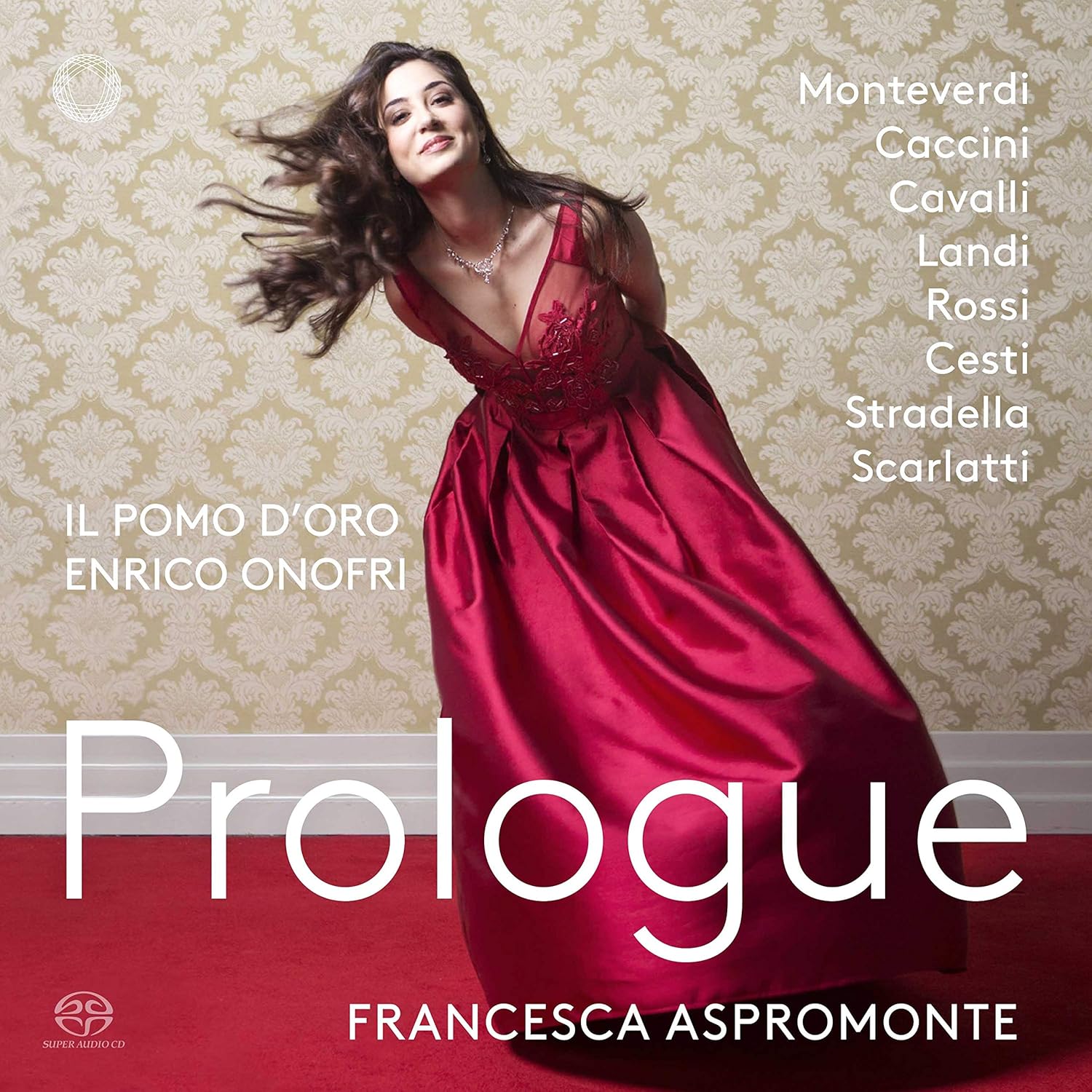
Album Review: "Prologue" by Francesca Aspromonte and Il Pomo d'Oro | An Album a Day Keeps the Doctor Away

Image result for aspromonte prologue

WHO: Francesca Aspromonte, soprano; Il Pomo d'Oro; Enrico Onofri, director
WHAT: Prologues to operas by Monteverdi, Caccini, Cavalli, Landi, Rossi, Cesti, Stradella, and A. Scarlatti
RELEASED: May 2018
LABEL: Pentatone

Guys, I'm really fucking bored. My brain is kinda turning to mush. I've turned to practicing cello to give myself something to do. Do you know how much I hate practicing? A lot. I hate practicing a lot.

Anyway, one thing I think we could all use during this weird, crazy time is music to listen to -- according to an email that one of my professors sent a couple hours ago, "music can be at its most powerful in times of crisis and uncertainty." Musicians always know how to cheer up a crowd, huh?

So I'm going to try to review an album every day that I'm stuck inside. No particular theme, just what I happen to be listening to at the moment. They're not going to be long, but hopefully they'll keep me busy and give you some new music to try out.

One thing that you should know about me is that I organize all the music I have yet to listen to into 60 or so playlists according to instrumentation and time period. "Romantic Keyboard"; "20th-Century Choral"; you get the idea. My "Baroque Solo Vocal" list is on the long side -- up around 170 hours (but I'm also terrible about clearing out what I've already listened to).

Today, I wanted Italian baroque opera, probably because I'm mourning the cancellation of Yale's annual baroque opera project (Cavalli's Doriclea, for anyone who cares -- good luck finding a recording). Luckily, this was near the top of my list.

Though prologues have fallen out of fashion in opera today, they were among the most important parts of early operatic structure. An allegorical character -- usually just named "Prologue" -- would come onstage and address the audience directly, breaking the fourth wall and foreshadowing the overarching themes of the plot to come. Usually, this takes the form of a recitative (imagine you're speaking, but while singing one note over and over again) with instrumental interludes (usually ornamented versions of a single theme).

Owning a recitative is hard. I've tried (and failed) myself -- it takes a lot of energy to make a repeated note interesting. You wouldn't know that from Francesca Aspromonte's performance. Recitative is clearly second-nature to her; her text stresses land with gravity, but don't halt forward momentum. Her voice is clear and sweet, blooming beautifully in the brief arias where she has less text to worry about.

Il Pomo d'Oro somehow put out six albums in 2018 alone, and all of the ones I've listened to are fantastic. This pared-down ensemble of a couple violins and a continuo section hits the mark; the violinists clearly play together rather than following one another, and the harpsichordist's improvisations combine pinpoint precision with wild, unhinged improvisation.

Great album, would recommend.

Monday, August 5, 2019

[40] Teatro Nuovo presents Bellini's "La straniera" at Rose Theater @ Jazz at Lincoln Center | #1Summer50Concerts

PC: Steven Pisano

WHO: Soloists, Chorus, and Orchestra of Teatro Nuovo; Will Crutchfield, maestro al cembalo; Jakob Lehmann, primo violino e capo d'orchestra
WHAT: BELLINI La straniera
WHERE: Rose Theater @ Jazz at Lincoln Center
WHEN: July 17, 2019 at 7:30pm

I open my computer. My stomach is in knots. The clock is counting down. Sweat pours down my face. I begin to hyperventilate. The stress is killing me. My hand, shaking violently, reaches for the mouse.

Yeah, that's what happened last time I had to choose between two concerts I really wanted to go see. Sometimes I think I'm too invested, y'know?

Anyway, I know I said at the beginning of the summer that I was choosing concerts based on what thought I would like most. Unfortunately, I like a lot of things, and sometimes I can't choose. So I've had to rely on another metric for deciding on concerts: the reproducibility factor. I always take into account the likelihood of getting to see a given concert (or one similar) at some point in the future. That's why I decided to go see the SEM Ensemble instead of Beethoven's Eroica at the NY Phil for the first concert in this series; why I went to go see ChamberQUEER instead of Boston Early Music Festival at Caramoor; why (in part) I decided to go see Vivica Genaux instead of going to NYC Pride.

So, when Teatro Nuovo's staged operas rolled around, I cleared my schedule, put on a tie, and walked up the five flights of stairs to the Jazz at Lincoln Center lobby.

Okay no, not really. I took the elevator. But the necktie part is real.

The formal-clad choir (PC: Steven Pisano)

Bellini's La straniera ("The Stranger") barely ever gets performed, falling at the feet of his more famous Norma, Puritani, and Sonnambula. The plot, as with many bel canto operas, is predicated upon a misunderstood love triangle -- Arturo loves Alaïde (the straniera in question), but thinks she is having an affair with Valdeburgo. Arturo tries to kill Valdeburgo until the "oh shit!" moment when he realizes that Valdeburgo is Alaïde's brother. Valdeburgo survives the attempt, Alaïde is dragged off for the murder, Arturo is urged to marry the woman he was originally planning to marry before any of this started (her name is Isoletta, she's only mildly relevant).

Except then it turns out that Alaïde is actually queen of France. So when Arturo botches his own wedding to beg Alaïde to run off with him, she is summoned back to the throne. Arturo is understandably sad. He kills himself. Alaïde is also sad. She threatens to kill herself. Curtain.

Ah yes, the Italian tragedy: only distinguishable from the Italian comedy in that, at the end, everyone dies instead of marrying each other.

So, I'm going to go out on a limb here and say something. I think comparing the Teatro Nuovo orchestra and choir is unfair. The singers are part of a young artists' program, still gaining valuable experience in the operatic field. The orchestra is the usual circuit of period-performance freelancers, many of whom I've already seen elsewhere this summer. So here are their separate reviews:

THE SINGERS: Great voices up on that stage. Tenor Derrek Stark was a poignant and relatable Arturo; soprano Christine Lyons's arias brought Alaïde's alienation to the forefront; baritone Steven LaBrie's Valdeburgo was rich and sweet, but not overly covered; mezzo Alina Tamborini rocked a confused Isoletta. But, for the great singing tone, the acting was somewhat anemic. Perhaps if there had been more staging to work off of, it would have been better, but the body movements were muted and awkward, the facial expressions barely expressive at all. Only LaBrie seemed to occupy the full character of his role. The chorus, made up of the rest of the young artists in the program, sounded as good as any professional opera chorus, their Italian perfect even in those infamous tongue-twister passages.

LaBrie as Valdeburgo (PC: Steven Pisano)

THE ORCHESTRA: Teatro Nuovo has a 60-piece orchestra that functions as a chamber ensemble. The concertmaster, sitting on the podium at the front, shares conducting responsibility with the maestro, sitting at a keyboard instrument (a late-model fortepiano, in this case) in the middle of the orchestra. The configuration of the orchestra is strange, to say the least -- the violins face each other (firsts facing the stage, seconds with their backs to the singers), the winds sit in an octet in the middle, the basses are split on either side of the ensemble. It made for an interesting sound, from the audience's perspective. The first violins and wind soloists are the center of attention in a bel canto orchestra, and they came through loud and clear. I'm not going to pretend that the modern configuration, with a real conductor serving solely as a musical interpreter and everyone facing the same way, isn't an innovation -- there's a reason the MET orchestra doesn't sit like Teatro Nuovo. But the orchestra's seating didn't seem to affect their accuracy and poise; they were fantastic in every sense of the word. I buy the configuration both as a musical and intellectual exercise. Special nod to harpist Parker Ramsay, who sat onstage to accompany two arias with very, VERY prominent parts.

Overall, an enjoyable evening. The entire concept had a novel sparkle to it, enough to offset any blandness in the acting. I was entirely satisfied -- the reproducibility factor seldom steers me wrong.

Monday, July 15, 2019

[29] Teatro Nuovo performs Donizetti and Rossini at Church of the Heavenly Rest | #1Summer50Concerts

That's an ophicleide, the love-child between a tuba and a bassoon, but cooler (PC: Gregory D'Agostino)

WHO: Teatro Nuovo soloists, chorus, and orchestra
WHAT: DONIZETTI Symphony in E minor; ROSSINI Stabat mater
WHERE: Church of the Heavenly Rest
WHEN: June 27, 2019 at 8:00pm

I always feel a little bit mean when I review young artist programs. Like, I'm not currently a powerful reviewer by any stretch of the imagination, but what if a review of mine goes viral and ruins someone's career? I don't know. I could discuss the what-ifs of music criticism all day. But we just have to keep in mind what the wise Ratatouille character Anton Ego once said: "The bitter truth we critics must face is that, in the grand scheme of things, the average piece of junk is more meaningful than our criticism designating it so."

Now that I'm done being angsty and self-deprecating, I should say that I loved this performance. The young artists were great. No one's career is getting ruined tonight.
Everyone loves to perform German early romantic music as it might have sounded in Beethoven or Schubert's day. There are some fabulous period Beethoven recordings out there -- my go-to is the fiery symphony-and-overture cycle from Anima Eterna Brugge. But no one considers the historical sound of their counterparts down in southern Europe; Rossini's Barber of Seville premiered in the same year as Beethoven's seventh symphony! Perhaps it's that whole opera aesthetic -- howling is howling!

Listen to the beginning of Coriolan. Your soul will be seared.
Anyway, Will Crutchfield's Teatro Nuovo performs bel canto opera as it might have been at the time. Usually that means no conductor -- more on that when I go to see the fully staged operas. But this time, they were seated as an orchestra usually sits (except the bassists were divided, two on each side), conductor in front, just like usual.

The orchestra, made up of NYC's finest period-performance freelancers (i.e. all the same ones that played on all the other period performance concerts), started with a Crutchfield-led performance of a Donizetti symphony, one that hadn't seen the light of day since the bel canto-ist's heyday. The orchestra clearly had a lot of technical talent, but it was clear their opinion of the piece was similar to mine: perhaps it should be re-buried.

But the orchestra perked up for the Rossini Stabat mater, because everyone likes that piece. It's kind of like if Rossini wrote an opera in Latin. Is it the most pious work? Hell no. Did Rossini go to hell for setting a series of corny cabalettas to biblical text? Probably. But is it kind of fun? Yeah.

At the helm for the Rossini was Jakob Lehmann, who has regularly played with and conducted Anima Eterna Brugge in similar repertoire. His gesture was clear, his interpretation vibrant; he elicited something different out of the orchestra (or maybe that was Rossini, who knows?). The chorus ranks were filled with the Teatro Nuovo students, each of whom is an opera singer. The sound, while somewhat wobbly and unblended, felt authentic to the 19th-century Italian opera chorus that probably premiered the piece.
Lehmann staring daggers at the violin section (PC: Gregory D'Agostino)

Of the soloists, tenor Derrek Stark stood out with his "Cujus animam gementem" -- the frequent octave-plus leaps sounded like no skin off of his back. The next movement's duo was equally memorable, with cheery soprano Christine Lyons and mezzo-soprano profundo Hannah Ludwig blending their vibrato perfectly. Ludwig, unlike most mezzos I've seen, took her cadenza to the lowest part of her voice instead of the highest part; she convincingly hit a note low enough that mezzos don't usually sing it.

Teatro Nuovo is an incredible project, and they execute their mission flawlessly. I know this is short notice, but if you can you should go see Teatro Nuovo, this Wednesday and Thursday, doing Bellini's La straniera and Rossini's La gazza ladra, respectively. I know I'm going to be there.