Thursday, June 6, 2019

[7] Baroque in the Fields presents Telemann at St. Luke in the Fields | #1Summer50Concerts

WHO: Baroque in the Fields sponsored by Gotham Early Music Scene
WHAT: Telemann Paris Quartets and solo fantasias
WHERE: Church of St. Luke in the Fields
WHEN: June 2, 2019, 3:00pm

Telemann came at an unfortunate time in music history, at least from a modern perspective. His music is, for the most part, tremendously well-written and creative, but he's been wholly overshadowed by a composer we all know and love: Bach.

The two are, on paper, very similar. They both lived around the same time (though Telemann has a few years over Bach on either end); in fact, Telemann was the first choice for the job of cantor of the Thomaskirche in Leipzig, the job that eventually went to Bach and caused him to write so much of his sacred organ and vocal works. Telemann ended up with a similar, better-paid job in Hamburg.

Twelve solo violin works to Bach's six; twelve solo flute works to Bach's one; twelve fantasias for solo bass instrument (viola da gamba as opposed to Bach's cello) to Bach's six; there is no question that Telemann was equally prolific to Bach. And I would argue that Bach is not "better" in the strictest sense, he was just lucky enough to have fiery revivalists on his side (namely Felix Mendelssohn in the 1820s).

I'm always thrilled when people choose to put on Telemann concerts. It feels to me like they're uncovering a hidden gem, one that people don't hear nearly often enough. So I dragged my friend to this lovely, free (free!) Sunday afternoon concert in the West Village. From what I gathered, the concert was another effort of the fine folks over at Gotham Early Music Scene: bringing early music to the masses since who knows when.

On tap were a smattering of Telemann's Paris Quartets, published in two volumes (1730 and 1738). The catch is that Telemann didn't actually visit Paris until 1737; the first set of quartets is no more Parisian than anything else coming out of Hamburg at the time. But, the second set was so associated with Telemann's celebrity visit to Paris that they were all sort of lumped together in history's ever-reductive eye. A few of Telemann's aforementioned solo works rounded out the program.
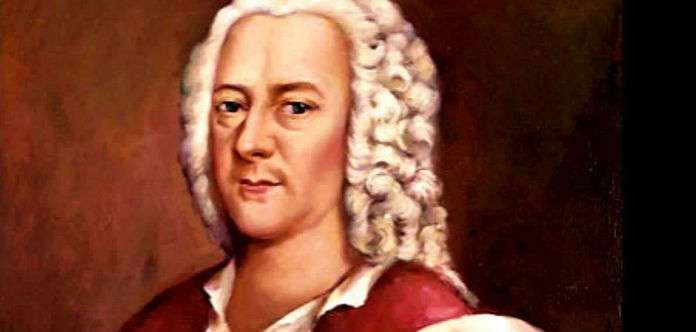
Image result for telemann
"What do you mean you've never heard of me? I'll have you know I'm VERY famous in Paris."

Can you tell I resent the fact that we didn't learn about Telemann in my music history class? I'm having flashbacks to the time I asked my TA why we skipped over Telemann and it ended in a ten-minute rant session about how good Telemann is. And that all happened by shouting/sign-languaging across an opera pit. Oop.

Some parts of this particular performance shone brightly. Flautist Immanuel Davis, a frequent duo partner of Berthold Kuijken (a member of the Kuijken family, three of whose five children are partially credited with the recent resurgence of historically-informed performance). His solo pieces, two fantasias played without pause, were impressively virtuosic without compromising the flavor of the music. His slower passages oozed aristocracy and nobility, while his faster runs were nimble and deft. In the quartets, he shone both as a leader and an instrumentalist.

Harpsichordist Dongsok Shin's fulfilled both of his roles in the performance -- first and foremost as an accompanist, but later on also a soloist -- with admirable flair. His continuo underpinnings were never too flashy so as to take away from the solo players, but were always reliable and tactfully timed. As a soloist, he approached his fantasia with restrained abandon, milking every ounce of passion he could out of a temperamental instrument like the harpsichord.

My friend: "That's A LOT of Telemann." Me: "TELEMANN TIME!!!!!"

Motomi Igarashi, the viola da gamba player for this performance, had her highs and lows. In the slower passages, her interpretation and tone were impressively strong; in the faster passages though, the bow seemed to often slip out from under her. Of course, I should give her the benefit of the doubt because the gamba parts for the Paris Quartets are twice as hard as the flute part and the violin part combined -- read: unplayable by mortals. Igarashi is a specialist on the lirone, an instrument that is like if the gamba could only play chords and nothing else; considering her strengths and weaknesses, I can easily see her being a master of this unusual instrument.

Violinist Leah Gale Nelson, though equally impassioned to her peers, fell a bit short in the technique department. It appeared that she was putting an inordinate amount of pressure on her bow, causing notes to crack or -- worse yet -- not to sound at all. That, combined with her sometimes *interpretive* intonation, detracted from an otherwise musical and enjoyable performance.

I'm of the opinion that it's hard to go wrong with a free concert, and I'm very glad I happened upon this one -- shout-out to Fred, the greeter from the Abendmusik concert I went to last Friday, for letting me know about this concert! Overall, I'm glad I went and I'm looking forward to GEMS's next season.

Tuesday, June 4, 2019

[6] Experiments in Opera presents "Chunky in Heat" at The Flea | #1Summer50Concerts

WHO: Experiments in Opera and Contemporaneous
WHAT: Chunky in Heat
WHERE: The Flea Theater
WHEN: June 1, 2019, 7:00pm

I like my opera like I like my Campbell's chicken noodle soup: chunky.

No, that's not it.

I like my opera like my grandmother describes my waistline: chunky.

Eh, that's better.

I had no idea what to expect when I showed up to The Flea, a venue for experimental theater, for Experiments in Opera's production of Chunky in Heat on Saturday evening. I don't really fancy myself a consumer of experimental theater, apart from opera; I found out that I very much fit the *opera* aesthetic. Whereas the theater nuts were dressed in felt hats and billowy cotton pants, I was there in a t-shirt, jeans, and cardigan. Too casual was perhaps not the issue so much as the wrong kind of casual.

At the door, I was greeted by a worker in a pride pin (it was June 1 after all -- HAPPY PRIDE MONTH!!!!) who asked me which performance I was there to see: Chunky, or two other performances whose names I don't recall but sounded just as strange. I got my ticket, mounted the stairs, and plopped down in an empty chair in a pretty sizeable black box theater. The stage was a simple house with an astroturf lawn, two lawn chairs, and a side table containing a can of TaB cola (throwback much?),  a cup of drinking straws, and a tube of sunblock. An inflatable smiling sun graced the background; a tree with a camera attached stood off to the side, by the rightmost edge of the audience.

The set, featuring one creepy-ass sun

Chunky in Heat started off like any other modernist opera. The orchestra built pulsing chords from the bottom up, not unlike the opening of John Adams's Death of Klinghoffer. Chunky (a nickname for Cynthia ) is onstage at her house (supposedly in Los Angeles -- hence "in heat"), agonizing over being a little bit...erm...chunky, as well as expressing her lust for the archetypal "boy next door" ("Walter, like a tall drink of water"). It could have continued relatively normally.

But then the tree started talking -- actually, not just talking, but describing in great detail two passing fruitflies engaging in coitus. And that's when I knew I was in for a ride and a half.

Suddenly, the stage turned devil-red; the orchestra's drummer began to play a generic dance-pop backbeat; on came Chunky's mother and father, dancing some faux-conga-line type thing. It was a riot.

Those sudden changes of scene occurred often throughout the 90-minute piece. A collaboration among six composers, Chunky in Heat appeared to lack a singular musical style, but it was presented in a way that made that decision with purpose and intention. It was definitely a pastiche, but it was a pastiche determined to be so rather than one that was so out of convenience.

Image result for chunky in heat
She's underwater, can't you tell?

The orchestra was Contemporaneous, one of NYC's foremost new music ensembles, led by co-founder Dan Bloom. They played exactly how you want an opera orchestra to play: tastefully, accurately, and supportively. This was right up their alley -- whereas Bang on a Can developed a signature aesthetic long ago, Contemporaneous is still up for anything and everything. I would go so far as to call them New York's most open-minded ensemble: everything, no matter how strange, is an experiment.

The singers were all excellent. Soprano Sarah Daniels (Chunky) kept a youthful levity throughout the opera, her voice reflecting her character's girlishness rather than becoming weighted with teenage angst. Emily Geller's (Mother) lower range was impressively forceful, penetrating easily over a fortissimo orchestra. Timothy Stoddard's (Walter/Fiancé/Beekeeper) high A's and Bb's were few and far between, but when they were written, they were delivered with full tone and gusto. Joshua Jeremiah's (Father) rich baritone and Abigail Doehring's whimsy mezzo (and impressive method acting as a coyote -- LA things only, amirite?) rounded out a strong cast.

If you're not a fan of non-traditional, this is not for you. But Experiments in Opera is obviously a noble cause, and truly unique. Few other cities have "opera collectives" at such a high level of professionalism, even though new opera is just as important as -- if not more important than -- old opera. If Einstein on the Beach left you craving more, or you just want to know what's happening *now*, give experimental opera a try.

Sunday, June 2, 2019

[5] Sonnambula and Piffaro play Praetorius at The Met Cloisters | #1Summer50Concerts

WHO: Sonnambula Viol Consort and Piffaro: The Renaissance Band
WHAT: Michael Praetorius: Dances from Terpsichore
WHERE: The Met Cloisters
WHEN: June 1, 2019, 3:00pm

The Cloisters are pretty inaccessible to anyone who does not have a car. It's super easy to get there if you can drive -- there's a road that dumps you straight outside the ominous stone doors. I, however, am confined to the subway.

The Met Museum website claims that 190th Street is the best subway stop for The Cloisters, but last time I tried to go that way I got very lost in the web of paths that calls itself Fort Tryon Park -- all roads supposedly lead to The Cloisters, except I managed to find all the ones that don't? So, I tried my luck with the next station, Dyckman Street.

Google Maps said 0.2 miles. Little did I know that it's 0.2 miles on a path that basically goes straight up the side of a sheer rock face. And I still managed to get lost. Sigh. There really is no winning.

But I did manage to get there eventually, dripping with sweat (humidity plus out-of-shapeness plus oh yeah literally rock-climbing to the museum), and I got to use the one phrase that I always have dreamed of using: "I'm with the musicians."

Image result for anne loftus playground
The path goes straight up the hill behind this building. No stairs. Just a 50-degree incline
and a landing that reeks eternally of weed and sad glutes.

I *may or may not* have begged a professor of mine for a ticket to this concert, in which he was playing recorder, lute, guitar, cittern and percussion (a motley array of instruments, more on that later). I have a bone to pick with the Met museums: their concerts don't offer student ticket pricing, and are often prohibitively expensive, to the tune of $70+ per ticket for the most desirable concerts. I understand that they have to turn a profit, I really do. But they have ticket sales to profit from. The New York Phil offers student tickets, and they turn a profit. What gives?

Anyway, I was offered a comp ticket on the condition that I sell CD's before and after the concert. Troubles with the Square card reader notwithstanding, I had lots of fun trying to come up with one sentence to explain what was on each CD. Sonnambula's album was relatively easy to explain: consort music by Leonora Duarte (mid 1600s Flemish) and her contemporaries. The Piffaro album, which had everything from Obrecht to Lassus to Praetorius to Bach, that was a little bit harder; I ended up settling for "everything before Bach" (conveniently, the album is called "Before Bach").

I slinked into my chair approximately 30 seconds before the show was to start; I barely had time to look at the program before the ensembles paraded onstage, bowed, and proceeded to play their first selection: a bransle (if you see a word you don't know in this post, chances are it's a French dance) for recorders, guitars, and....bagpipes?

I never thought I'd say this, but the bagpipes were nice.

The general format of the concert was grouped into different dance forms: the winds (Piffaro) would play a dance, then the strings (Sonnambula) would play a similar dance, then they'd all do it together. The contrast was always stark, but never jarring; the groups were acutely aware of each others' musical decisions and played off of each other like they had been doing it forever.

Of particular note was the set of volte that finished the concert, starting with a William Byrd arrangement from the Fitzwilliam Virginal Book as expertly interpreted by harpsichordist James Kennerly, which Sonnambula spryly repeated with gusto and joie de vivre. I had to leave (to reset the CD table) before the encore, but rest assured there was an encore, and it's currently stuck in my head even though I haven't the foggiest idea what it is.

There is no question that Sonnambula is a fabulous ensemble comprised of some of the best historically-informed string players (and one harpsichordist) in the NYC area. You will, without fail, have a lovely concert experience with them. Piffaro, though, is the real pièce de résistance of the concert. Each member of Piffaro played no fewer than four instruments, ranging from recorders of all sizes to krummhorns and dulcians and percussions and guitars and...the list goes on. Piffaro's concerts not only exhibit the highest level of musicianship -- the sackbut players played their instruments better than most of the trombone playing I've heard in my life -- but each concert is also an educational event. Co-director Bob Wiemken gives a humorous, yet thorough description of the millions of instruments that the group plays, rendering the concert appropriate for all ages.

The view on the way out of the park -- I tried to take it where the car was out
of the frame but....just kidding, I didn't even try to get the car out because I am LAZY

As I left, I decided I would try my hand at getting back to the 190th Street A train stop. I was treated to the most gorgeous view -- I think Fort Tryon Park may be the most beautiful spot in Manhattan. And what's more, I didn't even get lost. Are you proud of me?

[4] Abendmusik plays Lawes and Jenkins at St. Luke in the Fields | #1Summer50Concerts

WHO: Abendmusik, sponsored by Gotham Early Music Scene
WHAT: Fantasias and Consort Sets by John Jenkins and William Lawes
WHERE: Church of St. Luke in the Fields
WHEN: May 31, 2019, 8:00pm

I didn't know this when I started the week, but my office closes at 2pm on Fridays, which is super nice. So, I did what any sensible person would do with a free Friday afternoon: I took a nap. And we're not talking a graceful little catnap. When I say I took a nap, I mean one-hour-plus, spider-sprawled on my bed, snoring, mouth wide open. You know the kind.

I set my alarm to go to this concert, and when I woke up, I could barely move. But, like a good person, I dragged myself out of bed and hopped the 1 train downtown -- I figure if I set a precedent where I don't go to concerts because I'm "too tired" (a concept that college students quickly learn is merely a construct), then I'm never going to get to 50 this summer.

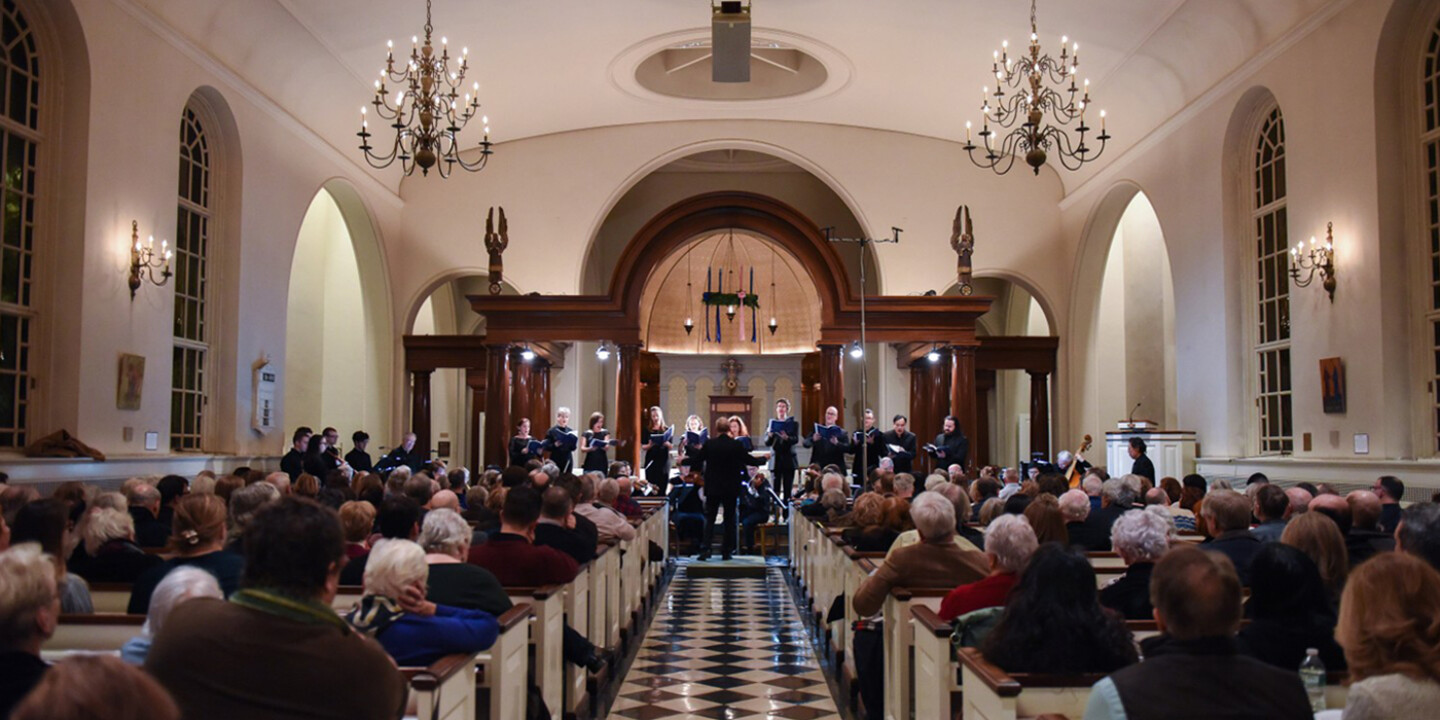
I'm still rubbing sleep from my eyes when I get to St. Luke in the Fields, a gorgeous Episcopal church in the West Village. I step inside and go to the ticket desk; the person selling tickets seems remarkably chipper. I ask for a student ticket, and the look on the ticket-seller's face turns from chipper to chipper-er.

Image result for church of st luke in the fields
The beautiful interior of St. Luke in the Fields

It's at that point that I look around and realize that I'm the youngest person there by a margin of probably 30 years. The guy behind the desk is just thrilled that someone under the age of 40 is at this concert.

This happens all the time. I'm used to it at this point, but usually I'm the only one who notices. Anyway, we get to talking, and I learn about Gotham Early Music Scene (GEMS), which is an organization dedicated to scheduling and programming interesting early music in NYC. They give free weekly concerts (Thursdays 1:15-2:15, I'll definitely keep that in mind for when I retire) as well as weekend concerts. They do everything from Bach to Renaissance polyphony, and I was even told about a concert of English song from 650AD put on by a couple of retired musicologists. Overall, a good organization.

Abendmusik's de facto director, Patricia Ann Neely, is as much musicologist as she is performer. Her viola da gamba playing was nimble and musical, but even her best performance moments paled in comparison to the program notes she wrote. The turn of the 16th century is a supremely unrelatable time for modern audiences, so Neely framed the program (consort sets by William Lawes and John Jenkins) starting with the works' rediscovery circa the British industrial revolution. The notes wove a unique narrative, one that evidently required a good deal of research and general knowledge.

The performance itself was charming. It really makes me sad that barely anyone performs this early English string music, because the pieces are really gems. They have a perfect balance of simplicity and complexity, not so boring that your ear has nothing to latch onto, but also not so complex that...well...your ear has nothing to latch onto.

Abendmusik played with gusto and spirit -- it was clear that they had all played together a good deal. Occasionally, one of the members would get lost -- because of the imitative nature of this kind of music, if you get lost it's nearly impossible to correct yourself -- but that only contributed to the lovely and intimate nature of the concert. It was as if the ensemble was expressly stating that they cared more about conveying a message than conveying it perfectly, a message that I agree with and that I wish reverberated a bit more with the rest of the classical music community.

Abendmusik performs regularly at GEMS's free concert series, so if you get the chance to see them you definitely should. Even if they're not as perfect as some of the full-time viol consorts (*ahem* FRETWORK *ahem*), they still play underperformed works at a remarkably high level and with a great amount of audience camaraderie. A fabulous low-key way to spend an evening.

An accidental photo that I took of a friend's viola da gamba scroll -- it happened to turn out very *aesthetically*

Saturday, June 1, 2019

[3] New York Philharmonic plays Brahms, Mozart, and Corigliano at David Geffen Hall | #1Summer50Concerts

WHO: New York Philharmonic; Jaap van Zweden, conductor; David Fray, piano
WHAT: BRAHMS Tragic Overture; MOZART Piano Concerto No. 24; CORIGLIANO Symphony No. 1
WHERE: David Geffen Hall
WHEN: May 30, 2019, 7:30pm

I've been known in the past to give tepid, if not negative reviews of the NY Philharmonic in the past. I saw them a couple times in their last season with Alan Gilbert, and their affect often seemed listless at best. It seemed like a group of accomplished soloists each playing without much regard for what the rest of the orchestra was doing.

I'm glad to say that era is on its way out. Jaap van Zweden, the notoriously fierce Dutch conductor who took over as the Phil's music director this year, is fixing them. The orchestra will almost certainly be back to its Bernstein-era glory in a few years.

Still, though, the Phil is in an intermediate period. There are moments where everything clicks and they sound like the most expressive, polished orchestra on this side of the Atlantic. One of those moments was at the beginning of the Brahms's Tragic Overture, which started this concert. Quite frankly, I find the piece to be very take-it-or-leave-it. Is it better than I could have written? Absolutely. Is it Brahms's magnum opus? Nowhere near. But the Phil brought certain moments to life -- the opening (and the recap) sounded almost like a period ensemble, with hard-sticked timpani and vibrato-less strings, a timbre that van Zweden clearly thought out well. The rest? It was fine.

I suppose I should mention the caveat that I had a TERRIBLE seat for the first half of the concert. The box office refused to sell me a student-priced ticket (even though there were empty seats everywhere?????), so I was stuck with the only other seat that was in my budget: top floor, side boxes, partial view. And it was still twice as expensive. UGH. I moved to a top-floor front-facing seat for the Corigliano (and thank god I did -- that partial view would have blocked out the mandolinists!).

To give you an idea of where I was sitting...Fray, van Zweden, and the orchestra

Both of Mozart soloist David Fray's last two albums have been Bach interpretations -- his concerti for multiple keyboards in 2018 followed by his sonatas with star French violinist Renaud Capuçon. I've like his Bach (much as I usually prefer my Bach on harpsichord), so I was interested to hear his Mozart. His Mozart (the 24th piano concerto) struck me as a little far removed from his Bach; his use of pedal was a little more liberal than I would have liked, though not totally outlandish. That being said, his slow movement was incredible: heartfelt, musical, and not too soupy. Special mention to the wind section Phil for that same slow movement.

I was proven wrong. But I still don't think the mandolins were *totally* necessary.
I really didn't want to like the Corigliano. At first glance, the orchestra seemed too big, almost big for the sake of being big. But John Corigliano himself came onstage and gave some verbal program notes, on the verge of tears as he remembered the people this piece eulogizes, friends of his who died in the AIDS epidemic. Once the piece started, I understood why that orchestra was so huge. Corigliano accurately encompasses so many emotions in this piece -- terror, sadness, wistfulness, nostalgia -- that even the most emotionless of listeners is moved.

The highlight of the piece was the opening of the third movement, in which principal cellist Carter Brey delivered a solo (in commemoration of a cellist friend) that was not only polished, but also so deeply felt that a cavern opened up in my stomach and I was fighting back tears. Overall, a tremendous performance.

If you get a chance to see the NY Phil, certainly do it. While they are not necessarily the best orchestra in NYC (that honor goes to the MET Orchestra), they are definitely worth a visit, even in their acoustically dead hall. But, more importantly, if you get a chance to see John Corigliano's Symphony No. 1, jump at it. I hear the Chelsea Symphony is doing it at the end of this month (June 29-30), who's going with me?

Thursday, May 30, 2019

[2] Uri Caine Trio at The Stone @ Mannes | #1Summer50Concerts

WHO: Uri Caine Trio (Uri Caine, piano; Mark Helias, bass; Ben Perowsky, drums)
WHERE: The Stone at The New School
WHEN: May 29, 2019, 8:30pm

I only decided I was going to this concert about 2 hours before it actually started. And I was almost late because I spent too long looking for the nonexistent lunchbox section at TJ Maxx.

Ah, the joys of adulting.

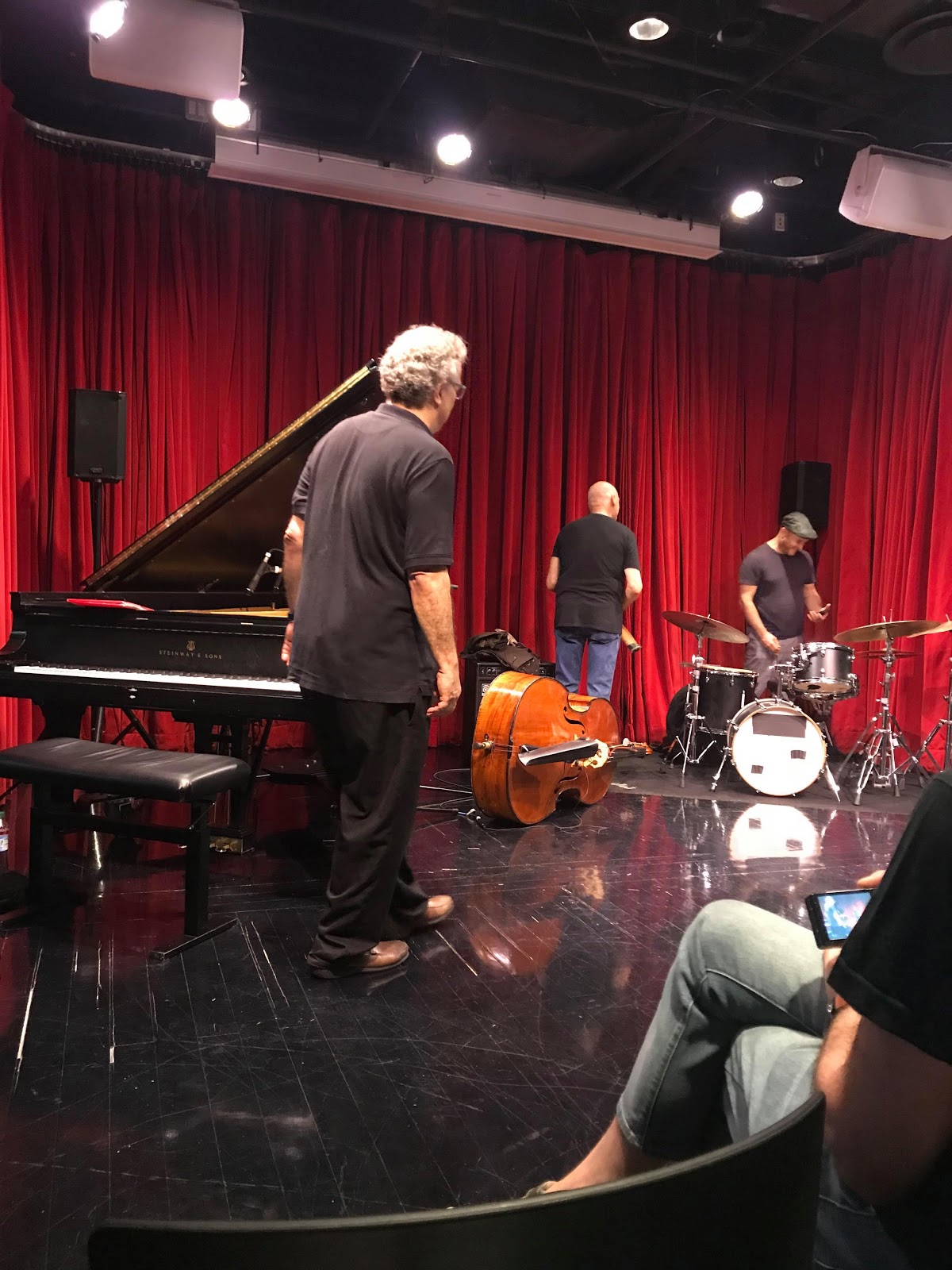
Admittedly, I didn't know a ton about Uri Caine before showing up to his concert last night. I knew was a pianist, and that he had done a jazz Mahler album that I've been meaning to listen to for years, and that was about it. I don't know why his week-long residency at Mannes didn't get more press -- the audience was maybe half full, only about 30 people. But that didn't stop the trio from taking the audience on an adventure to remember.

After sitting down at their instruments, the players began to noodle around, as is common for the first minute or two of a jazz set. But they kept noodling longer than that until eventually Perowsky began to play in something resembling a steady four-beat, seemingly on the fly. The other two adjusted their fooling around slowly, almost imperceptibly, until eventually the entire trio was synced. It was the kind of thing that leaves the audience with jaws on the ground; I know I was in total awe.

*applause* "Quick, take a photo, my phone is dead!" *band starts to pack up* "What, now?" "Yes!" *fumbling with phone*  -- an actual conversation my date and I had yesterday

The word that pops to mind when describing the trio is deft. Their entire set was full of tact and panache, and each player performed to his fullest without detracting from the others. Even at times when the music entered a "free" state similar to the opening of the set, it seemed like the players were aware of each others' improvisations -- perhaps that explains how they always found a common beat after a few seconds, even though Caine's gaze was glued to his hands and Helias never once opened his eyes.

Caine's improvised riffs very much evoked his career as a classical composer; though I didn't know he was classically trained when I saw him, there were a few moments where I turned to my date and mouthed "Debussy? Stravinsky? Messiaen?" and she smiled and nodded in corroboration. A disciple of George Crumb, Caine's claims to fame are his reworkings of classical music: not just Mahler, but Wagner, Schumann, Mozart, and even Bach's Goldberg Variations. One riff in particular from last night's concert evoked a dreaded piano solo from Stravinsky's Petrushka.

Helias's bass lines were creatively realized, if a bit stodgy. He, unlike many jazz bassists, was equally apt with a bow as pizzicato -- his bowed walking bass was refreshing. Perowsky left no timbre unexplored on his kit, from the side of the crash cymbal to the stands of his drums. His wrists alone were something to write home about; when he wanted a crash, but not too loud, he would tense his wrist completely and essentially push the cymbal down with his stick, muffling the sound just enough.

They played for an hour without stopping. The lines between actual charts and improvised filler material were blurry; that being said, the charts ranged from up-tempo rock-with-jazz-chords-sounding romps to the usual swing patterns. The final minute consisted of a series of dominant-tonic progressions -- literally V-I-V-I etc. -- but each time he played it he added more notes until he ended up with cluster-cluster-cluster-cluster. Take that, Mozart.

If you get a chance to see Uri Caine and any cohort of his, you should jump on that opportunity. His music has charisma and charm; it's nouveau-jazz without being inaccessible. And now that I've bought a lunchbox as well, my life is complete -- except for the fact that I forgot to bring it (with my lunch inside) to work today. Sigh.

The trim matches my backpack!

Wednesday, May 29, 2019

[1] S.E.M. Ensemble at Bohemian National Hall | #1Summer50Concerts

WHO: S.E.M. Ensemble
WHAT: New York - Ostrava: Influences and Initiatives
WHERE: Bohemian National Hall
WHEN: May 28, 2019, 7:30pm

Yes, last night I chose a new music concert over the New York Phil playing Beethoven's Eroica. But I saw the Phil do Eroica last season. And at this rate, I'll probably get to see it next season. And the next season. Ad nauseum.

Besides which, this concert had the universal college-student trump card: it was free.

As New York's new music ensembles go, S.E.M. is ancient. Founded shortly after Czech composer Petr Kotík moved stateside in 1969, they were -- and are -- closely linked with the American experimentalists that make baby boomers wrinkle their noses. They now perform regularly, mostly in Brooklyn Heights's Willow Place Auditorium (best described as a cross between a parochial school auditorium and a YMCA basketball court -- one of my favorite quirky concert venues in NYC).


Not pictured: the gymnastics mats piled in the back left corner

The program was composed of new pieces written by students of S.E.M.'s biennial Ostrava Days festival along with older stalwarts of the ensemble's repertoire. Particularly of note was violist-and-composer-on-the-side Anna Heflin's Included/Excluded (2019), which found a string quartet sitting with their backs to one another, each playing a fiendishly difficult and independent line. Then, all of a sudden, one of the violinists shouted: "CHAIR!"
"CHAIR!"

I was sort of confused -- maybe she said "share" or something like that? No, she said it again, "CHAIR!" at which point the cellist began clapping at rhythmically constant, but seemingly arbitrary intervals. A couple minutes later, the cellist launched into a tirade about how people who drop dead on the street are still expected to make polite banter with passers-by. It was absurdism at its finest; I found myself scratching my head, but oddly and thoroughly satisfied.

Other highlights included Alvin Lucier's Navigations for Strings (1991), a piece which consists primarily of ever-so-slightly compressing and widening microtones; if you listen carefully, you can hear the sound oscillations getting faster and slower with the changing dissonances. Kotík and Wolff's pairings of pieces each displayed a very distinct narrative of their compositional evolutions.

But, perhaps most amusing of all was the final piece, Earle Brown's Available Forms I (1961). The sheet music of the piece takes the form of six unbound pages, each with five "events." The events can happen in any order, the pages can be played in any order, with any number of repetitions. Kotík had constructed a nifty music stand-mounted cardboard contraption with which he could show the orchestra how to move between pages; the events were shown with the fingers of his non-baton hand.

Overall, a great start to the project. If you're in the mood for something a little weirder, S.E.M. is your group. Oh, and be sure to take a visit to the Bohemian National Hall on E 73rd St -- it's the only consulate-plus-cultural-center-plus-restaurant you'll ever visit, I assure you.