Showing posts with label string quartet. Show all posts

Sunday, March 22, 2020

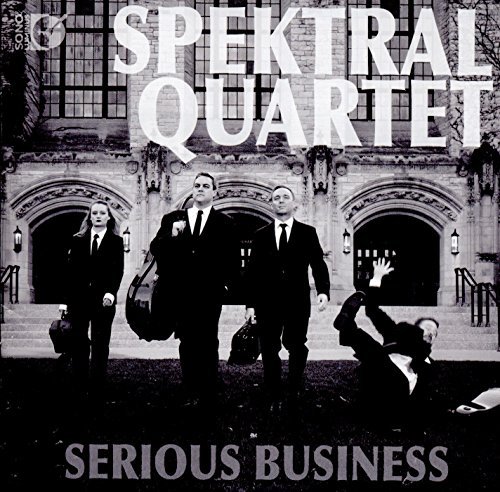
Album Review: "Serious Business" by Spektral Quartet | An Album a Day Keeps the Doctor Away

Image result for spektral serious business
And I oop--

WHO:
 Spektral Quartet
WHAT: New works by Sky Macklay, David Reminick, and Chris Fisher-Lochhead, plus a Haydn quartet
RELEASED: January 2016
LABEL: Sono Luminus

Challenge: I'm going to write this post before my oxtails come out of the pressure cooker in half an hour. For those of you who care: onions, garlic, stock, and red wine (a little bit for the oxtails, a little bit for me 😉). That's it.

Classical music is too damn serious. Have you ever dropped your program during a piece? People will literally look at you as if they want to throw you off a bridge.

Classical music hasn't always been so serious -- you can thank Richard Wagner for that -- but rarely is it overtly funny (barring opera buffa, of course). Haydn had his moments, even Mozart and Beethoven stepped into parody-land once in awhile.

For this album, The Spektral Quartet asked three composers to try their hands at "funny music" with wildly different results. Sky Macklay composed a piece that consists entirely of cadences -- Many Many Cadences as the title so creatively describes. The cadence, of course, functions as a tonal stabilizer. Macklay forces the quartet to hop between cadences with such speed that any sense of stability is lost, even though there is theoretically a "stabilization" every few seconds.

David Reminick chose absurdist poetry as his starting point; The Ancestral Mousetrap requires the quartet to sing a libretto by poet Russell Edson. They sing very well, proving my theory that instrumentalists are sometimes better singers than singers. One of the members sounds like Elvis Costello -- whoever does the bulk of the singing on the 4th movement.

The final premiere on the album, Chris Fisher-Lochhead's Hack, uses the instruments of the quartet to model the sounds produced by standup comedians during their routines. My linguist brain was intrigued. On the album, it doesn't evoke human speech so much, but it's so cool when they map the composition over the comedian's bit. Either way, cool piece.

And then in the middle of all this fun new music came the Haydn "Joke" quartet. I've played it. It's funny. But also, I kind of wish they had commissioned another new piece? I'm not exactly complaining, I'm always in favor of a good performance of a good Haydn quartet. But it also seemed a touch out of place.

Anyway, great album. Go listen. My oxtails are calling.

Saturday, October 19, 2019

Review: Hannah Lash's "Desire" at Columbia

Woman and "Man" (PC: longtime Kinhaven photographer Rob Davidson)

WHO: Kirsten Sollek, contralto; Daniel Moody, countertenor; Christopher Dylan Herbert, baritone; JACK Quartet; Rachel Dickstein, director; Daniela Candillari, music director
WHAT: HANNAH LASH Desire (world premiere)
WHERE: Miller Theatre @ Columbia
WHEN: October 16, 2019 at 8:00pm

I've been on the board of Yale's undergrad opera company for a couple years now, and I really truly love it. But when programming season comes around, we often hit trouble. There are only so many operas that are a) small enough that they can fit into one of the tiny theaters set aside for student use and b) fit our personnel (see: The Great Tenor Drought of 2017).

So we often end up with operas in one of three categories:
  • court-commissioned Baroque operas that we can pull off with a combined cast and orchestra of 10 people
  • edgy 20th-century chamber operas, often psychological thrillers or horror operas
  • scaled-down productions of classic operas
And I love all that we do. But the thing is...sometimes, it feels like composers always assume that every opera company in existence has infinite money and resources. And increasingly, that is not the case. There's a space in the market for new operas which are compact, minimal, and relevant.

JACK x JACKson Pollock (PC: Rob Davidson)

Luckily, Columbia has identified that void in the repertoire, and is filling it steadily, year by year, with their Chamber Opera Commissioning Initiative. Established in 2017, Desire is their second project; their first show, Missy Mazzoli's Proving Up, met great critical success when it premiered last year. But Columbia has had a long history with chamber opera, premiering works of Britten and Virgil Thomson in the 1940's; more recently, they staged U.S. premieres of works by Olga Neuwirth and Iannis Xenakis.

Unlike much of the modern opera I've seen last year (sorry to @ you again, Chunky, but it was bound to happen sooner or later), Desire didn't feel like it had an overwhelming number of moving parts. The plot was straightforward, if cryptic; the movement onstage was slow and deliberate; it felt weirdly comfortable in the best of all possible ways. This opera seemed to strive towards profundity rather than outright experimentalism, a goal which it met with flying colors.

All of the motion that was taken out of the staging was siphoned into the complex string-quartet score. There was never a moment when Hannah Lash left the room unfilled, whether by scuttling exchanges, insane leaping figures (yes, I saw that time when the cellist had to leap a full foot and a half up his fingerboard), or lilting nods to the passion-waltzes of high romantic opera.

In isolation, the pacing of the libretto (written by the composer) remained largely the same throughout -- the sentence length, structure, and syntax barely varied throughout. But Lash's plain words were brought to life by the virtuosic vocal lines; the composer altered the rhythmic elements of the music to impart a broad emotional palette into the text. In a way, it was reverse text painting: the music seemed to determine the meaning of the text, rather than vice versa.

The three-person cast was headed by contralto Kirsten Sollek as a woman who existed in two worlds: a dark gray bedroom and a shimmering mystery-garden. Though contraltos are rarely main characters, here it seemed right, her rich, chesty mid-range nestling squarely between the shrill countertenor of the garden inhabitant (designated in the program as a man, but his costume suggesting, in the wise words of my date, "more of an origami Transformer") and the concerned baritone of the woman's husband.

The final showdown (PC: Rob Davidson)

Daniel Moody's voice was exactly what I wanted out of a new-music countertenor, bright and full of forward-propelling vibrato. Christopher Dylan Herbert (see my review of him from this summer) filled his sweet voice with a surging sense of bewilderment and discomfort. And the seemingly-superhuman JACK Quartet....I simply don't think there are words. The amount of collective brainpower, acuity, and passion they bring to these treacherous new scores never fails to amaze. And yet, through the complex ebbs and flows of the music, they always maintain the most incredible sense of calm, as if they are incapable of making a mistake.

This production was genius. I can only hope it comes back around during my lifetime. Any regional new music ensemble would (or at least should) jump at the chance to stage this show -- I know I'd make the trek to see it again.

Sunday, August 25, 2019

[50] Mostly Mozart presents Takács Quartet at Alice Tully Hall | #1Summer50Concerts

Me, finishing something I started for the first time, like, ever

WHO: Takács Quartet; Jeremy Denk, piano
WHAT: MOZART String Quartet No. 21 in D major, K. 575 "Prussian"; BEETHOVEN String Quartet No. 16 in F major, Op. 135; DOHNÁNYI Piano Quintet No. 1 in C minor, Op. 1
WHERE: Alice Tully Hall
WHEN: August 5, 2019 at 7:30pm

I'm going to spare you the gritty details, but let me just say this -- I was a little bit emotional at this final concert. And it wasn't just because of the heart-rending slow movements from the Beethoven and the Dohnányi.

As the lights dimmed, and the robo-voice over the loudspeaker told the audience to silence their cell phones, I couldn't help but notice that the sad cavern in my stomach trumped the endorphin rush of triumph.

So much for sparing you the gritty details.

I posted about concert #50 on my Snapchat and got plenty of congratulations, but as I pointed out to all of my loyal followers, it's not over until it's over. Review #50 hasn't hit the web yet. Well, here it is.

I started this project with the most niche concert I could find. Well, it appears I've sold out -- here's a review of, like, one of the most famous quartets in the world.

I went into this concert with a more or less neutral idea of Takács. I listened to one of their Beethoven quartet recordings a while ago. I may have listened to a couple movements of the Bartók cycle at some point. But that's about it.

Takács is not a quartet where you have to call into question whether they play musically, or how well they play well as a quartet. They're obviously very good. The only thing I can do is to ask myself whether they approach the program the way I would. And the answer to that is...kind of?

Takács's approach to Mozart is distinctly different from mine. I love to relish in Mozart's simplicity, striking a balance between imparting my own musical ideas and letting the bright levity of the score speak for itself. Takács erred definitively on the side of the former, and to my ear it seemed a little bit overworked. It didn't help, of course, that their interpretation seemed overly romantic -- their wide, fast vibrato was always audible, which is *probably* not how Mozart would have wanted it. Oh, and it felt like cellist András Fejér was celebrating the upcoming Bartók anniversary a few months early with his short, hatchet-y accompanying strokes. Again, these are all personal objections. Objectively, they played very very well.

Their Beethoven was a little more to my liking -- their approach wasn't so different from that for the Mozart, but it felt a bit more appropriate for the parodistic aspects of Op. 135. Plus, as I said before, that slow movement was to die for (or, in my case, to cry for). And their romantic approach to the Dohnányi was perfectly idiomatic, strengthened by Jeremy Denk's insistently emotional, yet transparent playing.

My mind wasn't blown, but I still left pleased. Takács is eminently reliable. And besides which, I wasn't *really* thinking about the music. I was crying on the inside as the lovely critic sitting next to me (whose name I didn't catch -- he had to run for a train) was waxing poetic about Pekka Kuusisto's abomination of a Four Seasons mashup with Scandinavian folk music.

And now I'm crying on the outside. Stay tuned for the summer wrap-up posts, hopefully coming before my classes start on Wednesday!

Monday, July 29, 2019

[37] Davóne Tines and the Dover Quartet play Mendelssohn, Dvořák, Barber, and Caroline Shaw at Caramoor | #1Summer50Concerts

Perks of reviewing for legit organizations: actual professional photos (PC: Gabe Palacio)

WHO: Davóne Tines, bass-baritone; Dover Quartet
WHAT: MENDELSSOHN Theme and Variations, Scherzo, and Fugue from Four Pieces for String Quartet, Op. 81; BARBER Dover Beach; CAROLINE SHAW By and By; DVOŘÁK String Quartet No. 14 in A-flat major, Op. 105
WHERE: Spanish Courtyard at Caramoor
WHEN: July 12, 2019 at 8:00pm

I'm not going to say much about this performance -- I reviewed this concert for Opera News and I don't want to give away my opinions before it gets published. I'll link the review here once it gets published -- you can read it if you're a subscriber.

In the meanwhile, here are a few things that I didn't get to mention in my review:
  • Davóne Tines's stage outfit was a black suit with no shirt. Let me tell you, he ROCKED it.
  • There was some action with candles onstage -- Tines lit a candle in the silence between Dover Beach and By and By, and an ill-timed breeze nearly burned the stage tent down.
  • At the pre-concert Q&A session, a(n over-)zealous chamber-music camp parent chaperone asked Dover cellist Camden Shaw how he handles it when he gets lost in a performance. After a short pause, he answered in his booming, croony voice, "I don't know, look pretty?"
  • Caramoor is absolutely LOVELY. You know why? Because nature is great. NYC almost made me forget that.
  • Caroline Shaw was not there or I would have said hi to her this time. I promise.
Stay tuned for the full review!

Saturday, June 8, 2019

[9] Laura Kaminsky's "As One" at Merkin Hall @ Kaufman Center | #1Summer50Concerts

The full credits list
WHO: Briana Elyse Hunter, mezzo-soprano (Hannah After); Jorell Williams, baritone (Hannah Before)
WHAT: As One, by Laura Kaminsky
WHERE: Merkin Hall at the Kaufman Music Center
WHEN: June 4, 2019, 8:00pm

This is going to be a hard one to write. And I think I just need to get something off my chest real quick: I am not here to provide an evaluation of the subject matter expressed in this opera. I will be doing my best to evaluate the work objectively as an art form. This opera concerns itself with struggles that I am not qualified to comment on, and the last thing I want or intend to do is invalidate those struggles and the people who have endured them. I am not commenting on the message this opera conveys (I happen to agree with that message wholeheartedly); I am commenting on how the message is conveyed.

I was super excited when I heard about As One. The concept was fabulous, in my opinion: using two singers to chronicle a trans woman's struggle and eventual transition. I really truly think that music and text together are more powerful than either one in isolation.

The performances, by baritone Jorell Williams and mezzo Brianna Elyse Hunter, were fabulous. Williams's sheepish, yet confident acting (backed up by one hell of a voice) conveyed the internal struggle that the opera meant to convey. Hunter's intrepid final scene showed a newfound, in-plain-sight joie de vivre.

I really quite enjoyed the music of this opera as well. It was sort of a mishmash of American classical music: the pointed repetition of Reich and Glass, the ninth chords of Whitacre, the plaintive solo lines of Barber. The quartet that played the score was accurate, expressive, and always sensitive to the vocalists on stage. The set design, while minimal, was exactly as much as was needed.

The place where I feel like this opera fell flat was in the libretto. The opera was structured as a series of vignettes, and it seemed like at times the libretto did not connect one scene to the next. For instance, when Hannah decides she needs to get away from the society she knows, she decides to go to Norway; rather than showing a thought process, she just kind of sings, "Norway!" and then...she's there? A little bit discontinuous, in my opinion. Also, the libretto seemed to be very cookie-cutter -- I think about half of the sentences started with "I feel," especially towards the end of the opera. I think that the characters would have had more dimension if the libretto explained not only what they feel, but how they feel it.

Overall, not my favorite experience. There's a recording coming out soon, I might recommend listening to that; however, I wasn't so keen on this performance. It wasn't *bad* per se, but I think it could have used some fine-tuning.

Wednesday, May 29, 2019

[1] S.E.M. Ensemble at Bohemian National Hall | #1Summer50Concerts

WHO: S.E.M. Ensemble
WHAT: New York - Ostrava: Influences and Initiatives
WHERE: Bohemian National Hall
WHEN: May 28, 2019, 7:30pm

Yes, last night I chose a new music concert over the New York Phil playing Beethoven's Eroica. But I saw the Phil do Eroica last season. And at this rate, I'll probably get to see it next season. And the next season. Ad nauseum.

Besides which, this concert had the universal college-student trump card: it was free.

As New York's new music ensembles go, S.E.M. is ancient. Founded shortly after Czech composer Petr Kotík moved stateside in 1969, they were -- and are -- closely linked with the American experimentalists that make baby boomers wrinkle their noses. They now perform regularly, mostly in Brooklyn Heights's Willow Place Auditorium (best described as a cross between a parochial school auditorium and a YMCA basketball court -- one of my favorite quirky concert venues in NYC).


Not pictured: the gymnastics mats piled in the back left corner

The program was composed of new pieces written by students of S.E.M.'s biennial Ostrava Days festival along with older stalwarts of the ensemble's repertoire. Particularly of note was violist-and-composer-on-the-side Anna Heflin's Included/Excluded (2019), which found a string quartet sitting with their backs to one another, each playing a fiendishly difficult and independent line. Then, all of a sudden, one of the violinists shouted: "CHAIR!"
"CHAIR!"

I was sort of confused -- maybe she said "share" or something like that? No, she said it again, "CHAIR!" at which point the cellist began clapping at rhythmically constant, but seemingly arbitrary intervals. A couple minutes later, the cellist launched into a tirade about how people who drop dead on the street are still expected to make polite banter with passers-by. It was absurdism at its finest; I found myself scratching my head, but oddly and thoroughly satisfied.

Other highlights included Alvin Lucier's Navigations for Strings (1991), a piece which consists primarily of ever-so-slightly compressing and widening microtones; if you listen carefully, you can hear the sound oscillations getting faster and slower with the changing dissonances. Kotík and Wolff's pairings of pieces each displayed a very distinct narrative of their compositional evolutions.

But, perhaps most amusing of all was the final piece, Earle Brown's Available Forms I (1961). The sheet music of the piece takes the form of six unbound pages, each with five "events." The events can happen in any order, the pages can be played in any order, with any number of repetitions. Kotík had constructed a nifty music stand-mounted cardboard contraption with which he could show the orchestra how to move between pages; the events were shown with the fingers of his non-baton hand.

Overall, a great start to the project. If you're in the mood for something a little weirder, S.E.M. is your group. Oh, and be sure to take a visit to the Bohemian National Hall on E 73rd St -- it's the only consulate-plus-cultural-center-plus-restaurant you'll ever visit, I assure you.